
One Program. Four Variations.
Delivered at the Right Scale.
A single regulation-first coaching program delivered through four clearly defined variations: Individual, Group, Organisation, and Society.
The method remains constant. Delivery scale adjusts to context, headcount, and preparation requirements. Each variation applies the same core principles of regulation, clarity, and capacity development without expansion beyond the program structure.
Individual Variation
The program delivered at individual scale. One participant. Full depth. Direct application of the core method through 1:1 regulation-first coaching. Structure, tools, and pathway remain identical to all other variations.

Group Variation
The same program delivered to a defined group. Shared language, shared practices, and facilitated integration allow the method to operate collectively while preserving individual regulation and clarity.

Organisation Variation
The program delivered across departments or whole organisations. The core method is embedded at scale through leadership alignment, structured rollout, and system-level application.

Society Variation
The program delivered at population scale. Architecture, access pathways, and partnerships support wide reach while maintaining fidelity to the same underlying method.
Each column represents a delivery variation, not a different program.
The Program, Delivered at Scale
The Enasni Program operates through a single, stable method.
Delivery adapts only in scale, not in substance.
Regulation, clarity, and capacity development remain constant whether delivery serves one individual or a wider system.
This section exists to demonstrate delivery integrity.
Method fidelity is preserved across all four variations.
Preparation time, headcount, and implementation rhythm adjust while the core program remains unchanged.
Variation determines reach. The program determines structure.
How the Program Operates
Inside the Program

The Program, Fully Defined
The Enasni Program is complete in structure and precise in scope.
One method. One progression. Four delivery variations.
Each variation applies the same internal logic, standards, and regulatory principles at a different scale.
This page has presented the full program boundary. Selection now rests on delivery context, headcount, and preparation horizon rather than method or content.
Variation determines reach. The program remains unchanged.
-
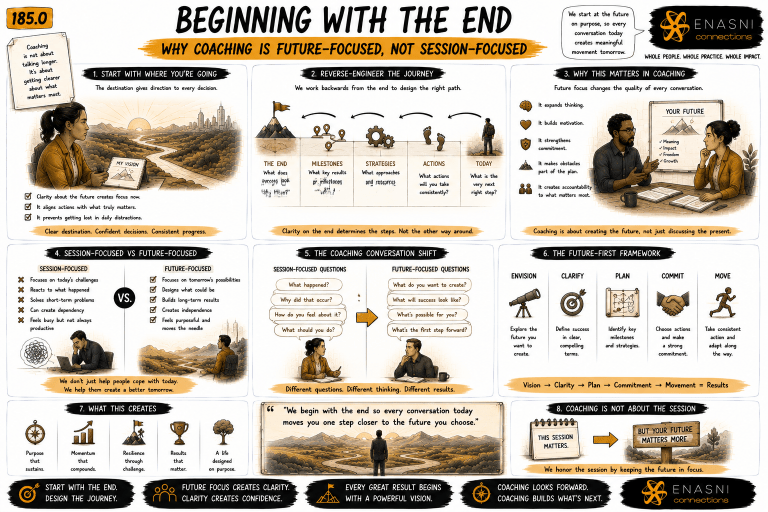
185.0 — Beginning With the End
Why Coaching Is Future-Focused, Not Session-Focused
Coaching effectiveness depends on direction because presence is far removed from progress on its own, and especially because clients leave sessions changed only when the future is actively shaped rather than merely explored.
This post clarifies why coaching begins with the end in mind, how journey goals and stepping stones operate within sessions, and why confusing session focus with future focus quietly undermines outcomes from a wholeness perspective.
-
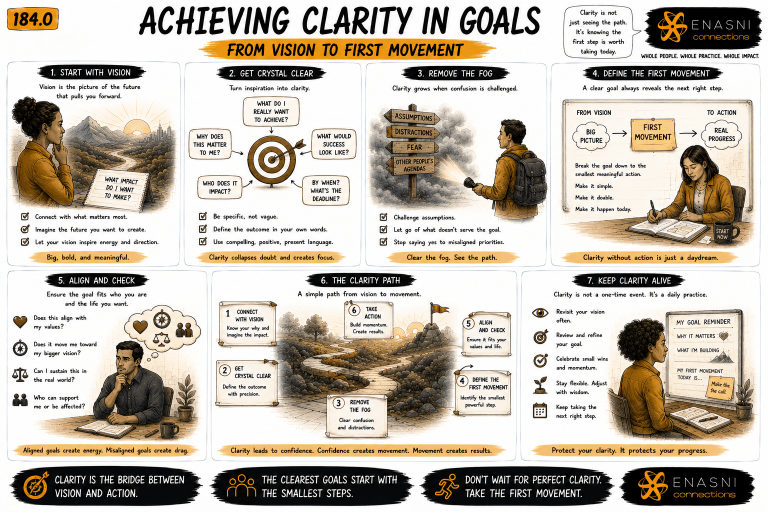
184.0 — Achieving Clarity in Goals
From Vision to First Movement
Clarity matters because motivation is far removed from progress on its own, and especially because without clarity, effort disperses, confidence erodes, and even meaningful goals begin to feel heavy rather than energising.
This post explores how coaches support clients to achieve clarity in goals by visualising outcomes, breaking complexity into manageable parts, and translating ambition into the first achievable movement — not through pressure, but through structure and sequence from a wholeness perspective.
-
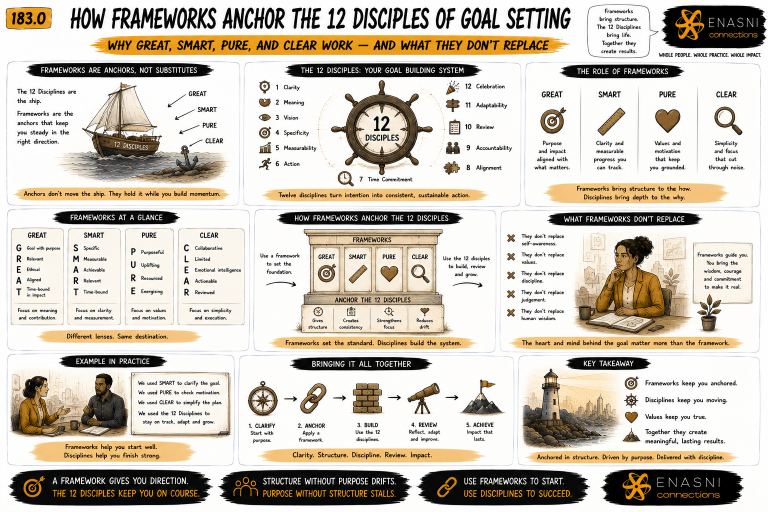
183.0 — How Frameworks Anchor the 12 Disciples of Goal Setting
Why GREAT, SMART, PURE, and CLEAR Work — and What They Don’t Replace
Frameworks matter because simplicity is far removed from sufficiency on its own, and especially because clients need accessible entry points into disciplined goal work without losing depth, ethics, or sustainability.
This post explores how popular goal-setting frameworks — GREAT, SMART, PURE, and CLEAR — anchor and activate the 12 Disciples of Goal Setting, and how coaches can use them skillfully without mistaking the map for the territory from a wholeness perspective.
-
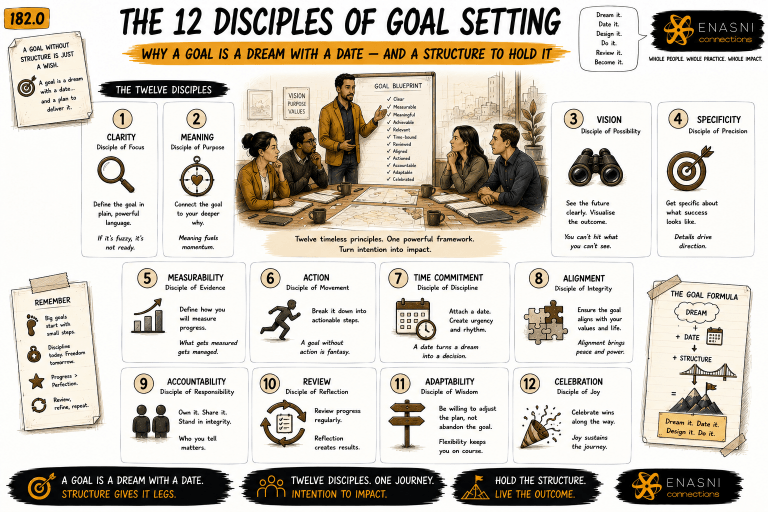
182.0 — The 12 Disciples of Goal Setting
Why a Goal Is a Dream With a Date — and a Structure to Hold It
Goal setting matters because ambition is far removed from achievement on its own, and especially because without structure, goals remain fantasies rather than forces that organise behaviour, attention, and energy.
This post sets out the 12 Disciples of Goal Setting — not as inspiration, but as a disciplined process that transforms intention into direction, and direction into sustained movement from a wholeness perspective.
-
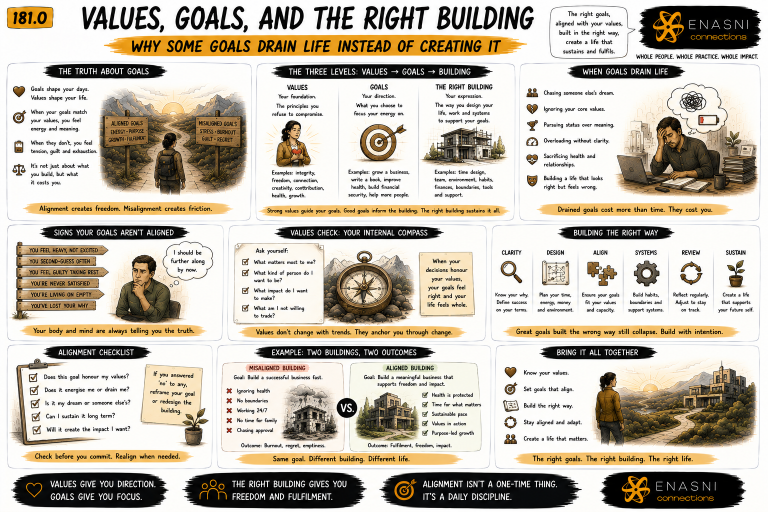
181.0 — Values, Goals, and the Right Building
Why Some Goals Drain Life Instead of Creating It
Goals matter because effort is far removed from fulfilment on its own, and especially because goals that are misaligned with values quietly create exhaustion, conflict, and inner fracture rather than progress.
This post explores why values must precede goal-setting, how coaching exposes hidden misalignment, and why many people struggle not because they lack discipline, but because their ladder of success is leaning against the wrong building from a wholeness perspective.
-
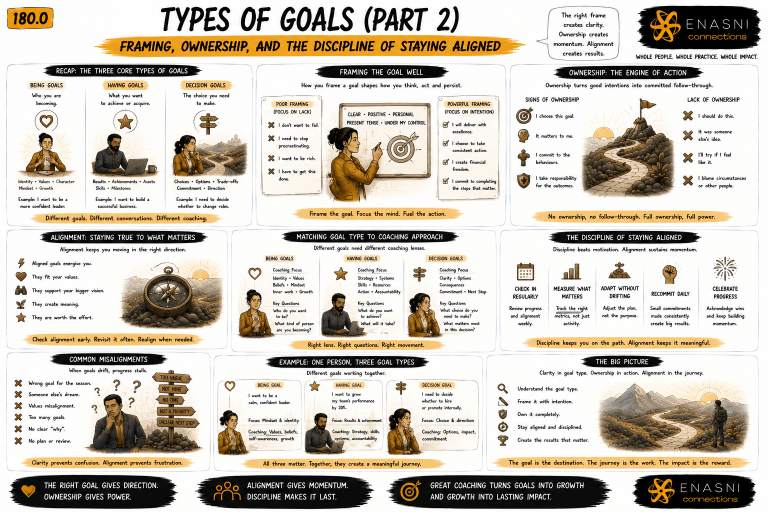
180.0 — Types of Goals (Part 2)
Framing, Ownership, and the Discipline of Staying Aligned
Goal mastery deepens because clarity is far removed from fulfilment on its own, and especially because goals only work when they are framed in ways the human system can sustain over time.
This post builds on the classification of goal types by exploring how goals are framed, internalised, reviewed, and recovered when they wobble — and why coaching plays a critical role in keeping goals aligned with the person rather than imposed upon them from a wholeness perspective.