
Structured stress regulation for sustained performance and human wholeness
Stress, decision load, and capacity at source
Not therapy.
Not coaching as you know it.
This work sits at the intersection of stress physiology, cognitive appraisal, system design, and human regulation.
Delivery is structured, paced, and outcome-driven.
Application remains practical, grounded, and role-relevant.
Capacity before performance
Output stabilises only after baseline regulation returns
Designed for real pressure
Built for healthcare, leadership, and responsibility-heavy roles
Stress treated as a system, not a symptom
Each programme targets the mechanisms that sustain stress rather than the surface experience alone. Regulation, capacity, and decision load are addressed together to restore functional stability and long-term resilience.
Intervention focuses on stress signalling, nervous-system regulation, and whole-system coherence.
Delivery remains structured, measurable, and grounded in real-world operational demands.
Stability first. Expansion second.
Stress recovery fails when intervention ignores system load and recovery capacity.
This work restores baseline regulation before introducing adaptive challenge.
Outcome: wholeness resilience without burnout cycles.



Lived outcomes, not abstract promises
Language focuses on lived experience rather than motivational narrative.

Stress no longer dictated daily decisions. Clarity returned. Capacity increased. Work felt manageable again.
06 vs 12
|
Aspect |
||
|---|---|---|
|
Depth |
Targeted |
Targeted + Comprehensive |
|
Focus |
Stabilisation |
Stabilise/Rebuild/Sustain |
|
Stress Load |
Mild-Moderate |
Moderate-Severe/Chronic |
|
System Scope |
Individual |
Individual + Systemic |
|
Time Horizon |
Short-Term Recovery |
Long-Term Recovery + Resilience |
|
Outcome |
Control Regained |
Control Regained + Capacity Transformed |
|
Pay |
|
|
Frequently Asked Questions
This space is to provide website visitors with a brief description on what to expect after purchasing this package..
-
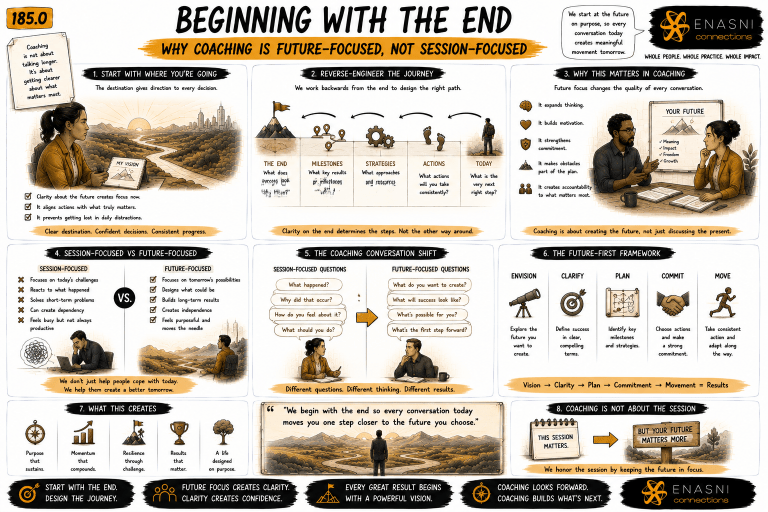
185.0 — Beginning With the End
Why Coaching Is Future-Focused, Not Session-Focused
Coaching effectiveness depends on direction because presence is far removed from progress on its own, and especially because clients leave sessions changed only when the future is actively shaped rather than merely explored.
This post clarifies why coaching begins with the end in mind, how journey goals and stepping stones operate within sessions, and why confusing session focus with future focus quietly undermines outcomes from a wholeness perspective.
-
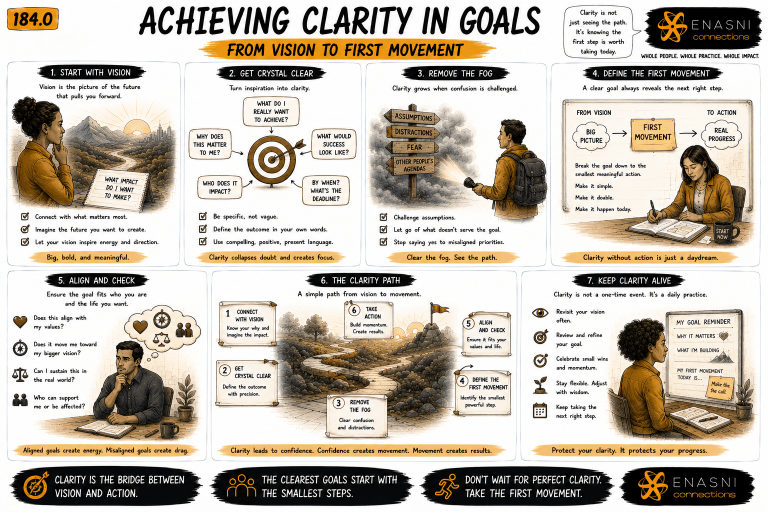
184.0 — Achieving Clarity in Goals
From Vision to First Movement
Clarity matters because motivation is far removed from progress on its own, and especially because without clarity, effort disperses, confidence erodes, and even meaningful goals begin to feel heavy rather than energising.
This post explores how coaches support clients to achieve clarity in goals by visualising outcomes, breaking complexity into manageable parts, and translating ambition into the first achievable movement — not through pressure, but through structure and sequence from a wholeness perspective.
-
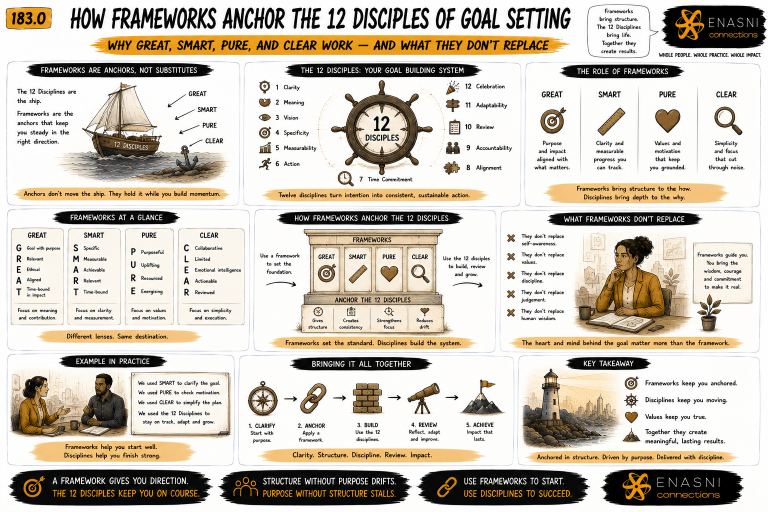
183.0 — How Frameworks Anchor the 12 Disciples of Goal Setting
Why GREAT, SMART, PURE, and CLEAR Work — and What They Don’t Replace
Frameworks matter because simplicity is far removed from sufficiency on its own, and especially because clients need accessible entry points into disciplined goal work without losing depth, ethics, or sustainability.
This post explores how popular goal-setting frameworks — GREAT, SMART, PURE, and CLEAR — anchor and activate the 12 Disciples of Goal Setting, and how coaches can use them skillfully without mistaking the map for the territory from a wholeness perspective.
-
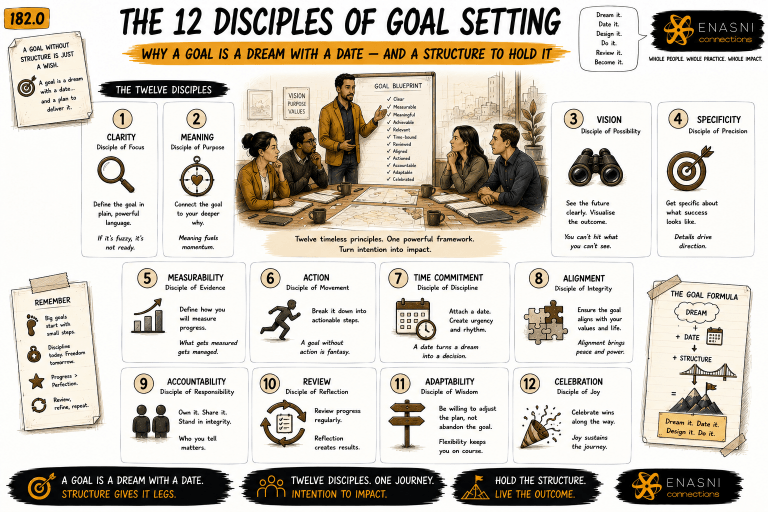
182.0 — The 12 Disciples of Goal Setting
Why a Goal Is a Dream With a Date — and a Structure to Hold It
Goal setting matters because ambition is far removed from achievement on its own, and especially because without structure, goals remain fantasies rather than forces that organise behaviour, attention, and energy.
This post sets out the 12 Disciples of Goal Setting — not as inspiration, but as a disciplined process that transforms intention into direction, and direction into sustained movement from a wholeness perspective.
-
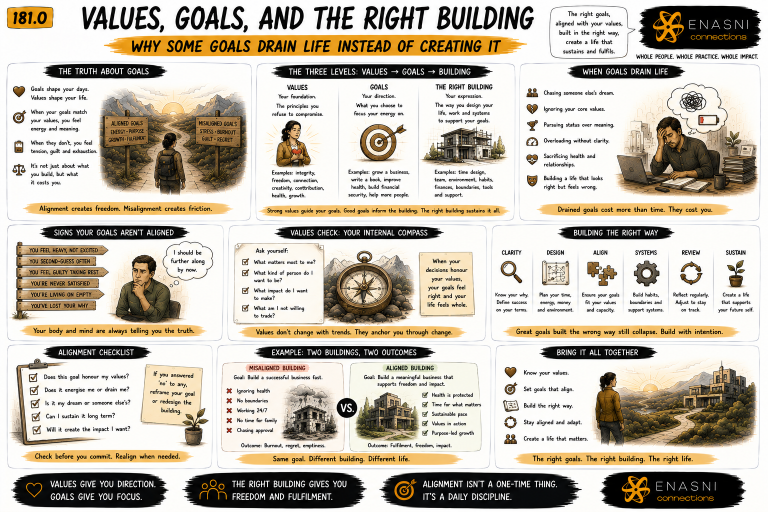
181.0 — Values, Goals, and the Right Building
Why Some Goals Drain Life Instead of Creating It
Goals matter because effort is far removed from fulfilment on its own, and especially because goals that are misaligned with values quietly create exhaustion, conflict, and inner fracture rather than progress.
This post explores why values must precede goal-setting, how coaching exposes hidden misalignment, and why many people struggle not because they lack discipline, but because their ladder of success is leaning against the wrong building from a wholeness perspective.
-
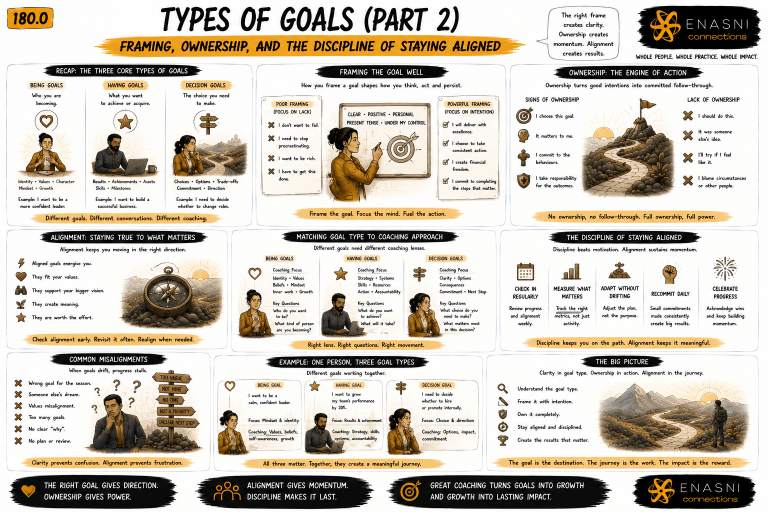
180.0 — Types of Goals (Part 2)
Framing, Ownership, and the Discipline of Staying Aligned
Goal mastery deepens because clarity is far removed from fulfilment on its own, and especially because goals only work when they are framed in ways the human system can sustain over time.
This post builds on the classification of goal types by exploring how goals are framed, internalised, reviewed, and recovered when they wobble — and why coaching plays a critical role in keeping goals aligned with the person rather than imposed upon them from a wholeness perspective.