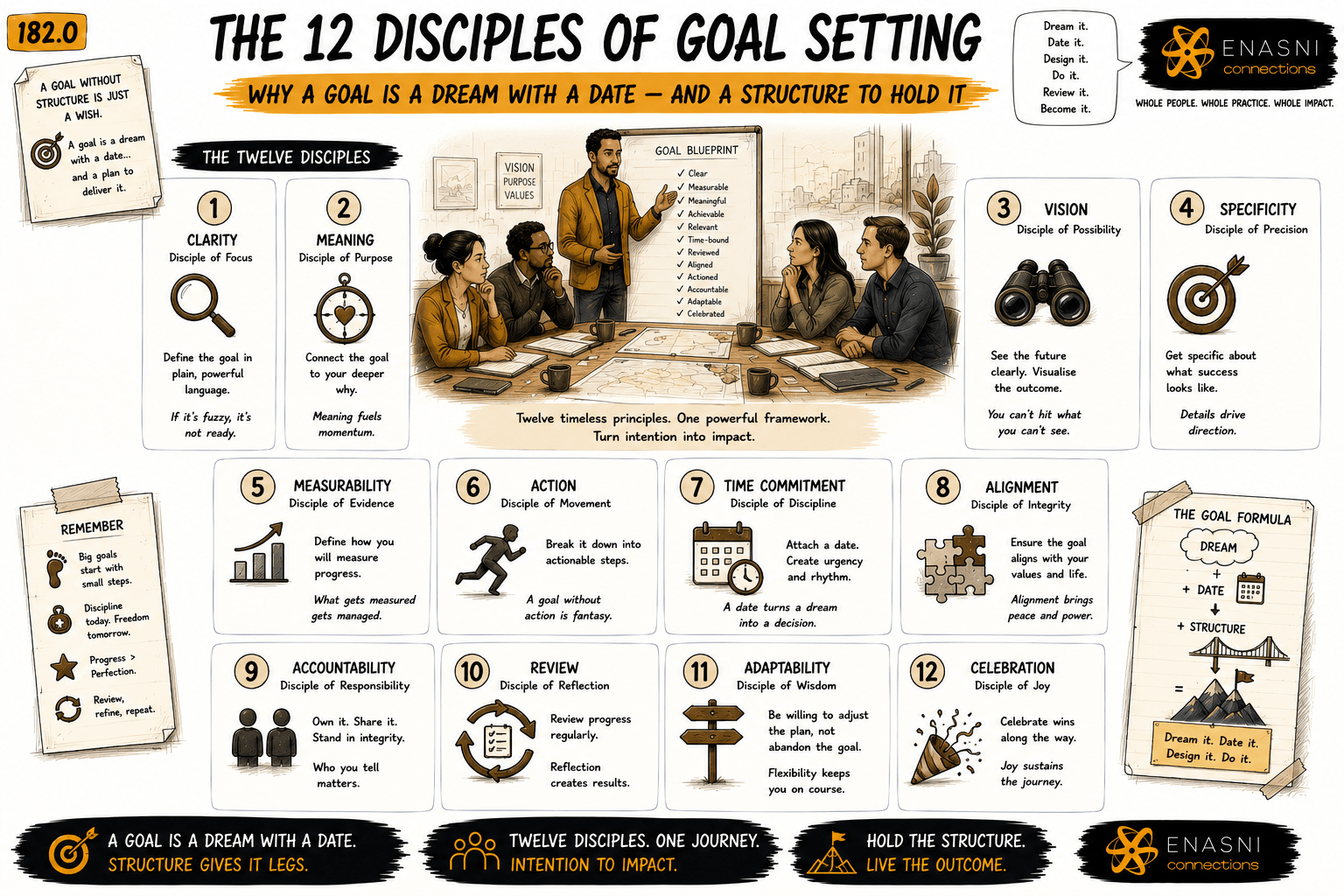
Why a Goal Is a Dream With a Date — and a Structure to Hold It
Goal setting matters because ambition is far removed from achievement on its own, and especially because without structure, goals remain fantasies rather than forces that organise behaviour, attention, and energy.
This post sets out the 12 Disciples of Goal Setting — not as inspiration, but as a disciplined process that transforms intention into direction, and direction into sustained movement from a wholeness perspective.
Why “Disciples” — Not Steps
The word disciples is intentional.
Steps imply:
- linear movement
- one-time completion
- mechanical compliance
Discipleship implies:
- commitment
- repetition
- embodiment
- lived practice
These principles are not done once.
They are returned to — again and again.
1. Alignment With Values
Every effective goal begins here.
If a goal conflicts with core values, resistance will appear — not as failure, but as protection.
Values are the building.
Goals are the ladder.
A ladder against the wrong building will never feel stable .
2. Recording the Goal
Unrecorded goals remain dreams.
Recording:
- engraves the goal into the subconscious
- moves it from fantasy to form
- creates something that can be returned to
Writing is preferred because it slows thinking and deepens imprint.
Recording is not documentation.
It is activation .
3. Regular Review
A goal reviewed daily moves from possibility to inevitability.
Review means:
- reading the goal morning and evening
- visualising achievement
- reconnecting with purpose
Weekly review allows updating.
Achieved goals are celebrated — then replaced.
Momentum is built through rhythm, not intensity .
4. Specificity
Vague goals diffuse effort.
Specific goals organise it.
“I want to see the world” becomes:
“I will travel to three European cities this year.”
Specificity gives the subconscious something to work toward.
Clarity precedes movement.
5. Positive Framing
The subconscious does not process negation reliably.
Goals framed as:
- “I don’t want…”
- “I must stop…”
often reinforce the very behaviour they oppose.
Reframing shifts attention to what is wanted.
Light replaces avoidance.
The agenda becomes forward-facing .
6. Present Tense
Goals phrased as already in motion engage belief.
“I am enjoying the health of a non-smoker”
lands differently than
“I will stop smoking.”
The conscious mind may question.
The subconscious does not.
Used wisely, this strengthens commitment — not complacency .
7. Imagination and Visualisation
Imagination personalises goals.
Questions include:
- What do you see?
- What do you hear?
- What are others saying?
- What are you doing?
Visualisation makes the goal tangible.
Emotion binds it.
Motivation follows naturally.
8. Measurability
A goal without a measure is directionless.
Measurement may be:
- numerical
- behavioural
- emotional
Even subjective measures (“I feel calmer”) are better than none.
Measurement answers one question:
How will you know you have arrived?
9. Challenge (The Stretch Zone)
Goals must stretch — not overwhelm.
The stretch zone sits between:
- comfort (boredom)
- panic (shutdown)
Growth happens here.
Challenge keeps attention alive and meaning intact .
10. Time Frames
Time creates commitment.
Every goal requires:
- a start date
- an end date
Time-bound goals focus attention and prevent drift.
Without time, intention decays.
11. Balance, Legality, and Ethics
Goals must be:
- legal
- ethical
- environmentally sound
- balanced across life domains
A goal that damages health, family, or integrity will extract its cost later.
Coaching does not support goals that violate wholeness .
12. Recording and Review (Again)
The cycle closes where it began.
Recording and review are repeated — not completed.
This creates:
- adaptability
- responsiveness
- sustained alignment
Goals evolve as life changes.
The discipline remains.
Acronyms as Entry Points — Not Replacements
Frameworks like:
- GREAT
- SMART
- PURE
- CLEAR
are helpful starting points.
They organise thinking.
But none replace the full discipleship of disciplined goal practice .
In Essence
A goal is not wishful thinking.
It is a relationship between:
- values
- attention
- behaviour
- time
The 12 Disciples ensure that relationship remains alive, ethical, and effective.
This is not about trying harder.
It is about building direction that can carry weight.
Key Learning Points (KLPs)
- Goals must align with values to be sustainable
- Recording activates the subconscious
- Regular review builds inevitability
- Specificity sharpens focus
- Positive framing redirects attention
- Present tense strengthens belief
- Visualisation personalises goals
- Measurement confirms progress
- Challenge sustains engagement
- Time frames create commitment
- Ethics protect wholeness
- Review completes the cycle
Action Points (APs)
- Guide clients to record and review goals daily
- Test every goal against core values
- Ensure goals sit in the stretch zone, not comfort or panic
Keywords
12 disciplines of goal setting, high quality goal setting, applied wholeness coaching, goal alignment values, subconscious goal setting, stretch zone goals, ethical goal setting, Enasni Connections