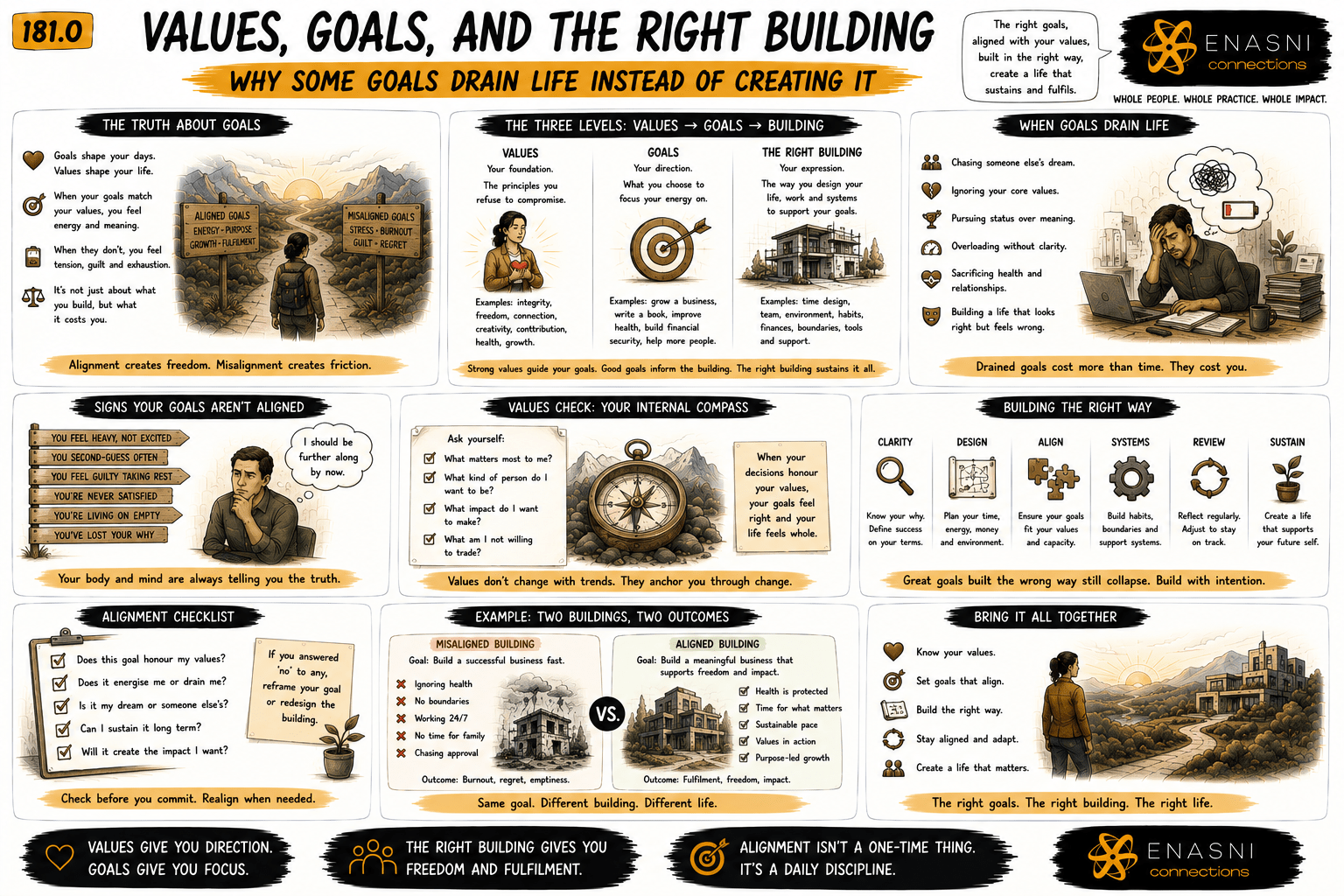
Why Some Goals Drain Life Instead of Creating It
Goals matter because effort is far removed from fulfilment on its own, and especially because goals that are misaligned with values quietly create exhaustion, conflict, and inner fracture rather than progress.
This post explores why values must precede goal-setting, how coaching exposes hidden misalignment, and why many people struggle not because they lack discipline, but because their ladder of success is leaning against the wrong building from a wholeness perspective.
The Ladder and the Building
A simple metaphor reveals a great deal:
Success is climbing a ladder.
Values are the building it leans against.
If the building is wrong, climbing higher does not help.
It only makes the fall more painful.
This is why coaching does not begin with how fast someone can move — but with what truly matters to them .
Values as the Real Drivers of Behaviour
Values are not abstract ideals.
They are:
- why people get out of bed
- what they protect under pressure
- what they sacrifice for — and what they will not
Goals that conflict with values produce:
- hesitation
- procrastination
- repeated course correction
- emotional depletion
This is not laziness.
It is internal resistance doing its job.
The Question That Changes Everything
A coaching moment illustrates this clearly.
A client felt professionally unfulfilled, yet deeply committed to family life. One of his stated goals was to travel the world extensively.
The coaching question was simple:
How does this goal align with the value you place on family?
He had never considered it deeply.
Not because he avoided reflection — but because such questions are uncomfortable.
Coaching creates the space to ask what life normally avoids .
Why People Avoid Values-Level Questions
Most people prefer:
- quick wins
- solvable problems
- immediate relief
Deeper questions take longer.
They surface trade-offs.
They expose conflict.
This is especially true for people with a strong “fixing” orientation — those who feel safest solving what is immediately actionable.
Coaching deliberately slows this impulse.
Not to frustrate — but to prevent self-betrayal.
When Caring Values Clash With Target-Driven Systems
Values conflict becomes acute in caring professions.
Healthcare, social care, education, and frontline support often place:
- deeply caring peopleinside
- heavily target-driven systems
This creates a Jekyll-and-Hyde environment:
- care on one side
- numbers on the other
Caring is an art form.
It does not translate cleanly into sales metrics.
When values are violated daily, burnout is not a mystery — it is inevitable .
The Hidden Cost of Self-Sacrifice
There is a myth that self-sacrifice is noble.
But when someone has already committed to:
- family
- faith
- health
- personal integrity
then excessive sacrifice becomes erosion, not virtue.
Long delays in achieving a goal often signal:
- misalignment
- internal conflict
- values being overridden
Coaching reads delay not as failure — but as information.
Ethics, Fairness, and Reasonableness
A structurally sound goal must be:
- ethical
- honest
- fair
- reasonable
These are not moral judgements.
They are sustainability tests.
If a goal requires someone to violate core values to achieve it, the cost will be paid later — in health, relationships, or meaning .
Coaching as a Safe Space for Hard Truths
Coaching does not tell clients what to value.
It provides:
- permission to reflect
- space to question
- safety to realign
Many people have never been invited to examine:
Is this goal actually serving what matters most to me?
Once asked, the answer changes everything.
When Money Is Not the Measure
For some, the realisation emerges that:
- chasing “premium” status
- maximising income
- pursuing scale
conflicts with spiritual, relational, or bodily values.
This does not reject money.
It puts money in its proper place — as a necessity, not a master.
Wholeness restores proportion.
In Essence
Goals do not fail because people lack commitment.
They fail because:
- values are ignored
- alignment is assumed rather than tested
- success is measured externally
Coaching brings goals back into relationship with what truly matters.
Only then does progress stop hurting.
Key Learning Points (KLPs)
- Goals must align with core values to be sustainable
- Misalignment creates internal resistance and exhaustion
- Values determine motivation under pressure
- Coaching surfaces uncomfortable but necessary questions
- Caring professions face systemic value conflicts
- Targets can clash with compassion
- Excessive self-sacrifice erodes wholeness
- Long delays often signal misalignment
- Ethical goals are fair and reasonable
- Alignment restores energy and meaning
Action Points (APs)
- Ask clients how each goal aligns with their top values
- Treat prolonged resistance as information, not failure
- Reframe success around alignment rather than speed
Keywords
values and goals coaching, ethical goal setting, applied wholeness coaching, values alignment, coaching for caring professions, goal sustainability, ladder of success metaphor, Enasni Connections