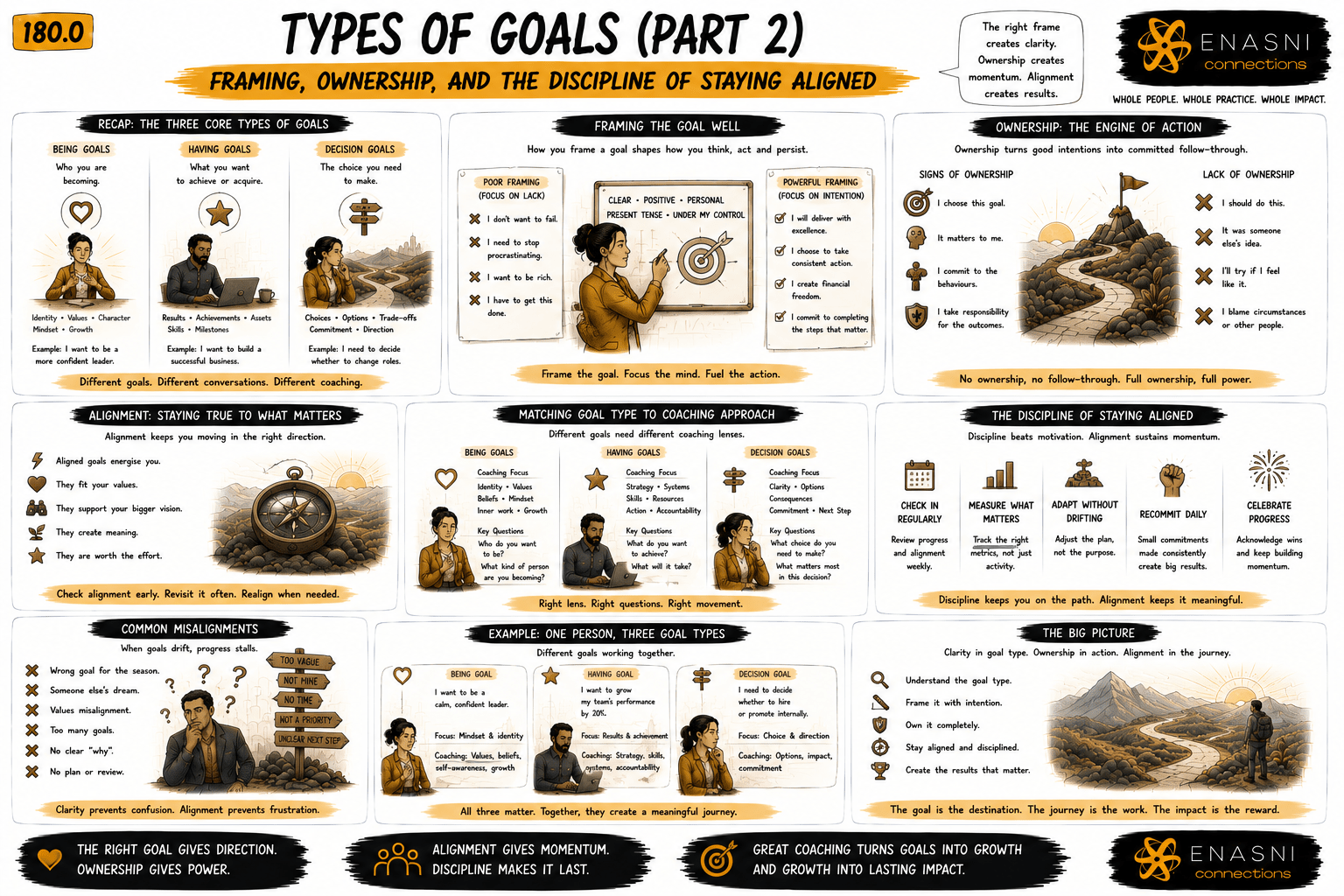
Framing, Ownership, and the Discipline of Staying Aligned
Goal mastery deepens because clarity is far removed from fulfilment on its own, and especially because goals only work when they are framed in ways the human system can sustain over time.
This post builds on the classification of goal types by exploring how goals are framed, internalised, reviewed, and recovered when they wobble — and why coaching plays a critical role in keeping goals aligned with the person rather than imposed upon them from a wholeness perspective.
Living Without Goals — and Living With the Wrong Ones
Living without goals often leads to:
- drift
- frustration
- a sense of unfulfilled potential
Yet living with misaligned goals can be equally corrosive.
When a destination is unclear, borrowed, or incongruent with a person’s true desires, the journey becomes:
- vulnerable to distraction
- difficult to sustain
- emotionally draining
Direction matters — but only when it is authentic .
The Journey Matters More Than Speed
A familiar phrase suggests:
If you go alone, you go faster; if you go together, you go further.
Experience complicates this.
Going alone can be fast — but also narrow.
Going with others can go further — but sometimes in the wrong direction.
Coaching reframes the journey:
- not speed vs distance
- but alignment vs drift
The role of coaching is not to accelerate movement, but to ensure the movement is yours .
Positive Goal Framing: Working With the Brain, Not Against It
The human brain is oriented toward more, not less.
Goals framed negatively:
- “I must not…”
- “I need to stop…”
often backfire by:
- drawing attention to the very thing being avoided
- creating internal resistance
Positive framing redirects attention.
For example:
- “I must not buy chocolate”becomes
- “I will reach the checkout without buying chocolate.”
The behaviour shifts because focus shifts .
Why Goals Must Be Personal
Goals that are imposed — particularly in organisational settings — often fail quietly.
Clients may attend coaching with:
- targets set by employers
- outcomes defined by others
- expectations not yet internalised
Coaching restores ownership by asking:
- How does this goal benefit you?
- What would make this meaningful personally?
A goal becomes workable only when it is owned, not assigned .
Present Tense Goals: Power and Pitfalls
Some approaches advocate framing goals in the present tense:
“Today is Friday, and I am cycling home having completed everything I needed to do.”
This can:
- strengthen belief
- increase emotional engagement
- clarify vision
However, it also carries risk.
When the subconscious interprets the goal as already achieved:
- urgency can drop
- effort can soften
- complacency can creep in
Effective coaching balances:
- vivid vision
- with conscious, ongoing pursuit .
Belief in Possibility: The Coach’s Hidden Labour
A recurring theme in effective coaching is faith.
Not blind optimism — but disciplined belief in the client’s capacity.
This requires the coach to:
- manage assumptions
- quiet judgement
- resist disbelief when goals seem ambitious
There will be times when:
- clients exceed expectations
- belief is reinforced
And times when:
- goals are not met
- assumptions resurface
Both outcomes are material for learning, not verdicts .
Learning When Goals Are Not Met
Failure is not the opposite of success.
Unexamined failure is.
When goals are missed, coaching invites reflection:
- What didn’t go as planned?
- What became visible?
- What would you adjust next time?
This transforms setbacks into:
- data
- insight
- recalibration
Progress resumes — without self-punishment .
Why Coaching Makes Goals Sustainable
Outside coaching, people struggle to:
- review honestly
- update goals without judgement
- stay aligned when motivation dips
Coaching provides:
- structure
- perspective
- accountability
- space for recalibration
Not pressure.
Sustainability.
In Essence
Goals do not fail because people lack willpower.
They fail because:
- framing is misaligned
- ownership is weak
- belief wavers
- reflection is absent
Coaching restores alignment by working with how humans actually think, focus, and learn.
This is not about trying harder.
It is about aiming truer.
Key Learning Points (KLPs)
- Living without goals leads to drift and frustration
- Misaligned goals are as harmful as no goals
- Coaching prioritises alignment over speed
- Positive framing works with the brain’s tendencies
- Goals must be personally owned to succeed
- Present tense goals require balance
- Coaches must hold belief in possibility
- Setbacks are learning opportunities
- Reflection sustains progress
- Coaching makes goals durable and humane
Action Points (APs)
- Reframe one negatively stated goal into a positive, achievable statement
- Review whether current goals are personally owned or externally imposed
- Build a reflection step after missed targets to extract learning
Keywords
types of goals coaching part two, goal framing coaching, positive goal setting, applied wholeness coaching, goal ownership, sustainable goals, coaching reflection, Enasni Connections