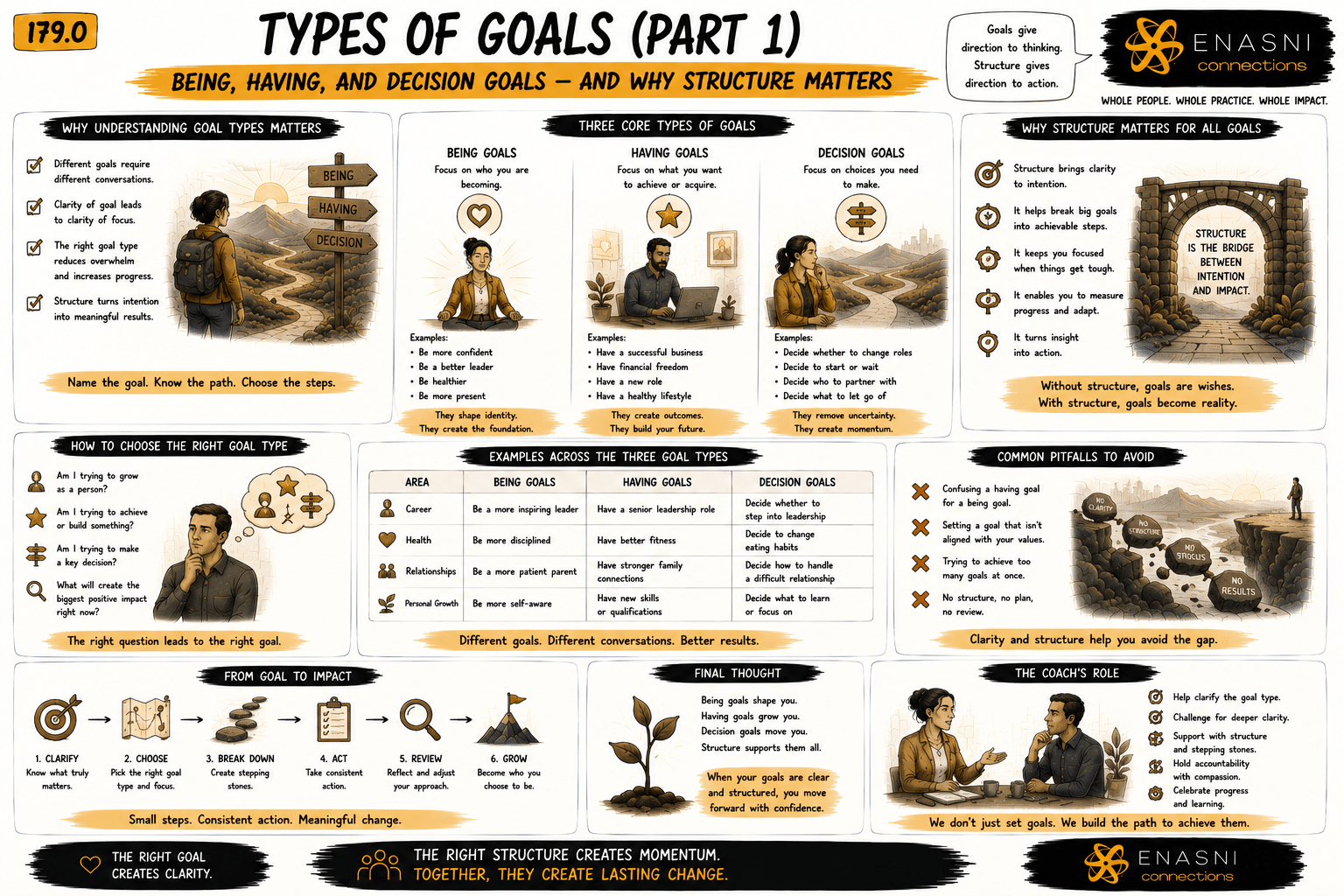
Being, Having, and Decision Goals — and Why Structure Matters
Understanding goal types matters because effort is far removed from progress on its own, and especially because confusing different kinds of goals leads to misplaced action, frustration, and stalled momentum.
This post introduces three core goal types commonly brought into coaching — Being Goals, Having Goals, and Decision Goals — and clarifies how recognising the difference sharpens direction, responsibility, and effectiveness from a wholeness perspective.
Why Goal Type Matters in Coaching
Clients rarely arrive saying:
“I have a being goal.”
Instead, they say:
- “I want to feel more confident.”
- “I want a new job.”
- “I need to decide whether to leave.”
Each statement signals a different structural category of goal.
Treating them all the same weakens coaching.
Differentiating them strengthens it.
1. Being Goals — Who the Client Is Becoming
What Being Goals Are
Being Goals relate to qualities of character or internal state, such as:
- confidence
- calmness
- patience
- focus
- authenticity
- leadership presence
They describe how someone wants to be, not what they want to own or decide .
Why Being Goals Matter
Being Goals:
- shape behaviour indirectly
- influence decisions automatically
- affect relationships continuously
They are powerful because they operate before action.
However, they fail when left abstract.
Coaching Being Goals Effectively
Effective coaching translates Being Goals into:
- observable behaviour
- daily choices
- situational responses
For example:
“Being more confident”
becomes
“Speaking once in each meeting without rehearsing internally.”
Being goals require embodiment, not affirmation.
2. Having Goals — What the Client Wants to Attain
What Having Goals Are
Having Goals focus on tangible outcomes, such as:
- a job
- a house
- financial security
- qualifications
- physical change
These are the most common goals clients bring to coaching .
The Common Structural Mistake
Many clients believe:
If I have X, then I will do Y, and then I will be Z.
For example:
- “If I get the job, I’ll feel confident.”
- “If I’m in a relationship, I’ll become more sociable.”
This reverses causality.
Coaching restores order:
Be → Do → Have
Being precedes doing.
Doing precedes having.
Coaching Having Goals Responsibly
Having Goals work best when:
- anchored to Being Goals
- supported by daily action
- kept within personal control
Without this, they become:
- externally dependent
- emotionally loaded
- fragile under pressure
3. Decision Goals — Choosing a Direction
What Decision Goals Are
Decision Goals arise when a client wants to:
- change jobs
- end or begin a relationship
- accept or refuse an opportunity
- redefine standards or boundaries
They are about choice, not possession.
Where Coaching Often Goes Wrong
Clients often say:
“I want to make a decision today.”
What they are often seeking is:
- advice
- reassurance
- permission
This risks shifting responsibility to the coach.
Reframing Decision Goals
Effective coaching shifts the focus from:
- the decision itselfto
- what the decision is meant to achieve
Powerful questions include:
- What would making this decision help you move toward?
- What outcome does this clarity support?
This returns ownership to the client and keeps coaching outcome-focused .
What All Effective Goals Have in Common
Regardless of type, effective goals are:
- outcome-focused
- specific
- inspiring
- measurable
- time-limited
- within personal control
- written down
- reviewed and updated regularly
These are not motivational tips.
They are structural requirements.
Why This Is Part 1
This post establishes classification.
Later posts will explore:
- how different goal types interact
- how goal types evolve over time
- how misalignment creates resistance
- how advanced coaching adapts language and pacing
Mastery begins with differentiation.
In Essence
Not all goals are the same.
When coaches help clients identify what kind of goal they are working with, clarity increases, effort aligns, and progress accelerates.
Structure precedes motivation.
Key Learning Points (KLPs)
- Coaching goals fall into Being, Having, and Decision types
- Being Goals shape identity and behaviour
- Having Goals relate to tangible outcomes
- Decision Goals focus on choice and direction
- Confusing goal types weakens coaching
- Being precedes Doing precedes Having
- Decision goals require outcome-focused framing
- Effective goals share core structural qualities
- Review and update are essential
- Differentiation improves coaching precision
Action Points (APs)
- Practise identifying goal type early in sessions
- Reframe decision goals toward desired outcomes
- Anchor Having Goals in Being and Doing behaviours
Keywords
types of goals coaching, being goals having goals decision goals, applied wholeness coaching, goal classification coaching, be do have model, goal setting mastery, coaching fundamentals, Enasni Connections