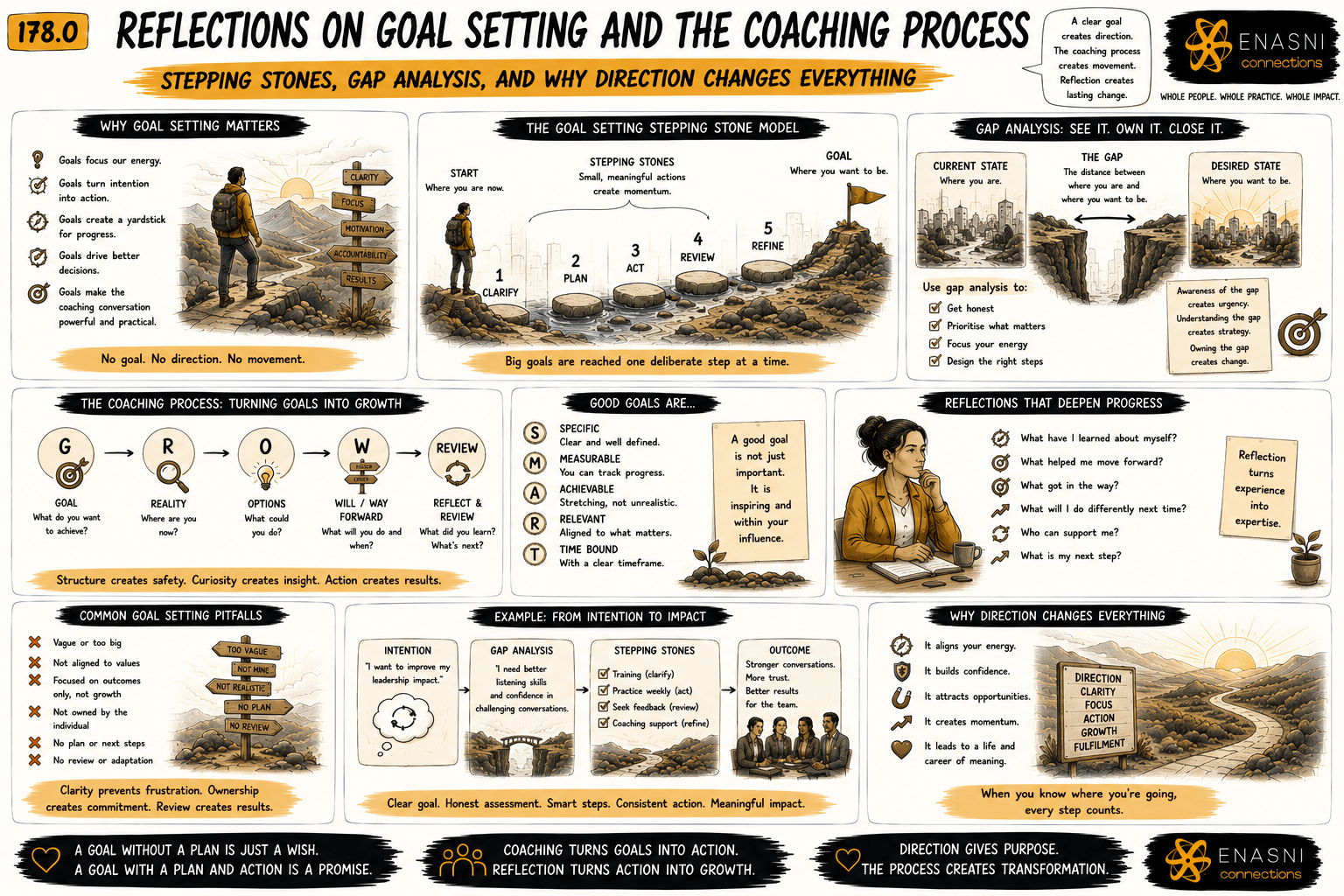
Stepping Stones, Gap Analysis, and Why Direction Changes Everything
Goal setting matters because intention is far removed from movement on its own, and especially because coaching only becomes effective when direction is defined before effort is applied.
This post reflects on goal setting as a central coaching discipline, drawing from practical coaching experience to examine how clarity of outcome, honest assessment of reality, and structured progression transform both the coaching process and its results from a wholeness perspective.
Why Goal Setting Sits at the Heart of Coaching
One of the most defining insights in coaching practice is that goal setting is not an accessory.
It is the organising principle.
Coaching focuses on:
- learning rather than teaching
- future possibility rather than past failure
- belief in the client’s capacity to generate solutions
Without a goal, these principles drift.
With a goal, they align .
Beginning With the End in Mind
The Stepping Stones model begins with a defining moment:
the precise point at which the client knows the goal has been achieved.
This is not abstract visualisation.
It is forensic clarity.
Clients are invited to describe:
- where they are
- what they are doing
- who is present
- sensory detail
- contextual markers
The specificity matters.
A vague end point produces vague effort.
A vivid end point reorganises attention and behaviour .
Why Reality Must Follow Goal — Not Precede It
A critical discipline in coaching is sequencing.
Starting with reality alone risks:
- problem fixation
- identity collapse into circumstance
- reactive goal formation
When reality is examined after the goal is clear, it becomes:
- a starting point
- a reference position
- data rather than judgement
Reality stops being a verdict.
It becomes a coordinate.
This preserves agency while maintaining honesty .
The Coach as a Gap Analyst
At its core, coaching is gap work.
The coach specialises in:
- identifying distance between reality and outcome
- mapping intermediate steps
- revisiting and recalibrating regularly
Gap analysis transforms aspiration into process.
It replaces overwhelm with:
- sequence
- proportion
- momentum
Movement becomes measurable.
Progress becomes visible.
Journey Goals as the Focus of Sessions
Each coaching session is not about the whole future.
It is about the next stepping stone.
Journey goals:
- are specific
- sit within current capacity
- move the client closer to the end goal
The intake session establishes:
- the end goal
- the starting point
Every session thereafter refines the path between the two.
This prevents:
- wandering sessions
- motivational inflation
- loss of direction
Structure protects progress.
The Intake Session as Infrastructure
Experience shows that a thorough intake session is non-negotiable.
A two-hour intake allows:
- depth of goal clarification
- precision in reality assessment
- realistic journey mapping
Rushed intakes lead to:
- unclear direction
- repeated course correction
- frustration for both client and coach
The intake is not orientation.
It is engineering.
Continuous Review as Mastery Practice
Progress is not linear.
This is why review is embedded:
- compare
- contrast
- evaluate
- adjust
Repeated often enough, this process becomes:
- unconscious
- fluid
- automatic
Clients learn to self-correct.
The coach becomes progressively less central.
This is success, not loss of influence .
Why Many People Fail at Goals Outside Coaching
Most people know how to set goals.
They struggle to:
- maintain clarity
- bridge gaps consistently
- review honestly
- adjust without self-judgement
Coaching provides:
- structure
- accountability
- disciplined sequencing
Not motivation.
Direction.
In Essence
Effective coaching is not about fixing people.
It is about:
- clarifying destination
- naming starting point
- building a path between the two
- walking it one step at a time
When goal setting is treated as structural rather than inspirational, progress becomes inevitable rather than accidental.
Key Learning Points (KLPs)
- Goal setting organises the coaching process
- Beginning with the end clarifies direction
- Sensory specificity strengthens commitment
- Reality functions best as data, not judgement
- Coaching is fundamentally gap analysis
- Sessions focus on journey goals
- Intake sessions create infrastructure
- Continuous review enables mastery
- Structure outperforms motivation
- Direction preserves agency
Action Points (APs)
- Practise end-goal clarification before reality exploration
- Use stepping stones to define session focus
- Build regular review into every coaching engagement
Keywords
goal setting coaching, stepping stones model, gap analysis coaching, applied wholeness coaching, coaching intake process, journey goals, coaching mastery, Enasni Connections