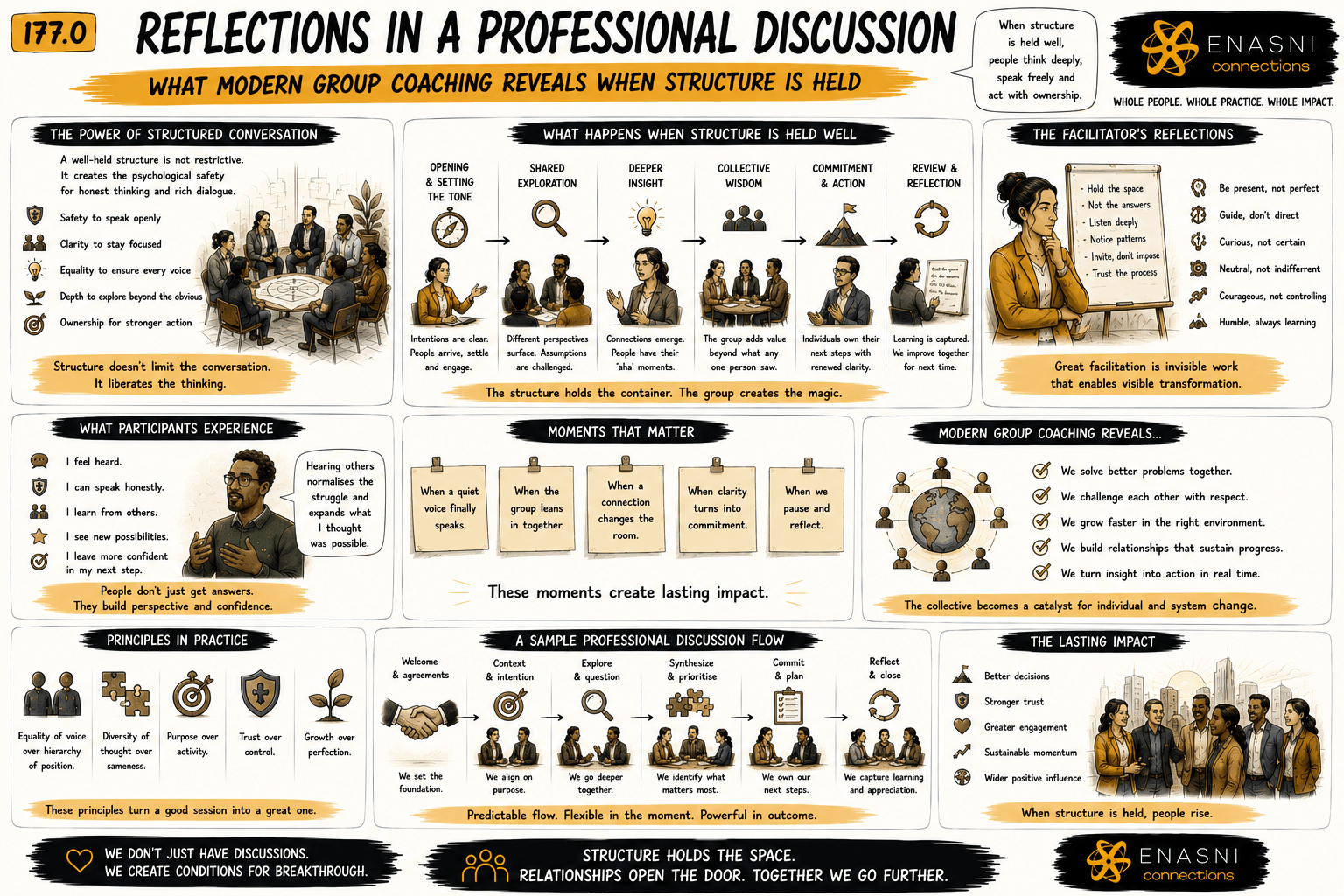
What Modern Group Coaching Reveals When Structure Is Held
Reflection matters because experience is far removed from learning on its own, and especially because professional growth depends on the ability to extract principle from practice rather than opinion from outcome.
This post reflects on a live group coaching session facilitated with the South London Coaches, examining what emerged when a structured, neutral, fast-paced coaching approach was applied in a collective setting — and what this reveals about modern coaching practice from a wholeness perspective.
From Individual Focus to Collective Direction
One of the clearest distinctions surfaced during the session was the shift away from traditional group coaching formats.
Rather than:
- individuals bringing separate personal goals into a shared space
the session adopted:
- a collective focus
- a shared direction
- a common line of inquiry
This approach mirrors business and team dynamics, where outcomes depend on alignment rather than individual optimisation. The result was not dilution, but increased penetration — participants moved further, faster, because attention was unified rather than fragmented .
Efficiency Through Structure, Not Speed
The session demonstrated that efficiency in coaching does not come from rushing.
It comes from:
- a clear structure
- disciplined pacing
- deliberate sequencing
Neutral, non-leading, fast-focused questions allowed participants to engage immediately, without requiring:
- background stories
- contextual explanations
- disclosure of personal history
This revealed a core principle of modern coaching:
effectiveness does not require familiarity — it requires structure .
Questioning as the Primary Intervention
Questions carried the session.
Not clever questions.
Not personalised questions.
Not interpretive questions.
But:
- neutral
- sequential
- focused
These questions functioned as a guiding hand, allowing participants to explore their own thinking without interference. The coach did not need to know:
- expertise
- background
- achievements
This reinforced a foundational coaching principle:
the coach does not need content mastery — the structure does the work .
The Coach’s Role: Restraint Over Presence
Perhaps the most striking observation was what the coach did not do.
There was:
- no advice
- no guidance
- no interpretation
- no personal insight offered
The absence of these elements did not reduce impact.
It amplified it.
Participants remained fully responsible for their thinking, their conclusions, and their next steps. This preserved agency and avoided dependency — a hallmark of ethical coaching practice .
Universality as Influence
The reflection highlights why this particular coaching approach has become influential within the industry.
Its power lies in:
- universality
- portability
- simplicity without shallowness
The ability to:
coach anyone, anywhere, on anything
does not arise from charisma or expertise, but from deep understanding of coaching fundamentals. This is what makes such approaches durable — even if the responsibility they carry is substantial .
Group Coaching as Demonstration, Not Explanation
The session also functioned as a demonstration.
Participants experienced:
- clarity
- development
- movement
within a short time frame.
This made it possible to invite reflection on longer-term engagement:
- three months
- six months
- twelve months
Not as a sales pitch, but as a logical extension of lived experience. When coaching is demonstrated rather than described, its value becomes self-evident .
What This Reflection Reveals About Modern Coaching
Several principles become clear:
- modern group coaching benefits from collective focus
- structure increases depth rather than restricting it
- neutral questioning protects autonomy
- minimal coach presence preserves responsibility
- universality amplifies reach
- demonstration outperforms explanation
These are not stylistic preferences.
They are professional disciplines.
In Essence
This professional discussion reveals that modern group coaching reaches depth not through intensity or familiarity, but through structure, restraint, and trust in the client’s capacity to think.
When the coach holds the frame and steps back, the work steps forward.
Key Learning Points (KLPs)
- Collective focus can deepen group coaching impact
- Structure enables efficiency without rushing
- Neutral, non-leading questions drive exploration
- Coaching does not require personal disclosure
- Restraint preserves client responsibility
- Universality strengthens coaching influence
- Demonstration clarifies value more than explanation
- Group coaching can accelerate insight when contained
- Coaching fundamentals outperform stylistic complexity
- Reflection turns experience into professional learning
Action Points (APs)
- Practise neutral, sequential questioning in group contexts
- Reduce reliance on client background information
- Use structured group sessions as demonstrations of coaching principles rather than explanations
Keywords
professional coaching reflection, group coaching discussion, applied wholeness coaching, modern group coaching, neutral questioning coaching, collective coaching practice, coaching fundamentals, Enasni Connections