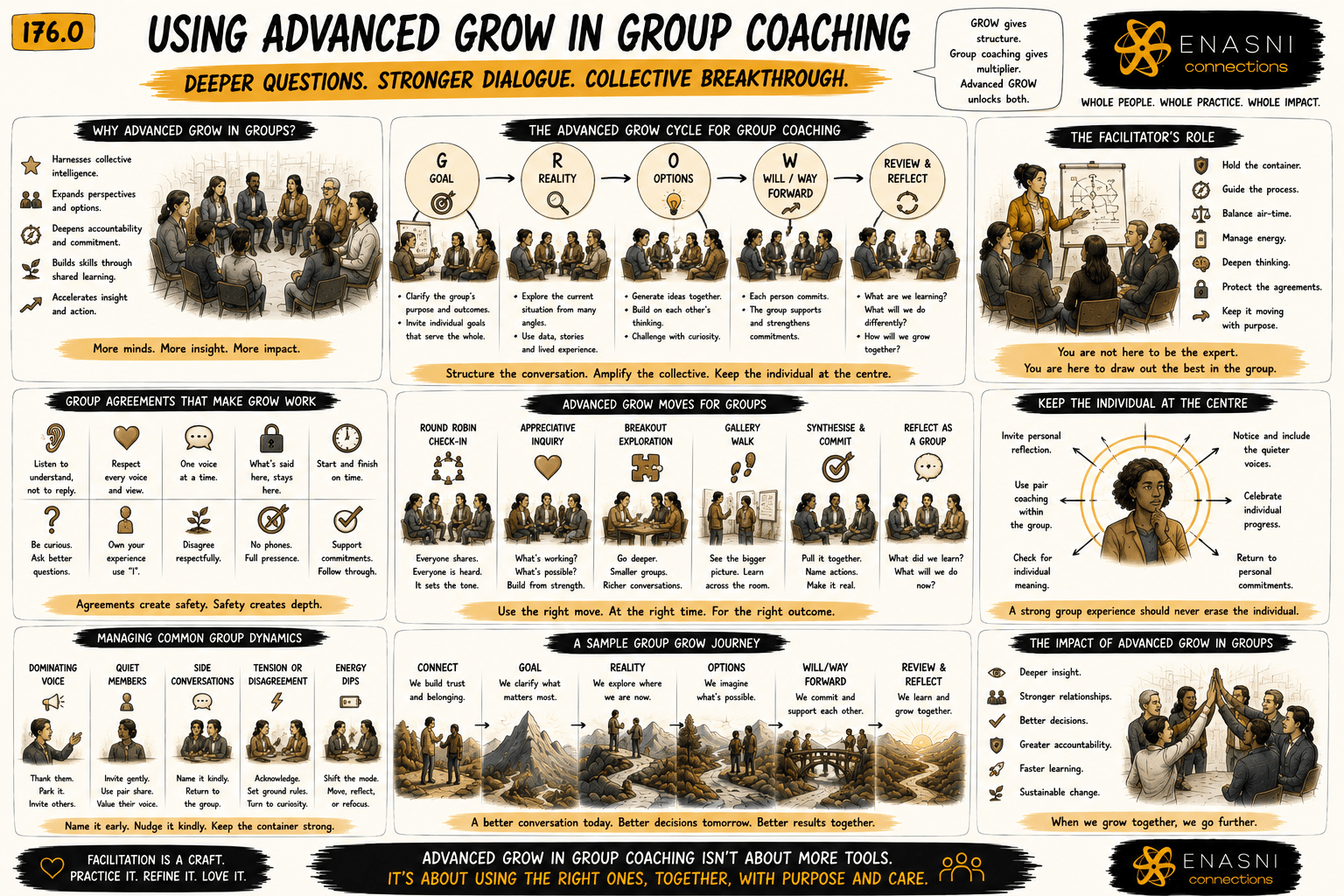
What Adapts, What Holds, and Why G + R Matter Most
Advanced GROW matters in group coaching because scale is far removed from simplicity on its own, and especially because working with multiple people simultaneously magnifies both the strengths and the risks of structured models.
This post explores how the Goal and Reality stages of GROW adapt in group coaching, how they remain fundamentally consistent, and why disciplined use of these two stages protects depth, safety, and individual agency within a collective setting from a wholeness perspective.
Why GROW Changes in a Group Context
In one-to-one coaching:
- the model follows a single internal system
- pace adjusts moment by moment
- depth can be personalised continuously
In group coaching:
- multiple internal systems are present
- shared time constrains depth
- psychological safety must be preserved collectively
The model does not disappear.
It reorients.
What Must Remain Consistent
Despite contextual changes, several principles must not shift:
- responsibility remains with each participant
- goals must be personally owned
- reality must be honestly faced
- action must stay within individual control
These principles protect:
- autonomy
- dignity
- ethical clarity
Without them, group coaching collapses into advice, discussion, or performance .
Goal (G): How It Adapts in Group Coaching
In groups, goals must be:
- broad enough to fit diverse contexts
- specific enough to matter personally
- framed internally rather than publicly
Participants are guided to:
- choose a real area of concern
- ensure it matters personally
- confirm it is within personal control
Goals are often:
- held privately
- refined internally
- revisited silently
This prevents:
- comparison
- performance anxiety
- goal contamination
The structure stays.
The expression adapts.
Why Goal Clarity Is Even More Critical
In groups, unclear goals create:
- distraction
- disengagement
- emotional drift
Clear goals anchor attention.
They allow participants to:
- translate shared questions into personal meaning
- stay oriented even when another person is speaking
This is why early goal work is non-negotiable in group settings .
Reality (R): How It Adapts in Group Coaching
Reality exploration in groups:
- becomes internal rather than verbal
- relies on self-honesty rather than disclosure
- prioritises reflection over explanation
Participants are invited to:
- examine what is actually happening
- reflect on past attempts
- notice obstacles and patterns
- identify what is already working
All without needing to share details aloud.
This preserves safety while retaining depth.
Why Reality Must Be Tightly Held
Reality is where group coaching often weakens.
Common risks include:
- staying abstract
- avoiding specifics
- generalising obstacles
Advanced facilitation counters this by:
- prompting precision
- discouraging vague language
- inviting specificity internally
Reality work does not need airtime.
It needs honesty.
Options (O) and Way Forward (W): Secondary but Necessary
In group coaching:
- options are generated internally
- creativity is encouraged without obligation
- commitment remains individual
Participants select:
- one or two realistic actions
- achievable within a short timeframe
- aligned with current capacity
Public commitment is optional.
Private commitment is essential.
The Facilitator’s Discipline
Advanced group coaching requires the facilitator to:
- resist over-explaining
- avoid personalising examples
- trust the structure
- hold pace without rushing
The facilitator protects:
- the frame
- the time
- the psychological field
This restraint is the skill.
Why G + R Carry the Most Weight
In group settings:
- Goals anchor attention
- Reality prevents fantasy
When G + R are held well:
- Options become relevant
- Way Forward becomes realistic
When G + R are weak:
- action becomes performative
- motivation collapses post-session
Advanced practice invests heavily at the front.
In Essence
Advanced GROW in group coaching is not about doing more.
It is about holding less — more precisely.
Goals and Reality adapt in expression but remain unchanged in principle.
When these are held cleanly, group coaching becomes:
- safe
- powerful
- deeply personal — without exposure
Key Learning Points (KLPs)
- Group coaching requires structural adaptation of GROW
- Responsibility must remain individual
- Goals are often held privately in groups
- Goal clarity anchors attention
- Reality work can be internal, not verbal
- Precision matters more than disclosure
- Options and actions must match capacity
- Facilitator restraint preserves depth
- G + R carry disproportionate weight in groups
- Advanced practice protects autonomy
Action Points (APs)
- Tighten goal framing at the start of group sessions
- Encourage private honesty over public disclosure
- Invest more time in Goal and Reality stages than later phases
Keywords
advanced GROW group coaching, group coaching goals and reality, applied wholeness group coaching, GROW in groups, collective coaching structure, group facilitation GROW, coaching responsibility, Enasni Connections