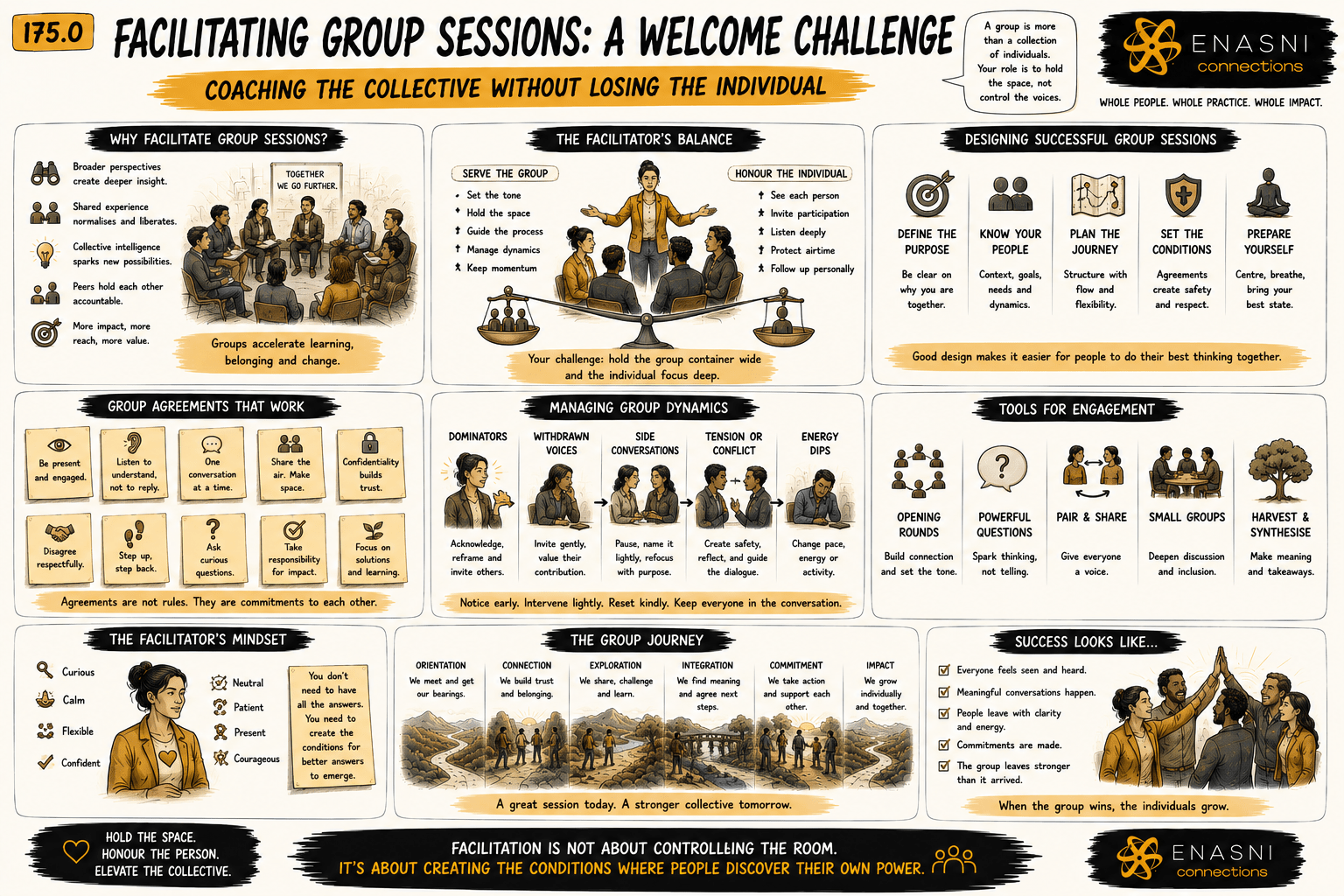
Coaching the Collective Without Losing the Individual
Group coaching matters because multiplying voices is far removed from multiplying insight on its own, and especially because facilitating a collective requires the coach to hold structure, pace, safety, and responsibility across many nervous systems at once.
This post explores what makes group coaching uniquely challenging and uniquely powerful, drawing on lived facilitation experience, and clarifies how collective work can accelerate individual movement when structured correctly from a wholeness perspective.
Why Group Coaching Is Not “One-to-One Times Ten”
Group coaching is not scaled individual coaching.
It introduces:
- multiple internal realities
- varied readiness levels
- shared time and pace
- collective emotional fields
The facilitator is no longer tracking one system.
They are holding many systems simultaneously.
This changes everything.
The Collective as a Learning Environment
In group coaching, learning is amplified through:
- resonance
- mirroring
- shared language
- parallel insight
Participants often experience:
“That question wasn’t about me — but it unlocked something important.”
This is collective wisdom in action.
Insight does not require airtime to be personal .
Why Structure Is Non-Negotiable
In group sessions, structure is not restrictive.
It is protective.
Clear structure:
- prevents dominance by confident voices
- protects quieter participants
- preserves psychological safety
- maintains pacing and flow
Without structure, group sessions collapse into discussion, advice, or storytelling.
Coaching disappears.
Housekeeping as Regulation
The South London Coaches sessions demonstrate how housekeeping becomes regulation rather than admin.
Key elements include:
- fixed duration (30 minutes)
- explicit confidentiality
- no cross-sharing
- no interruptions
- permission to rephrase questions
- acceptance of varied pacing
These rules are not formalities.
They regulate attention and nervous system load .
Why “No Sharing” Deepens Reflection
Removing sharing:
- prevents comparison
- reduces performance anxiety
- keeps focus internal
- avoids emotional spillover
Participants are guided to:
notice what is noticed
adapt questions internally
move on when needed
This creates depth without exposure.
Questions as the Central Tool
In group coaching, questions carry more weight.
They must:
- be spacious enough to fit many contexts
- land without explanation
- allow personal interpretation
Participants are encouraged to:
- rephrase internally
- ignore what does not fit
- stay with what resonates
This protects autonomy and agency.
The Philosophy of ‘Love’ in Group Work
The explicit centring of love — defined personally — serves a structural role.
It:
- softens self-judgement
- increases tolerance for ambiguity
- reduces internal resistance
- supports self-directed honesty
Love is not sentiment.
It is permission to be real without punishment .
Preparation Is Part of the Intervention
Participants are asked to arrive with:
- a real area of concern
- something within personal control
- a general focus, not a solution
- a single, clear sentence
This preparation:
- accelerates engagement
- prevents surface participation
- anchors responsibility
The work begins before the session starts.
The Coach’s Role in Group Facilitation
The facilitator does not:
- manage discussion
- solve problems
- personalise content
- chase engagement
The facilitator:
- holds structure
- maintains pace
- protects boundaries
- trusts the process
Restraint is the skill.
Why Group Coaching Accelerates Development
When done well, group coaching:
- normalises struggle
- reduces isolation
- increases momentum
- sharpens self-reflection
Participants move forward not because they are advised — but because they are activated within a coherent field.
In Essence
Group coaching is a welcome challenge because it demands more:
- structure
- discipline
- trust
- restraint
When facilitated professionally, it becomes a powerful accelerator — allowing individuals to move forward together, without being collapsed into sameness.
Key Learning Points (KLPs)
- Group coaching is structurally distinct from one-to-one work
- Structure protects depth and safety
- Housekeeping regulates attention and nervous systems
- Removing sharing deepens self-reflection
- Questions must be adaptable and spacious
- Love functions as a permissive frame
- Preparation accelerates engagement
- Facilitation requires restraint
- Collective insight amplifies individual movement
- Group work accelerates development when contained
Action Points (APs)
- Design clear non-negotiable structure before group sessions
- Remove unnecessary discussion to protect reflection
- Frame questions to allow internal adaptation rather than explanation
Keywords
group coaching facilitation, coaching the collective, applied wholeness coaching, group coaching structure, collective learning coaching, professional group sessions, South London Coaches, Enasni Connections