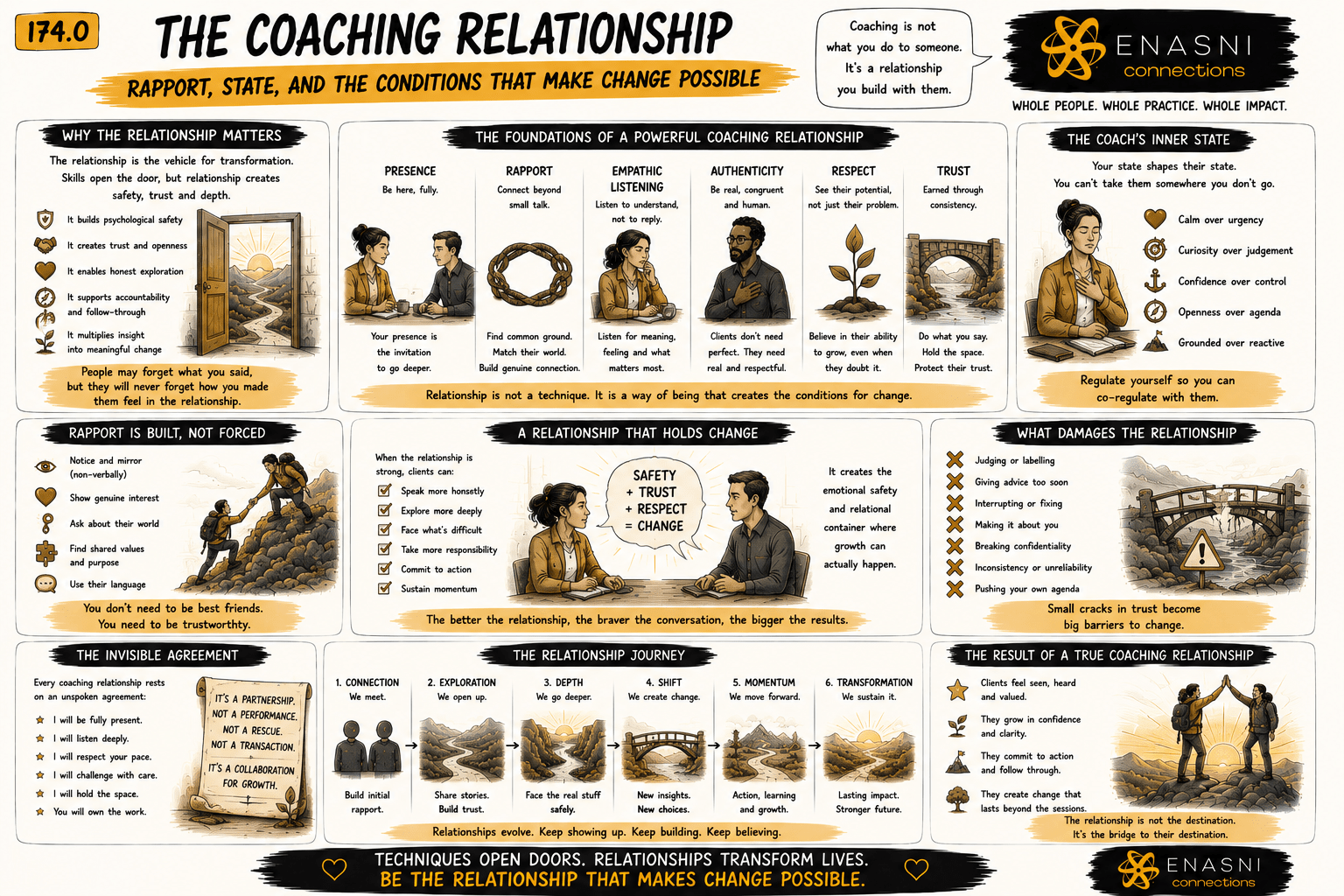
Rapport, State, and the Conditions That Make Change Possible
The coaching relationship matters because technique is far removed from effectiveness on its own, and especially because no goal, model, or question can function properly without a relationship capable of holding attention, emotion, and responsibility.
This post clarifies what actually empowers the coaching relationship, how it is actively maintained session by session, and why rapport, state management, preparation, and feedback are structural — not optional — elements from a wholeness perspective.
The Coaching Relationship Is Not a Given
A coaching relationship does not exist simply because two people meet.
It is built through:
- consistent presence
- disciplined attention
- emotional steadiness
- professional boundaries
Rapport is not friendliness.
It is functional trust — the kind that allows challenge without collapse.
Rapport Is Built Through Questioning, Not Agreement
Rapport forms when a client feels:
- genuinely heard
- taken seriously
- neither rushed nor rescued
Effective questioning:
- signals interest
- invites depth
- keeps responsibility with the client
Agreement is unnecessary.
Curiosity is essential .
State Management: The Invisible Skill
One of the most underestimated aspects of the coaching relationship is state management.
Both client and coach bring nervous systems into the room.
State is shaped by:
- sleep
- nutrition
- hydration
- stress
- emotional load
Ignoring state leads to:
- shallow work
- emotional reactivity
- loss of focus
Managing state is not therapy.
It is professional hygiene .
Preparation Strengthens the Relationship
Preparation is relational.
When a coach:
- reviews previous notes
- remembers goals and actions
- prepares tools and materials
the client experiences:
- continuity
- respect
- seriousness of intent
Disorganisation quietly erodes trust.
Preparation reinforces it.
Beginning the Session: Energy and Context
The start of a session sets the relational field.
Key elements include:
- arriving with appropriate energy
- grounding attention
- naming the focus or theme
This is not ritual.
It is orientation.
Without it, the relationship becomes reactive rather than purposeful.
Anchoring and Emotional Regulation
When difficult material emerges, emotional responses follow.
Tools such as:
- anchoring
- grounding
- pausing
allow the relationship to:
- withstand intensity
- maintain safety
- continue productively
The aim is not to suppress emotion, but to contain it.
Containment preserves relationship integrity.
Feedback: Evidence Before Interpretation
Feedback is one of the most relationally sensitive moments in coaching.
Effective feedback:
- begins with evidence
- references the client’s words, stories, or actions
- names observed strengths explicitly
This mirrors professional disciplines like nursing:
evidence first, interpretation second
Clients trust feedback that is grounded, not projected .
Summarising and Paraphrasing: Proof of Presence
Summarising and paraphrasing are not filler skills.
They demonstrate:
- accurate listening
- respect for meaning
- shared understanding
They also help:
- clarify thinking
- slow emotional charge
- reinforce insight
Clients feel held when their meaning is returned intact.
Ending Well: Closing the Loop
The end of a session matters as much as the beginning.
A strong conclusion includes:
- articulating what was achieved
- verbalising impact
- confirming actions and timescales
A closing reflective question such as:
What have you gained from this session?
shifts attention from detail to learning.
This completes the relational arc .
What Empowers the Relationship Over Time
Across sessions, the relationship strengthens through:
- consistency
- preparedness
- emotional steadiness
- clear boundaries
- respectful challenge
Not through intensity.
Not through over-involvement.
The relationship is empowered by professional reliability.
In Essence
The coaching relationship is not warmth.
It is capacity to hold:
- focus
- emotion
- responsibility
- movement
When rapport, state, preparation, and feedback are treated as structural elements, the relationship becomes a stable platform for real change.
Key Learning Points (KLPs)
- Rapport is functional trust, not agreement
- Questioning builds relationship depth
- State management affects session quality
- Wellbeing practices support relational steadiness
- Preparation reinforces trust and continuity
- Energy and context shape engagement
- Evidence-based feedback protects trust
- Summarising proves presence
- Strong endings consolidate learning
- Relationship quality determines coaching effectiveness
Action Points (APs)
- Review preparation habits before each session
- Practise evidence-first feedback
- Close sessions with a learning-oriented reflective question
Keywords
coaching relationship, building rapport coaching, state management coaching, applied wholeness coaching, professional coaching relationship, coaching feedback skills, session structure coaching, Enasni Connections