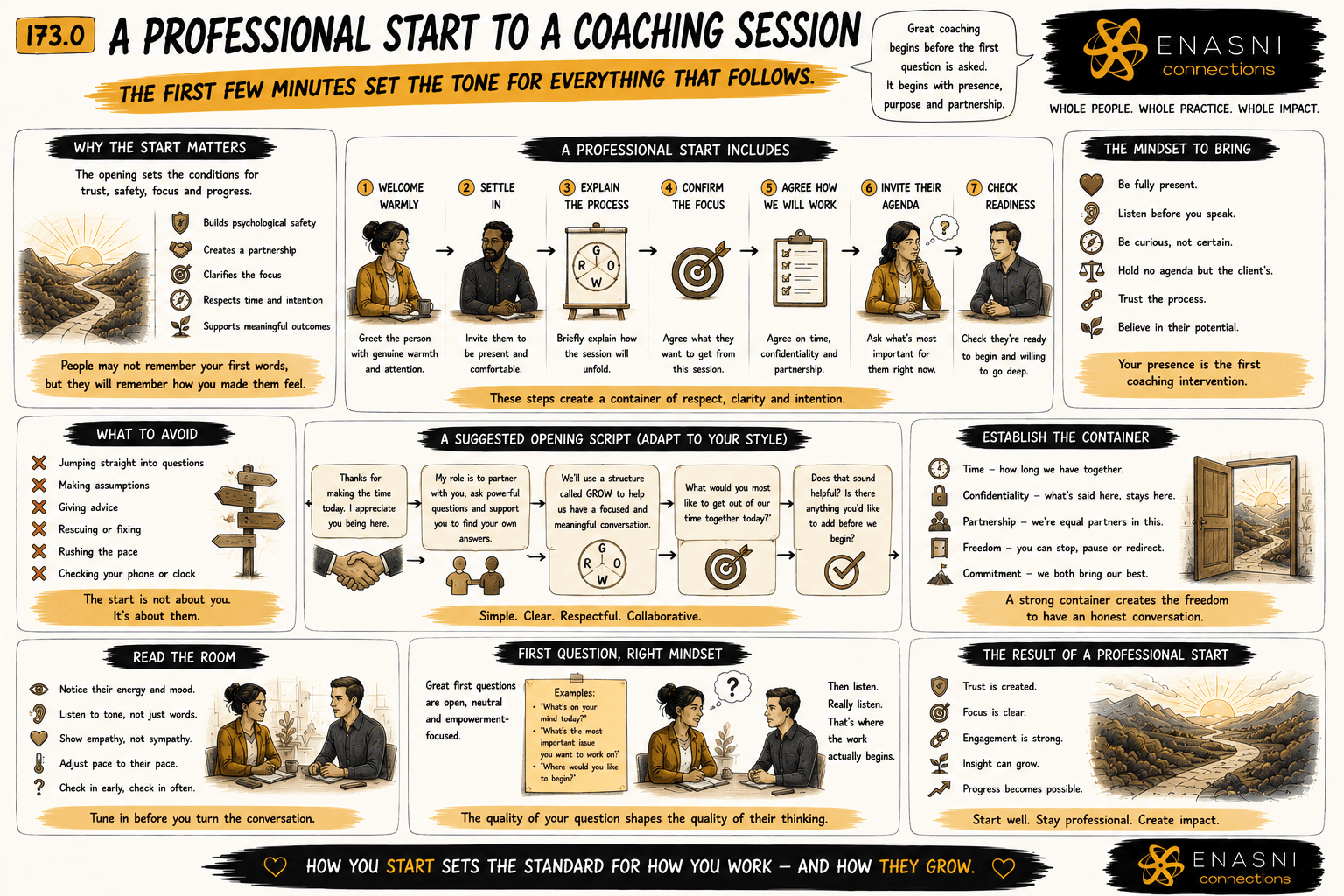
Setting the Conditions for Direction
The start of a coaching session matters because intention is far removed from effectiveness on its own, and especially because how a session begins determines whether goals and reality can be worked with honestly, calmly, and productively.
This post clarifies what a professional start to a coaching session actually involves, why it typically occupies the first ten minutes, and how it functions as structural preparation for meaningful work from a wholeness perspective.
Why the First Ten Minutes Matter
The opening of a session is not a warm-up.
It is a threshold.
What happens in the first ten minutes determines:
- whether the client is present or distracted
- whether responsibility is held or diffused
- whether the session is grounded or reactive
Skipping this stage often results in:
- rushed goal setting
- shallow exploration of reality
- emotional spillover
- loss of direction
A professional start prevents this before it begins .
Housekeeping: Creating the Right Conditions
Housekeeping is far removed from administrative politeness.
It is cemented, and rightly so, as environmental regulation.
This includes:
Physical Space
- client comfort
- appropriate seating
- water available
- distractions minimised
- mobile phones off or silent
The body must feel settled before the mind can focus.
Mental Space
- a pause to arrive
- brief breathing or grounding
- acknowledgement of the transition into coaching
This is not therapy or ritual.
It is orientation.
Without it, attention remains fragmented .
Tone and Attitude: The Coach Sets the Field
A professional start requires the coach to bring tone deliberately.
Tone communicates more than words:
- belief in the client’s capacity
- calm confidence
- openness rather than urgency
The coach’s attitude signals:
This space is purposeful, safe, and capable of holding what matters.
Clients respond to tone before content.
The Recap: Where Responsibility Is Re-Anchored
The recap is not a report.
It is a responsibility check-in.
Key questions include:
- What actions were committed to last time?
- What went well?
- What could have gone better?
- What was learned?
This creates a “trinity”:
- success
- challenge
- learning
Responsibility remains with the client, not the coach .
First Sessions: Establishing the Pattern
When there is no previous session, the recap adapts:
- What has gone well since last contact?
- What has been challenging?
- What has been learned already?
The pattern matters more than the content.
It teaches the client:
- reflection is expected
- learning is continuous
- action matters
This becomes the rhythm of future sessions.
Time Awareness as Containment
Naming the available time is not restrictive.
It is liberating.
Time awareness:
- focuses attention
- reduces anxiety
- supports prioritisation
A clear time boundary allows:
- deeper exploration
- cleaner endings
- better goal formation
Containment enables depth.
Equipment and Practical Readiness
Professional readiness includes:
- recording devices (where appropriate)
- pen and paper or digital equivalents
- exercises or materials prepared
- water available
Practical disorganisation undermines trust.
Preparation communicates care.
Why This Belongs in Chapter 5
Chapter 5 works with Goals and Reality.
Without a grounded start:
- goals become rushed
- reality becomes distorted
- motivation becomes emotional rather than structural
A professional start creates the conditions for mastery.
In Essence
A professional start is not about being polished.
It is about being intentional.
When the environment, tone, responsibility, and time are aligned, coaching can do what it is meant to do:
work with reality honestly and move toward goals deliberately.
Key Learning Points (KLPs)
- The first ten minutes shape the entire session
- Housekeeping regulates physical and mental space
- Tone communicates belief and safety
- Recap anchors responsibility with the client
- Reflection creates learning continuity
- Time awareness supports focus
- Practical readiness builds trust
- Professional starts enable deeper work
- Patterns matter more than perfection
- Mastery begins with containment
Action Points (APs)
- Design a consistent opening structure for sessions
- Practise grounding before setting goals
- Use recap questions to reinforce responsibility
Keywords
professional coaching session start, coaching session preparation, applied wholeness coaching, coaching housekeeping, session structure coaching, coaching responsibility, goal and reality preparation, Enasni Connections