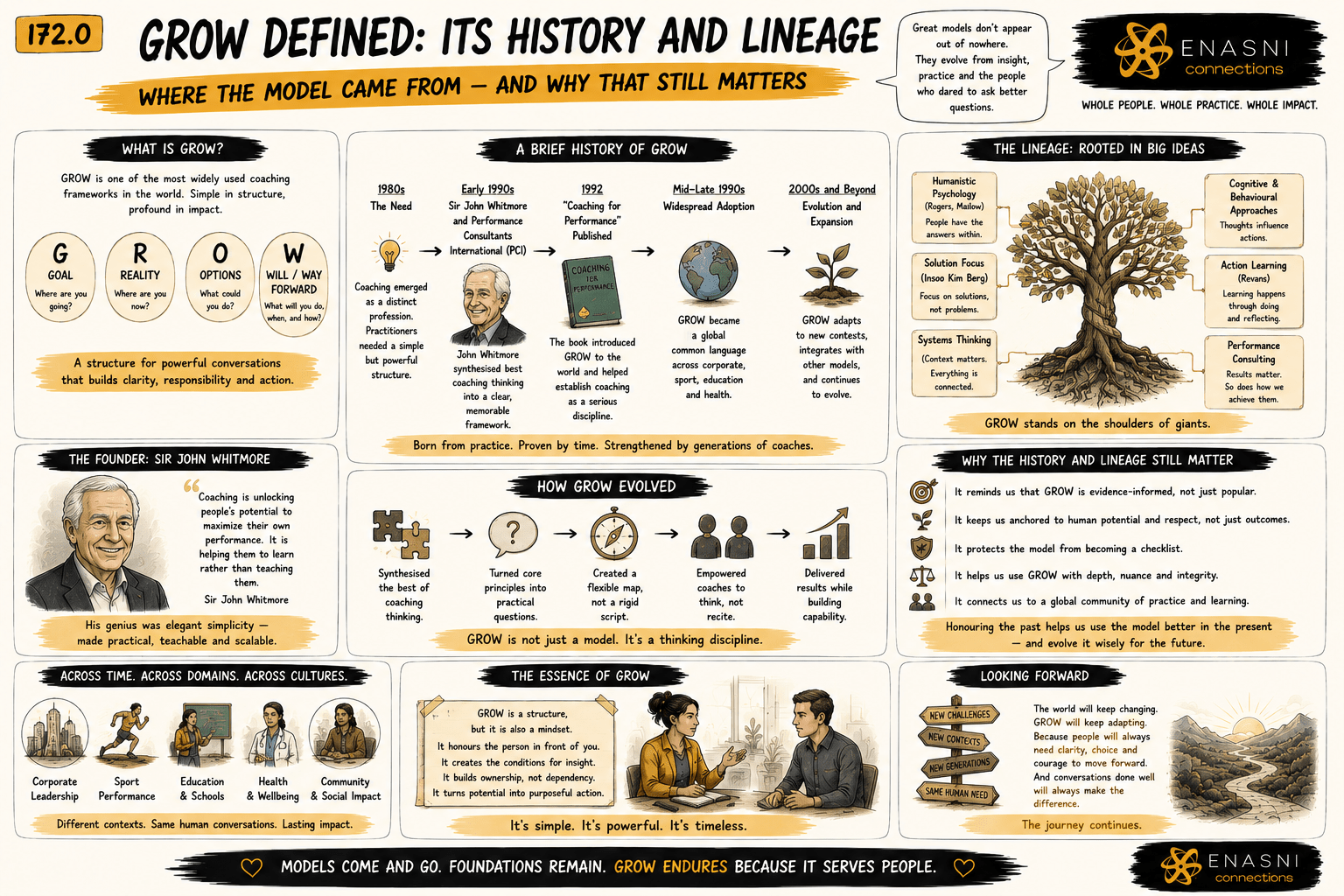
Where the Model Came From — and Why That Still Matters
The GROW model matters because frameworks are far removed from wisdom on their own, and especially because understanding where a model comes from shapes how responsibly it is used.
This post defines the GROW model through its historical development, key contributors, and original intent — not as mythology, but as professional context — from a wholeness perspective.
Why History Matters in Coaching Models
Coaching models do not appear fully formed.
They emerge from:
- specific cultural moments
- organisational needs
- leadership challenges
- philosophical assumptions
Ignoring origin leads to misuse.
Understanding lineage preserves integrity.
The Origins of GROW
The GROW model emerged during the late 1980s and early 1990s, a period marked by:
- increased focus on performance
- changing leadership styles
- movement away from directive management
- early recognition of adult learning theory
The model was initially developed by Graham Alexander, a pioneer in executive and performance coaching .
Alexander’s work focused on:
- unlocking potential rather than issuing instruction
- improving performance through awareness and responsibility
- working with individuals inside complex organisational systems
John Whitmore and Global Adoption
While Graham Alexander developed the foundational structure, the GROW model became widely known through Sir John Whitmore, particularly via his book Coaching for Performance .
Whitmore’s contribution was pivotal because he:
- articulated the model clearly
- positioned coaching as a leadership skill
- framed performance as a function of awareness and responsibility
Through Whitmore’s work, GROW moved from practice into global organisational culture.
The Philosophical Assumptions Beneath GROW
At its core, GROW rests on several non-negotiable assumptions:
- humans are capable of learning from experience
- insight precedes sustainable action
- responsibility cannot be outsourced
- awareness changes behaviour
These assumptions align closely with:
- humanistic psychology
- adult learning theory
- non-directive leadership
This is why GROW resists advice-giving by design.
Original Language and Early Variations
Early practitioners used flexible language around the model.
Examples included:
- Goal as topic, theme, or aim
- Reality as real situation or realness
- Options as possibilities or “oh” moments
- Will as way forward, wrap-up, or daily win
This flexibility was intentional.
GROW was never meant to be rigid.
It was meant to become unconsciously competent through practice .
Why “Will” Was Chosen
The final stage — Will — was not about motivation alone.
It focused on:
- commitment
- decision
- action
- follow-through
Early language often reframed Will as:
- How will you win today?
- What will success look like this week?
This grounded the model in daily behaviour, not abstract intention .
GROW as a Performance Framework
Originally, GROW was deeply connected to:
- executive coaching
- leadership development
- performance improvement
Its popularity grew because it:
- was simple without being simplistic
- worked across industries
- could be taught, practised, and adapted
Its portability is a major reason it endured.
Why GROW Spread So Widely
GROW gained traction because it:
- respected autonomy
- avoided diagnosis
- supported clarity under pressure
- transferred responsibility back to the individual
In organisational settings, this was revolutionary.
Managers stopped solving problems for people.
They started thinking with them.
What Has Been Lost Over Time
As GROW became popular, two risks emerged:
- mechanical application
- loss of philosophical grounding
When history is forgotten:
- questions become scripts
- coaching becomes formulaic
- responsibility subtly shifts back to the coach
This is why revisiting origin matters before advancing practice.
Why This Context Belongs in Chapter 5
Chapter 5 is about mastery.
Mastery requires:
- understanding origin
- recognising intent
- applying models with judgement
Without history, “advanced” becomes performative.
With history, it becomes disciplined.
In Essence
The GROW model is not a modern invention.
It is a product of:
- humanistic thinking
- leadership evolution
- performance psychology
Its power lies not in novelty, but in clarity, restraint, and respect for human capacity.
Understanding where it came from is the first step in using it well.
Key Learning Points (KLPs)
- GROW originated in the late 20th century coaching movement
- Graham Alexander developed the foundational structure
- John Whitmore popularised and articulated the model globally
- GROW is grounded in awareness and responsibility
- Early language around GROW was intentionally flexible
- “Will” emphasises commitment and daily action
- GROW emerged from performance and leadership contexts
- Its simplicity enabled global adoption
- History protects against mechanical misuse
- Mastery begins with understanding origin
Action Points (APs)
- Revisit personal assumptions about GROW’s purpose
- Reflect on whether usage aligns with original intent
- Hold flexibility in language while preserving responsibility
Keywords
GROW model history, Graham Alexander coaching, John Whitmore coaching, coaching for performance, origins of GROW, coaching frameworks history, applied wholeness coaching, Enasni Connections