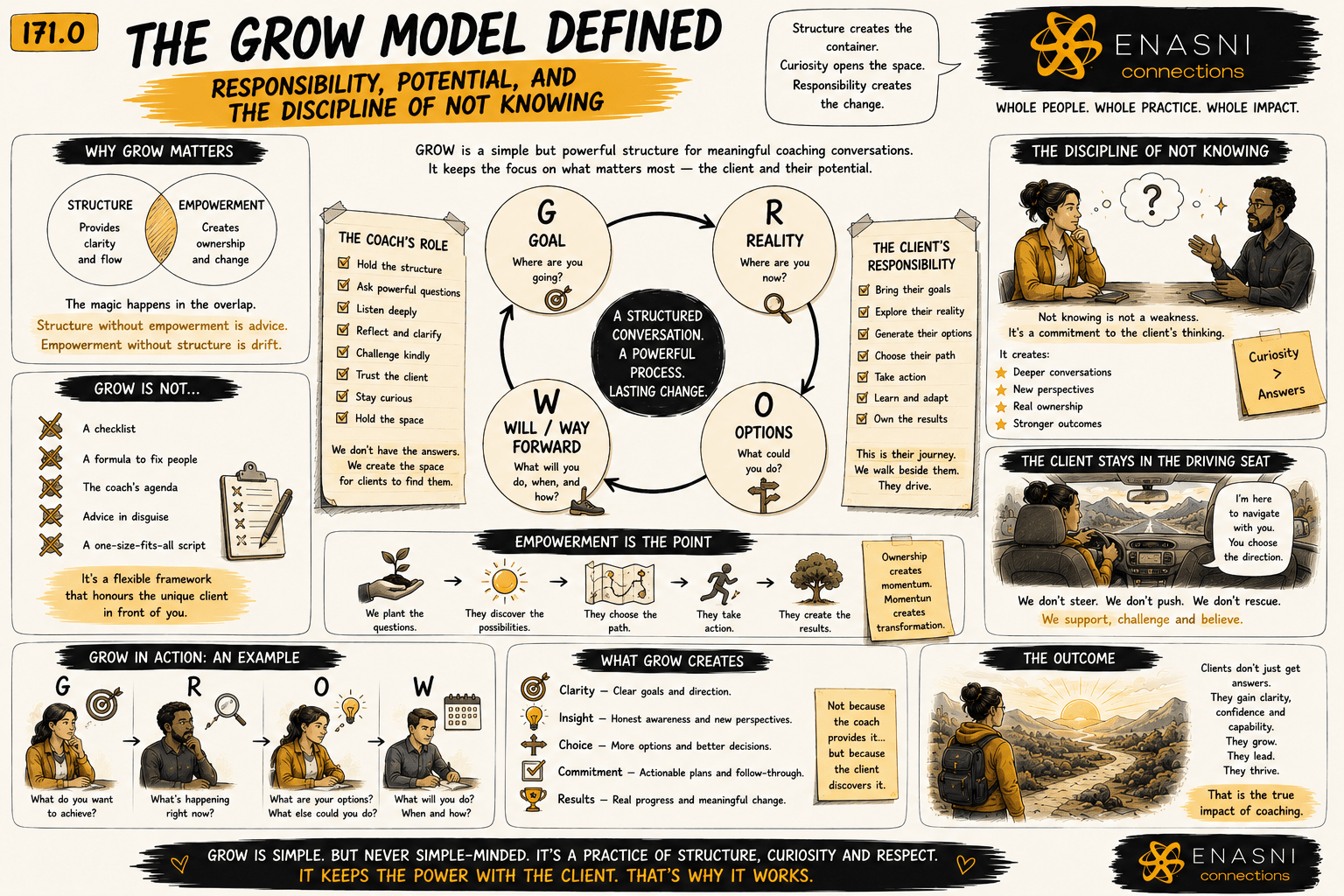
Responsibility, Potential, and the Discipline of Not Knowing
The GROW model matters because structure is far removed from empowerment on its own, and especially because coaching only works when responsibility remains with the client rather than transferring subtly to the coach.
This post defines the GROW model not as a technique to follow, but as a principled framework grounded in belief in human potential, future-orientation, and disciplined restraint by the coach from a wholeness perspective.
What GROW Is Built On (Before What It Does)
The GROW model rests on one non-negotiable assumption:
The client already possesses the capacity to resolve their challenges and move toward their goals.
This is not optimism.
It is a professional stance.
Without this belief, coaching collapses into advice, reassurance, or rescue .
Coaching vs Mentoring: A Structural Difference
The files make the distinction unmistakably clear.
Mentorship
- draws on personal experience
- offers advice and guidance
- transfers knowledge
- reduces uncertainty through direction
Mentors say:
I’ve been there. I know how to do this.
Coaching
- operates without preconceived answers
- refuses to lead the client’s thinking
- facilitates discovery
- preserves responsibility
Coaches say:
I trust that you can find your way — and I will help you do so.
This difference is not stylistic.
It is ethical .
The Coach as Catalyst, Not Authority
A core principle of GROW is that the coach:
- does not own the outcome
- does not impose solutions
- does not judge the client’s choices
The coach functions as a catalyst.
Change happens through the client, not because of the coach.
This protects:
- agency
- dignity
- sustainability
When coaches insert themselves into outcomes, dependency forms.
GROW prevents this by design .
Responsibility Never Leaves the Client
The model is explicit:
- the client is responsible for their situation
- the client is responsible for their solutions
- the client is responsible for outcomes
This is not harshness.
It is empowerment.
Removing responsibility may feel supportive in the short term, but it erodes capacity long-term.
GROW keeps responsibility exactly where it belongs.
Learning, Not Teaching
GROW distinguishes sharply between:
- teaching (transferring knowledge)
- learning (developing insight through experience)
The coach does not explain life.
The coach helps the client:
- extract learning from experience
- apply that learning forward
- refine choices over time
The emphasis is always:
What did you learn, and how will that shape what you do next?
Not:
Why did this happen to you?
Why GROW Is Future-Oriented
GROW is not interested in dwelling on past failure.
Past experience is referenced only to:
- extract learning
- inform future action
This prevents:
- identity entrenchment
- justification loops
- blame fixation
The past is data.
The future is the direction of travel.
Individuality Is Non-Negotiable
Another foundational principle:
Every client is unique and intrinsically valuable.
GROW adapts to the client — not the other way around.
This makes:
- comparison irrelevant
- templates secondary
- formulaic coaching unsafe
Structure exists to support individuality, not erase it .
Why GROW Is Often Misused
GROW fails when:
- used mechanically
- treated as a checklist
- applied without belief in client capability
- overridden by coach ego or anxiety
The model does not fail.
The stance fails.
This is why mastery matters.
What GROW Ultimately Protects
When used as intended, GROW protects:
- client autonomy
- coach humility
- ethical clarity
- sustainable change
It prevents the quiet slide from coaching into:
- mentoring
- therapy
- advice-giving
- emotional rescue
That protection is its greatest strength.
In Essence
The GROW model is not a sequence of questions.
It is a discipline of restraint grounded in belief in human potential.
It exists to ensure that growth belongs to the client — not the coach.
Used well, it develops capacity.
Used poorly, it becomes performance.
Key Learning Points (KLPs)
- GROW is built on belief in client potential
- Coaching differs structurally from mentoring
- The coach acts as catalyst, not authority
- Responsibility always remains with the client
- Coaching prioritises learning over teaching
- GROW is future-oriented by design
- Individuality is central, not optional
- Misuse stems from stance, not structure
- GROW protects autonomy and ethics
- Mastery requires restraint
Action Points (APs)
- Audit personal stance when using GROW
- Notice where advice or rescuing creeps in
- Practise holding belief in client capability under pressure
Keywords
GROW model defined, coaching vs mentoring, applied wholeness coaching, coaching responsibility, client potential coaching, future oriented coaching, coaching principles, Enasni Connections