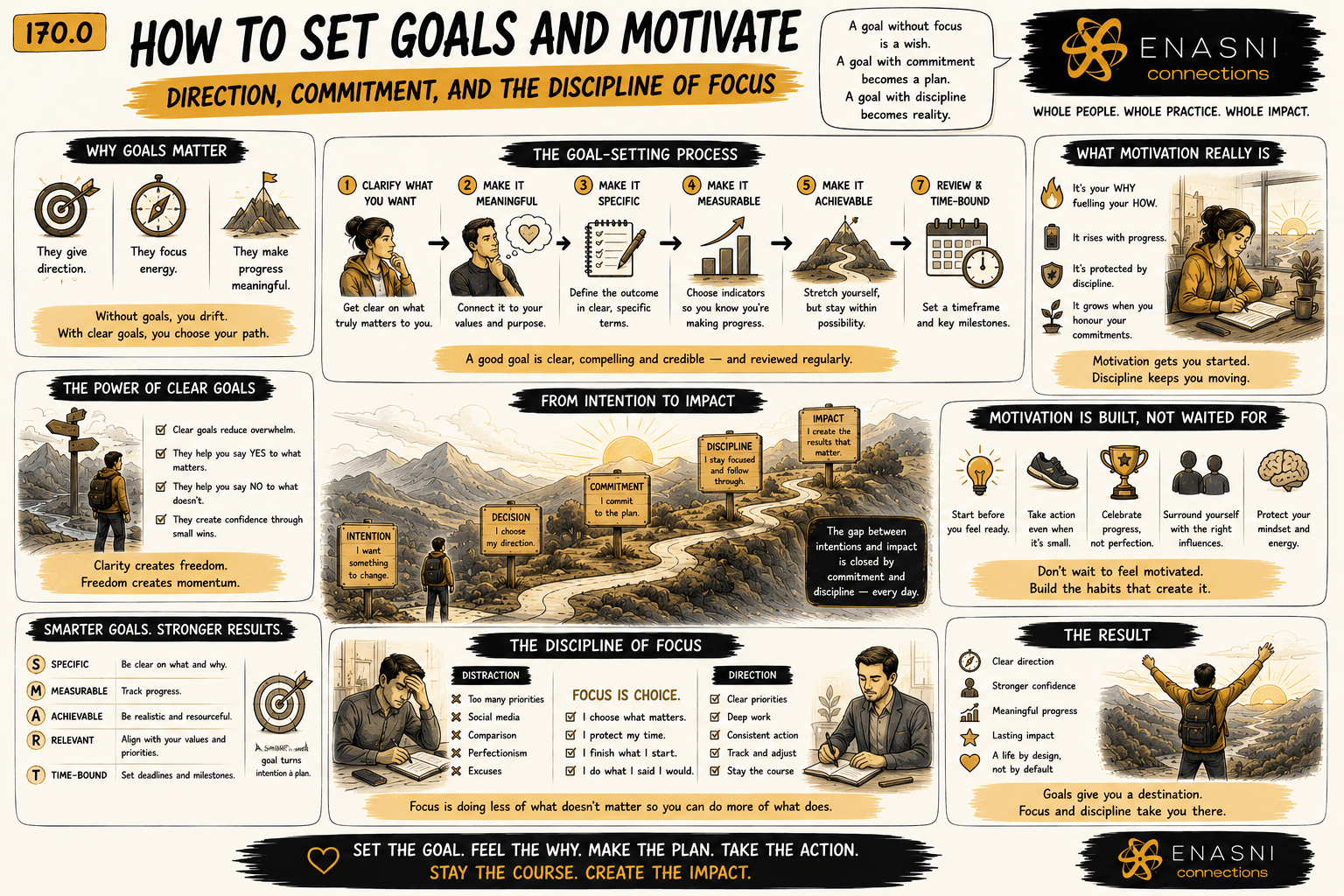
Direction, Commitment, and the Discipline of Focus
Goal setting matters because desire is far removed from direction on its own, and especially because goals shape behaviour, attention, identity, and stress long before results appear.
This post explores how goals actually work, why motivation must accompany them, and how poorly formed goals quietly create pressure, frustration, and self-violence rather than progress from a wholeness perspective.
Why Goals Come First
Goals are not optional extras.
They are the first structural move in shaping a future.
Without goals:
- effort diffuses
- energy scatters
- decisions default to circumstance
- pressure increases without direction
This is why people without goals often feel:
- anxious
- frustrated
- reactive
- controlled by external forces
Direction restores agency .
What a Goal Actually Is
A goal is:
- the object toward which effort is directed
- a terminal point
- a finish line
It is not a wish.
It is not a mood.
A goal gives effort somewhere to go.
Once set, it becomes a fulcrum:
every other effort in life subtly reorganises around it .
The Three Essential Qualities of Effective Goals
Well-formed goals must be:
- Exciting — they generate engagement
- Relevant — they align with values and context
- Challenging — they stretch capacity without overwhelming it
Goals lacking these qualities either:
- fade quietly
- create resistance
- or become sources of chronic stress
This is not a mindset issue.
It is structural.
Goals as Positive Statements of Intent
A goal is a positive declaration:
This is where effort is going.
It requires:
- absolute commitment
- daily action
- repeated re-orientation
Commitment is not intensity.
It is consistency.
Small actions performed daily outperform dramatic bursts followed by collapse .
Motivation Is Not Optional
Goals without motivation become obligations.
Motivation provides:
- energy
- meaning
- persistence
Motivation can be:
- internal (desire, values, purpose)
- external (pressure, reward, avoidance)
Sustainable goals are powered primarily by internal motivation.
External motivation works — but it exhausts faster.
Focus Shapes Reality
Attention is not neutral.
Where attention goes:
- perception follows
- energy flows
- behaviour reorganises
The subconscious mind does not distinguish between:
- what is wanted
- what is feared
It responds to focus.
This is why goals framed around avoidance (“I don’t want…”) often recreate the very outcomes people wish to escape .
Why Many Goals Fail Quietly
Common failure points include:
- vague formulation
- lack of emotional relevance
- unrealistic scope
- absence of daily action
- failure to revisit and refine
Failure is rarely dramatic.
Goals are more often forgotten than abandoned.
This is why review is not optional.
The Coach’s Role in Goal Formation
Coaching does not impose goals.
It helps clients:
- articulate what they actually want
- separate desire from obligation
- refine goals into clear statements
- reconnect motivation when it fades
The coach guards against:
- fantasy goals
- borrowed ambitions
- self-punishing objectives
This is ethical direction, not motivation theatre .
Observation Goals: Training Focus
A simple but powerful exercise involves observation goals:
- noticing red cars
- spotting sales adverts
- tracking specific patterns
The purpose is not the content.
It is to reveal how:
- focus alters perception
- goals change awareness
- attention trains behaviour
This teaches clients how goals quietly reorganise experience.
Goals, Freedom, and Responsibility
Without goals:
- future direction is surrendered
- choice narrows
- freedom erodes
Drifting is not neutral.
It hands control to circumstance.
Goals reclaim:
- authorship
- agency
- intentional living
This is why goal mastery sits at the heart of Chapter 5.
In Essence
Goals are not about achievement.
They are about direction under pressure.
When goals are exciting, relevant, challenging, and paired with motivation, they organise effort without violence.
When they are poorly formed, they drain energy and distort reality.
Mastery begins here.
Key Learning Points (KLPs)
- Goals provide structural direction
- A goal is a terminal point for effort
- Exciting, relevant, challenging goals sustain engagement
- Commitment requires daily action
- Motivation fuels persistence
- Focus shapes perception and behaviour
- The subconscious responds to attention
- Vague goals fail quietly
- Coaching refines goals ethically
- Direction restores agency
Action Points (APs)
- Rewrite one current goal to make it exciting, relevant, and challenging
- Identify whether motivation is internal or external
- Introduce a simple observation goal to train focus
Keywords
how to set goals, motivation and goal setting, mastery of goals, applied wholeness coaching, focus and subconscious mind, ethical goal setting, coaching goals, Enasni Connections