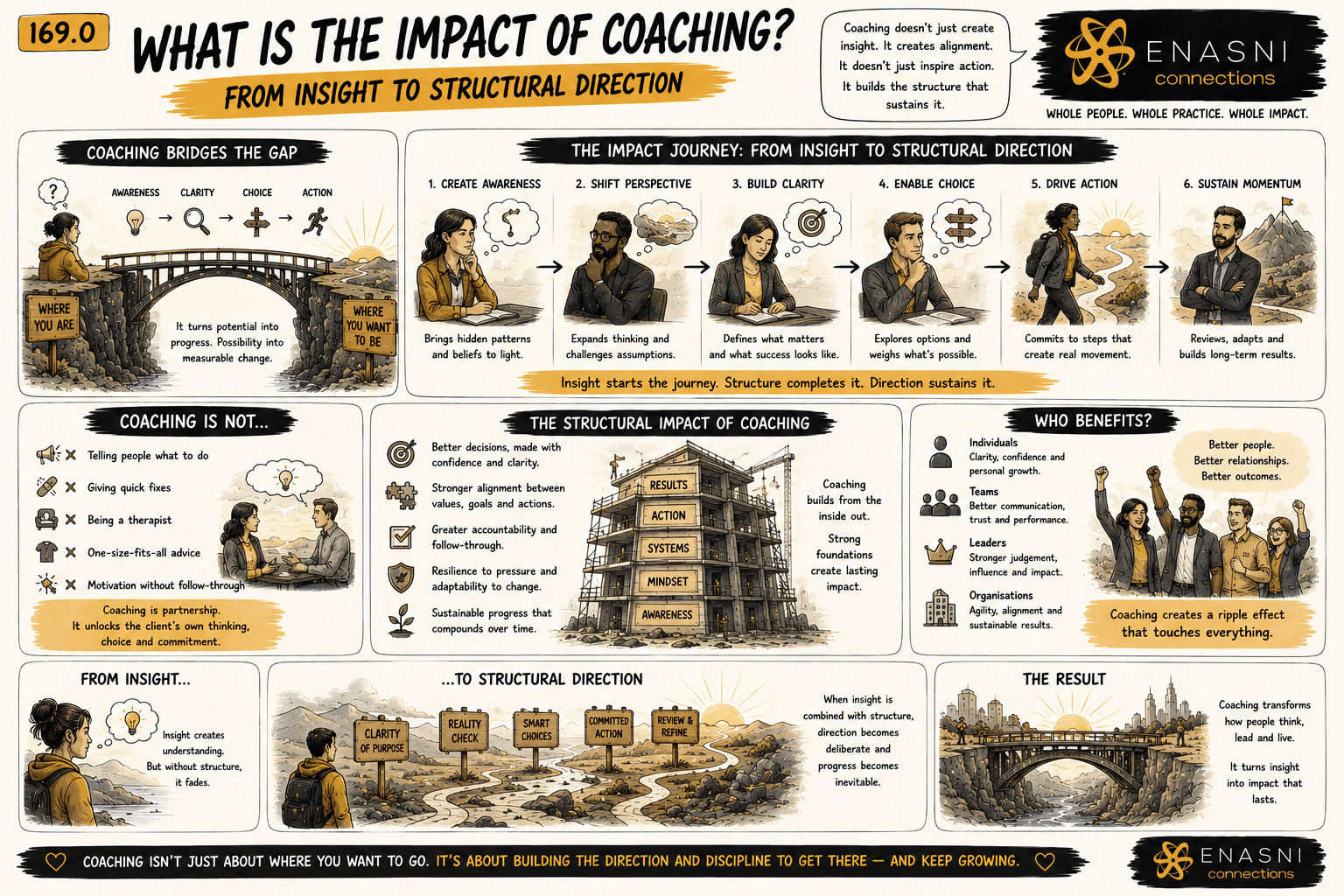
From Insight to Structural Direction
The impact of coaching matters because feeling better is far removed from living differently on its own, and especially because coaching introduces a new form of structural direction that reorganises behaviour, perception, and choice over time.
This post examines the real impact of coaching as described by lived experience — not as inspiration or promise, but as a measurable shift in structure, direction, and agency from a wholeness perspective.
One Word, Many Meanings
When people are asked to describe the impact of coaching in a single word, the answers are revealing:
- Structural
- Transformational
- Unleashed
- Growth
- Revealing
- Life-changing
- Empowering
- Hope-inspiring
- Freedom
These words do not describe a mood.
They describe movement .
Structural Direction: What Changes First
One of the clearest impacts of coaching is the introduction of new structure.
Participants describe coaching as offering direction that is:
- distinct from professional training
- different from family systems
- separate from education
- unlike religious or moral frameworks
Coaching does not replace these structures.
It introduces an additional organising lens — one focused on agency, choice, and responsibility .
Transformation as a Ripple, Not an Event
For some, coaching is described as transformational.
Not because of a single moment — but because of a transference effect.
New insight leads to:
- changed behaviour
- altered decision-making
- different relational responses
That change is then observed, mirrored, and transferred to others.
Transformation snowballs.
This is not performance.
It is systemic impact .
Unleashing Capacity, Not Creating It
The word unleashed appears frequently.
This matters.
Coaching does not insert something new.
It removes constraints.
Participants describe:
- clearer self-trust
- permission to act
- release from internal friction
What was already present becomes accessible.
This distinction protects coaching from exaggeration.
Coaching and Positivity: A Necessary Nuance
Coaching is often described as a positive experience.
But the data reveals an important nuance.
Coaching does not require someone to be “positive”.
It requires movement toward possibility — even by a fraction.
A shift from 49.9% negativity to 50.1% openness still changes trajectory.
Exclusion based on mindset undermines the purpose of coaching .
Readiness Is the Differentiator
One of the clearest insights concerns readiness.
Coaching works best when a person:
- recognises they are not where they want to be
- believes change is possible
- is willing to engage
This aligns with the idea of coaching being for the “worried well” — not broken, but aware.
Without belief in possibility, change may still occur, but it originates from pressure rather than agency .
Why Coaching Close Relationships Is Difficult
Experience also highlights limits.
Coaching family or close friends is challenging because:
- participation may be driven by obligation
- readiness may be absent
- boundaries blur
Coaching requires voluntary engagement.
Without it, structure collapses.
Impact Depends on Skill, Not Intention
The impact of coaching is closely tied to:
- quality of goal formation
- depth of reality exploration
- skill in questioning
- restraint in intervention
Tools like GROW are foundational — but only effective when applied with judgement.
Mastery takes time.
Linear use precedes flexible use.
This is developmental, not deficient .
Coaching as Experience, Not Explanation
A key insight emerges around communication.
Coaching is best understood when it is described as an experience, not explained as a process.
Impact words matter because they bridge:
- the world of the coach
- the expectations of the client
When the experience is named accurately, trust forms.
In Essence
The impact of coaching is not motivation.
It is structural reorganisation.
It changes how people:
- interpret reality
- choose goals
- allocate energy
- relate to others
When done well, coaching does not fix people.
It restores direction.
Key Learning Points (KLPs)
- Coaching introduces new structural direction
- Transformation occurs through ripple effects
- Coaching unleashes existing capacity
- Positivity is not a prerequisite
- Readiness determines depth of impact
- Coaching close relationships is structurally complex
- Skill matters more than intention
- GROW requires mastery to be effective
- Experience communicates impact better than explanation
- Structural change outlasts emotional uplift
Action Points (APs)
- Assess readiness before beginning coaching
- Describe coaching as an experience, not a promise
- Focus on structural shifts rather than emotional outcomes
Keywords
impact of coaching, structural direction coaching, transformational coaching impact, applied wholeness coaching, coaching readiness, coaching experience, GROW model application, Enasni Connections