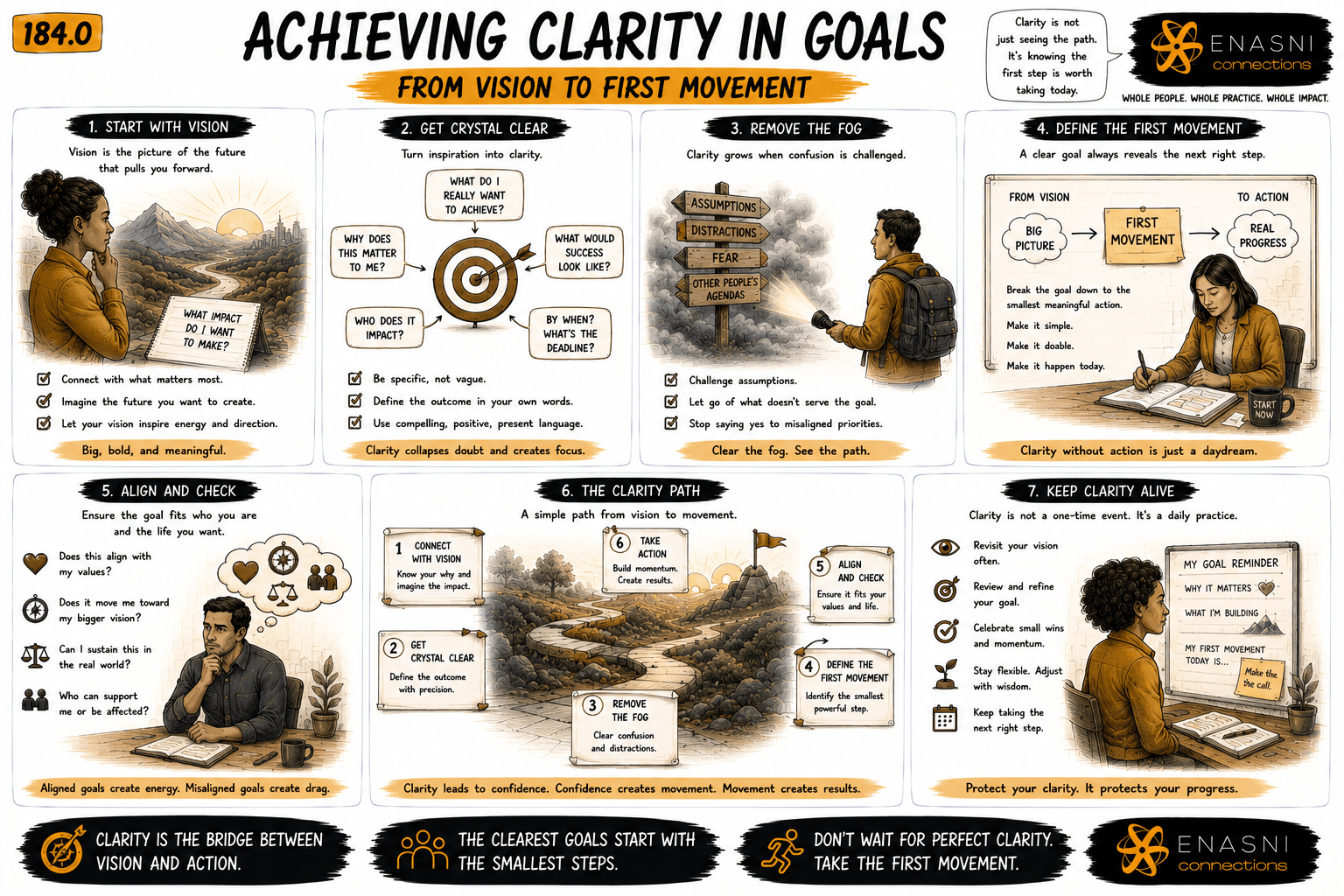
From Vision to First Movement
Clarity matters because motivation is far removed from progress on its own, and especially because without clarity, effort disperses, confidence erodes, and even meaningful goals begin to feel heavy rather than energising.
This post explores how coaches support clients to achieve clarity in goals by visualising outcomes, breaking complexity into manageable parts, and translating ambition into the first achievable movement — not through pressure, but through structure and sequence from a wholeness perspective.
Why Clarity Is the Real Starting Point
Most clients arrive in coaching with topics, not goals.
Statements like:
- “I want to cycle around the world.”
- “I want to run a marathon.”
- “I want to change my career.”
sound clear, but structurally they are not.
They are themes — broad, variable, and emotionally loaded.
Without clarification, such goals overwhelm rather than mobilise.
Clarity transforms a theme into a direction the nervous system can engage with safely and sustainably .
Visualisation: Making the Future Tangible
Clarity begins by inviting the client to step into the future.
Not metaphorically — but sensory-specifically.
Effective questions include:
- What can you see when this is achieved?
- What are you holding?
- What are others saying?
- What does success feel like in your body?
For example, a client aiming to obtain a diploma might be guided to imagine:
- holding the certificate
- seeing it displayed or shared publicly
- feeling legitimacy, accomplishment, and recognition
Visualisation does not create fantasy.
It creates psychological plausibility.
When the mind can see an outcome, effort becomes organised rather than scattered .
Linking Goals to Impact and Values
Clarity deepens when the client explores why the goal matters.
Questions such as:
- What difference would achieving this make?
- Who benefits?
- What would this allow you to become or contribute?
draw out values beneath ambition.
For some clients, the impact might be:
- becoming a role model
- contributing more meaningfully
- restoring self-respect
- opening new possibilities
This stage often reveals whether the goal is:
- genuinely owned
- inherited from others
- driven by comparison
- compensating for something else
Goals aligned with values feel right — even when they are demanding.
Misaligned goals feel heavy before they even begin .
Why Large Goals Create Paralysis
Large goals fail most often not because they are unrealistic, but because they are unstructured.
When the brain sees:
“everything that needs to be done”
it responds with:
- demotivation
- procrastination
- avoidance
Coaching intervenes by breaking the whole into component parts.
Instead of:
“cycling around the world”
the focus shifts to:
- equipment
- logistics
- finance
- fitness
- technology
- safety
Each component becomes a manageable domain of focus rather than an amorphous mountain.
From Topic → End Goal → Components
Effective coaching follows a funnel:
- Topic — the broad theme
- End Goal — what “success” looks like when complete
- Component Parts — what must exist for that to be true
Only once this structure is clear does movement begin.
This prevents premature action and false urgency.
Clarity first.
Effort second.
Journey Goals: The Missing Middle
Between the big goal and daily actions sit journey goals.
Journey goals are:
- specific
- achievable within weeks
- directly linked to one component
For example:
- “Get the bike professionally assessed.”
- “Research and purchase appropriate panniers.”
- “Book training sessions for fitness conditioning.”
Each journey goal creates momentum without overwhelm.
Progress becomes visible.
Confidence builds through completion, not aspiration .
Focusing on the First Component
A critical discipline is choosing only one journey goal at a time.
The coach asks:
- Which of these matters most right now?
- Which will unlock the others once completed?
Clients often discover that clarity itself reveals the correct starting point.
For example:
- before buying equipment
- the bike must be assessed
Sequence reduces waste.
Energy follows order.
Assessing Reality Without Judgement
Once the first journey goal is chosen, the client assesses where they are now.
Tools include:
- scaling (1–10)
- evidence-based reflection
- factual inventory
This is not self-criticism.
It is orientation.
Reality becomes a coordinate, not a verdict.
From there, the client identifies:
- what would move them one step closer
- what is realistic within the next 2–4 weeks
- what commitment feels achievable
Short timeframes protect momentum and confidence .
Session Outcomes vs Session Experience
A subtle but important distinction is made in effective coaching:
- not what the client wants to take away
- but what the client wants to achieve
The guiding question becomes:
What outcome would make this session useful?
This keeps sessions:
- purposeful
- outcome-oriented
- grounded in progress
Reviewing the session is secondary.
Achieving movement is primary.
Recording and Review: Making Progress Visible
Recording progress transforms effort into learning.
Clients are encouraged to:
- write journey goals
- track completion
- review regularly
Review allows:
- adjustment without judgement
- recognition of progress
- recalibration of timelines
Completed journey goals give permission to move forward.
Uncompleted goals provide information — not shame .
Why SMART Alone Is Not Enough
SMART goals help with:
- specificity
- measurability
- time-bounding
But when goals are large, long-term, or multi-layered, SMART alone cannot:
- prevent overwhelm
- maintain motivation
- manage complexity
Breaking goals into components and journey goals fills this gap.
Structure replaces strain.
In Essence
Clarity is not about certainty.
It is about direction that feels manageable.
When clients can see:
- where they are going
- why it matters
- what comes first
effort stops feeling forced.
Movement becomes natural.
Coaching does not make goals easier.
It makes them possible to live with.
Key Learning Points (KLPs)
- Clarity precedes sustainable action
- Visualisation makes goals psychologically real
- Values anchor motivation
- Large goals overwhelm without structure
- Component parts reduce complexity
- Journey goals create momentum
- One focus at a time prevents overload
- Reality assessment should be non-judgemental
- Session outcomes matter more than session review
- Recording and review sustain progress
Action Points (APs)
- Guide clients to visualise outcomes with sensory detail
- Break large goals into clear component parts
- Identify one achievable journey goal per session
- Set outcomes, not just discussion points
- Encourage recording and regular review
Keywords
achieving clarity in goals, breaking down large goals, journey goals coaching, applied wholeness coaching, goal visualisation, coaching session outcomes, sustainable goal setting, Enasni Connections