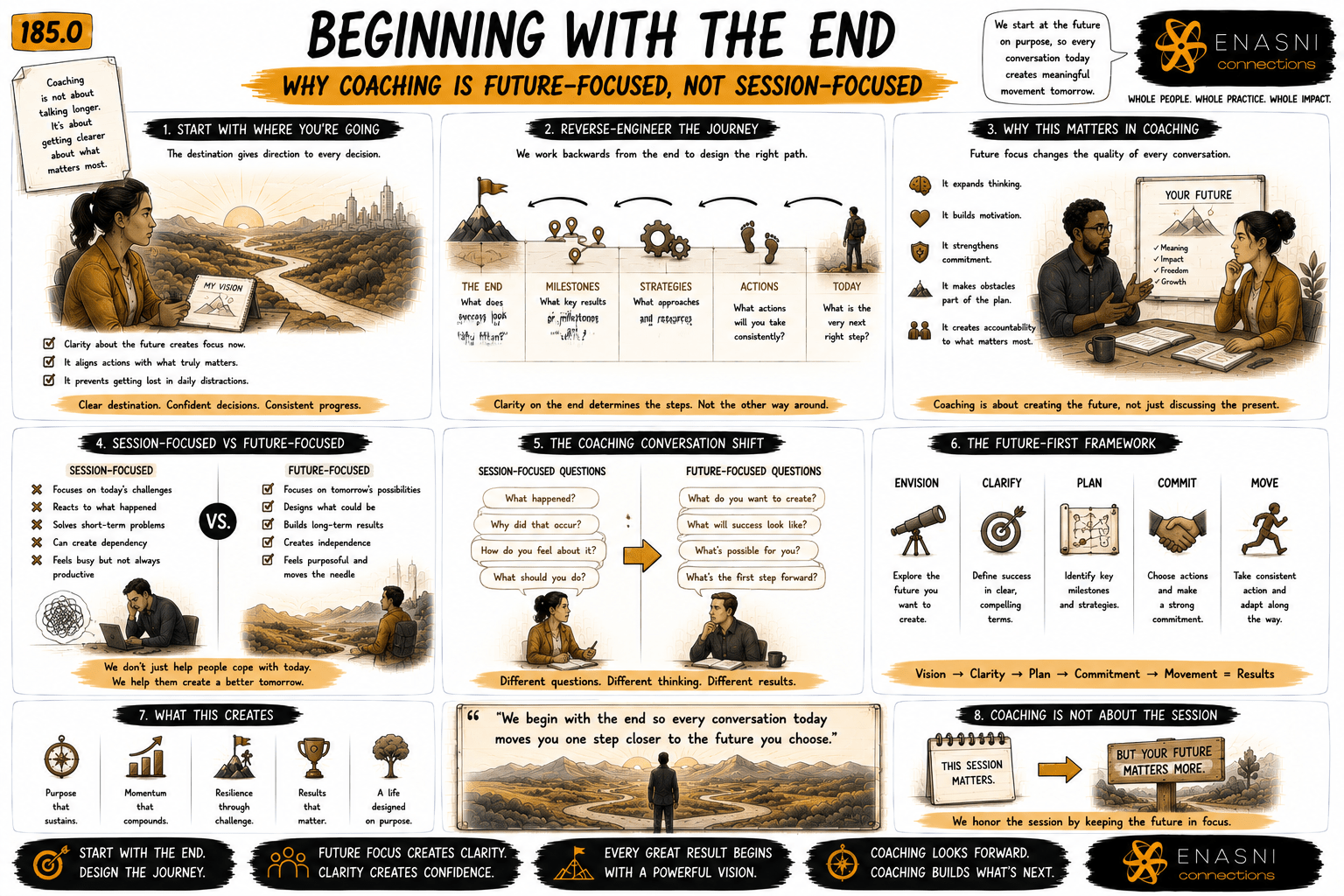
Why Coaching Is Future-Focused, Not Session-Focused
Coaching effectiveness depends on direction because presence is far removed from progress on its own, and especially because clients leave sessions changed only when the future is actively shaped rather than merely explored.
This post clarifies why coaching begins with the end in mind, how journey goals and stepping stones operate within sessions, and why confusing session focus with future focus quietly undermines outcomes from a wholeness perspective.
Session Focus vs Future Focus
A subtle but critical distinction separates effective coaching from reflective conversation.
Session-focused conversations ask:
- What do you want to talk about today?
- What needs exploring right now?
These questions often lead to:
- insight
- emotional release
- understanding
But not necessarily movement.
Future-focused coaching asks:
- What do you want to achieve as a result of this session?
- What would make this session useful in the future?
This shift changes everything.
The session becomes a bridge, not a container.
Why Over-Focusing on the Present Limits Progress
When coaching remains anchored in:
- present emotions
- current frustration
- immediate experience
it begins to resemble:
- counselling
- reflective therapy
- cognitive exploration
These have value — but they do not produce direction.
Coaching differs because it:
- starts with the desired future
- works backwards
- uses the present as data, not destination .
Coaching Begins With the End in Mind
Effective coaching begins by clarifying:
- the long-term goal
- the overall outcome
- the defining moment of success
A powerful question is:
What is the precise moment when you will know for sure that you have achieved this goal?
This creates:
- clarity
- motivation
- orientation
The mind engages differently when the end point is concrete rather than abstract.
Defining Success Signals
Success signals are not vague indicators like:
- “I’ll feel better”
- “Things will improve”
They are observable moments:
- crossing a finish line
- holding a certificate
- completing a first week of a new routine
- seeing measurable change
These signals anchor motivation because they answer:
How will I know I have arrived?
From End Goal to Journey Goals
Once the end goal is clear, coaching moves to gap analysis:
- Where is the client now?
- Where do they want to be?
The distance between the two is not crossed in one leap.
It is crossed via journey goals.
Journey goals are:
- short-term
- achievable
- directional
They act as stepping stones across the gap.
Each Session Has One Journey Goal
A defining feature of effective coaching is focus.
Each session:
- centres on one journey goal
- explores reality, options, and actions in relation to that goal
- avoids scattering effort across multiple priorities
For example:
- End goal: Run a marathon
- Journey goal: Create a diet plan
- Session outcome: Diet plan ready by end of next week
This prevents sessions from becoming diffuse or theoretical.
Actions Flow From the Journey Goal
Actions are not generic tasks.
They are:
- directly related to the journey goal
- achievable within 2–3 weeks
- realistic within current capacity
A well-run session usually ends with:
- around three clear actions
Not because three is magic — but because:
- fewer risks under-commitment
- more risks overwhelm
Proportion matters .
Reality, Options, and Actions Stay Aligned
When the journey goal is clear:
- reality exploration stays relevant
- options remain practical
- actions feel purposeful
Without a journey goal:
- reality becomes a complaint list
- options become abstract
- actions lose traction
Structure protects momentum.
Review Is Built In, Not Bolted On
Journey goals are reviewed regularly:
- what worked
- what didn’t
- what was learned
This keeps the process:
- adaptive
- responsive
- non-judgemental
Missed actions are not failures.
They are feedback.
Why This Approach Reduces Overwhelm
Breaking large goals into:
- end goals
- journey goals
- session outcomes
- actions
allows clients to:
- stay focused
- experience progress
- build confidence incrementally
Momentum builds through completion, not pressure.
In Essence
Coaching is not about what happens in the session.
It is about what happens after the session.
By beginning with the end, defining success signals, working through journey goals, and anchoring each session to future outcomes, coaching becomes a disciplined pathway rather than an insightful conversation.
Direction replaces drift.
Key Learning Points (KLPs)
- Coaching must be future-focused to create outcomes
- Session focus differs from future focus
- Over-focusing on the present limits action
- Coaching begins with the end in mind
- Success signals strengthen motivation
- Journey goals bridge the gap to long-term goals
- Each session should focus on one journey goal
- Actions must relate directly to that journey goal
- Three actions per session maintains proportion
- Review turns effort into learning
Action Points (APs)
- Reframe session questions toward future outcomes
- Help clients define precise success signals
- Anchor each session around one journey goal
- End sessions with three clear, achievable actions
Keywords
future focused coaching, journey goals coaching, session goals vs outcomes, applied wholeness coaching, stepping stones model, coaching session structure, goal mastery practice, Enasni Connections