
PAY AS YOU GROW
Pricing Breakdown
PAYG is most effective when pressure is high, time is limited, and clarity must be restored quickly. Each session focuses on identifying the dominant stress mechanism and applying the smallest effective intervention to regain functional stability.
10-Minute PAYG Session
Purpose: ultra-fast clarity
Best for: one sharp decision, one immediate block
Includes: grounding + rapid solution & stabilisation + one action
20-Minute PAYG Session
Purpose: clarity + micro-shift
Best for: micro-intervention + next-step design
Includes: grounding + exploration + micro intervention
30-Minute PAYG Session
Purpose: standard resolution for one problem
Best for: Single issue standard exploration with integration support
Includes: grounding + exploration + intervention + integration
45-Minute PAYG Session
Purpose: complex or emotional issues
Best for: complex or emotionally loaded single issue needing deeper mapping
Includes: expanded exploration + advanced micro intervention + structured integration
Structured micro-regulation for immediate clarity and decisive forward movement.
Session length is determined by the option selected.
One problem addressed per session.
Micro sessions. Real shifts.
A clinically grounded, systems-aware PAYG format designed for professionals operating under extreme pressure, responsibility, and complexity.
Focus remains on regulation, capacity, and decision clarity—delivered in single, high pressure time containers.
Stress, decision load, and capacity—one issue at a time
Focused intervention within a defined time container
What PAYG delivers
PAYG provides focused, time-bound intervention designed to stabilise stress, restore clarity, and enable immediate action around one defined issue.
Decision making under time pressure
What PAYG Is Not
1) Not therapy
2) Not open-ended coaching
3) Not advice-led
4) Not multi-issue exploration
5) Not a substitute for clinical or safeguarding support
Micro-regulation, macro impact
Each PAYG session targets the single mechanism sustaining the immediate stressor rather than the surface experience alone. Regulation, capacity, and decision clarity are addressed together to restore functional stability and enable immediate forward movement.
Intervention focuses on stress signalling, rapid nervous-system regulation, and restoring whole-system coherence within a single, time pressure-contained session.
Delivery remains tightly structured, outcome-led, and grounded in immediate real-world operational demands.
Stability first. Expansion second.
Micro work succeeds when stability returns before challenge.
This work restores clarity first, then introduces the smallest effective shift for permanent progress.
Outcome: wholeness resilience without breakdown.




Lived outcomes, not abstract promises
Language focuses on lived experience rather than motivational narrative.
I felt 1,000,000 times more confident.

OPTIONAL ADD-ONs
Add-On Services
Pricing Breakdown
Accountability + light course-correction without session time.
7-Day Micro Check-In
Purpose: accountability + small adjustments
Best for: application support
Includes: short WhatsApp touchpoints only
Micro Resource Kit
Purpose: reinforcement
Best for: structural support
Includes: grounding + exploration + micro intervention
Prefer Bundles?
FAQs
Clear answers to common questions about scope, structure, and what to expect from a PAYG session.
-
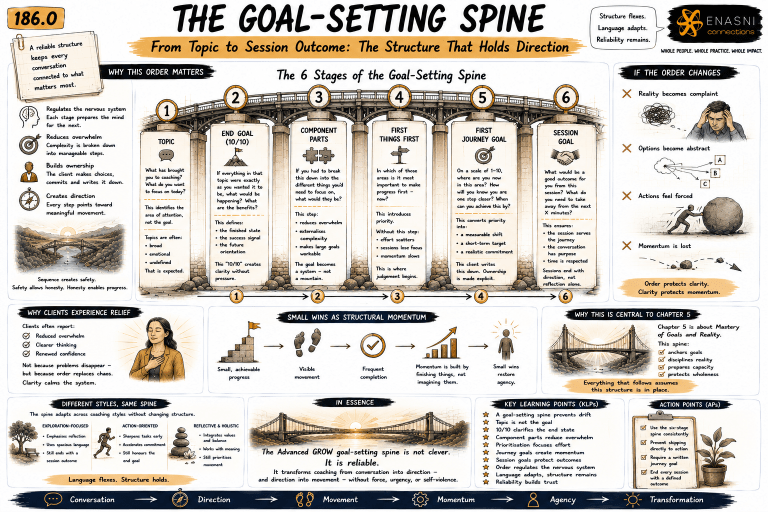
186.0 — The Goal-Setting Spine
From Topic to Session Outcome: The Structure That Holds Direction
Goal-setting requires structure because intention is far removed from traction on its own, and especially because without a clear sequence, coaching conversations drift, fragment, or collapse back into discussion.
This post sets out the Advanced GROW Goal-Setting Spine — the repeatable structure that moves a client from topic, to clarity, to prioritisation, to action — and shows how different coaching styles adapt the same spine without breaking it from a wholeness perspective.
-
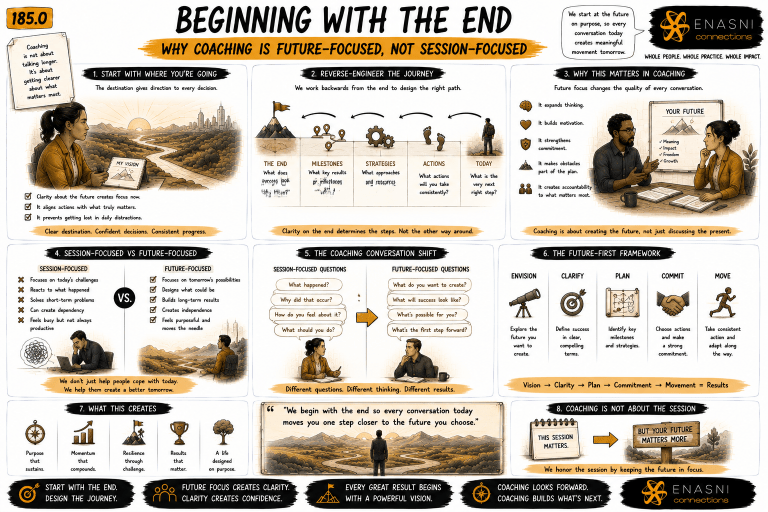
185.0 — Beginning With the End
Why Coaching Is Future-Focused, Not Session-Focused
Coaching effectiveness depends on direction because presence is far removed from progress on its own, and especially because clients leave sessions changed only when the future is actively shaped rather than merely explored.
This post clarifies why coaching begins with the end in mind, how journey goals and stepping stones operate within sessions, and why confusing session focus with future focus quietly undermines outcomes from a wholeness perspective.
-
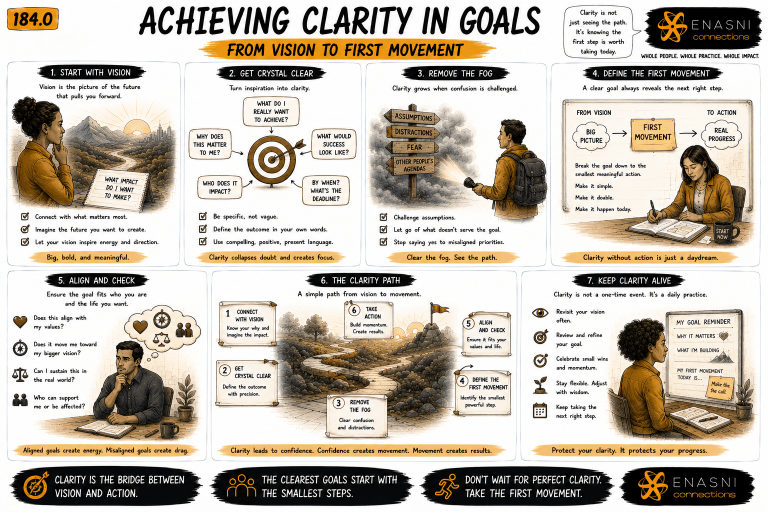
184.0 — Achieving Clarity in Goals
From Vision to First Movement
Clarity matters because motivation is far removed from progress on its own, and especially because without clarity, effort disperses, confidence erodes, and even meaningful goals begin to feel heavy rather than energising.
This post explores how coaches support clients to achieve clarity in goals by visualising outcomes, breaking complexity into manageable parts, and translating ambition into the first achievable movement — not through pressure, but through structure and sequence from a wholeness perspective.
-
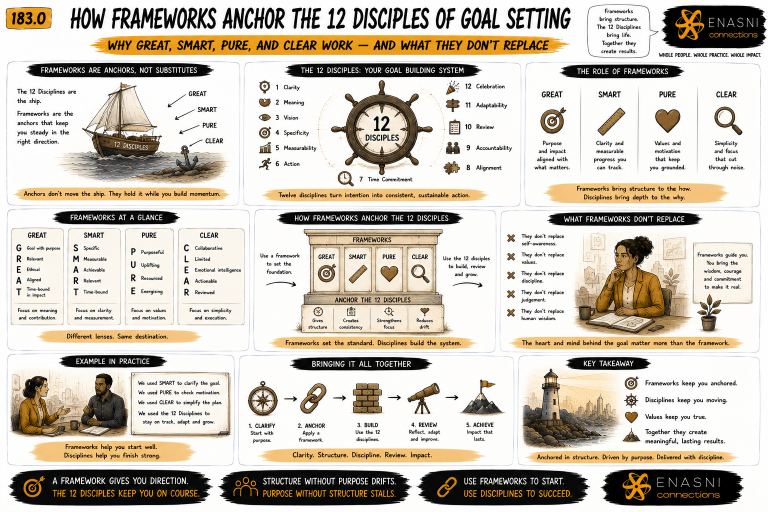
183.0 — How Frameworks Anchor the 12 Disciples of Goal Setting
Why GREAT, SMART, PURE, and CLEAR Work — and What They Don’t Replace
Frameworks matter because simplicity is far removed from sufficiency on its own, and especially because clients need accessible entry points into disciplined goal work without losing depth, ethics, or sustainability.
This post explores how popular goal-setting frameworks — GREAT, SMART, PURE, and CLEAR — anchor and activate the 12 Disciples of Goal Setting, and how coaches can use them skillfully without mistaking the map for the territory from a wholeness perspective.
-
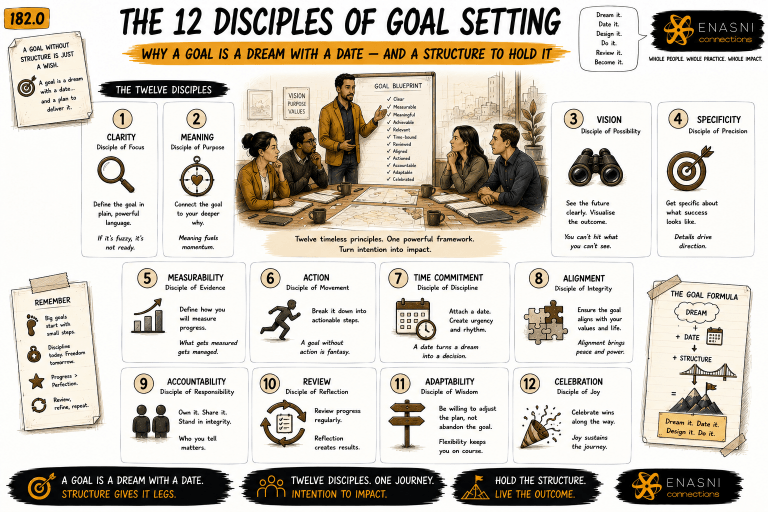
182.0 — The 12 Disciples of Goal Setting
Why a Goal Is a Dream With a Date — and a Structure to Hold It
Goal setting matters because ambition is far removed from achievement on its own, and especially because without structure, goals remain fantasies rather than forces that organise behaviour, attention, and energy.
This post sets out the 12 Disciples of Goal Setting — not as inspiration, but as a disciplined process that transforms intention into direction, and direction into sustained movement from a wholeness perspective.
-
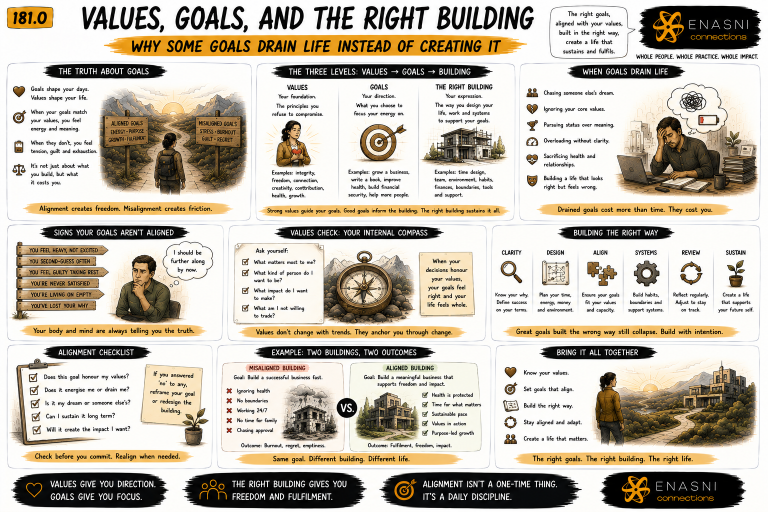
181.0 — Values, Goals, and the Right Building
Why Some Goals Drain Life Instead of Creating It
Goals matter because effort is far removed from fulfilment on its own, and especially because goals that are misaligned with values quietly create exhaustion, conflict, and inner fracture rather than progress.
This post explores why values must precede goal-setting, how coaching exposes hidden misalignment, and why many people struggle not because they lack discipline, but because their ladder of success is leaning against the wrong building from a wholeness perspective.