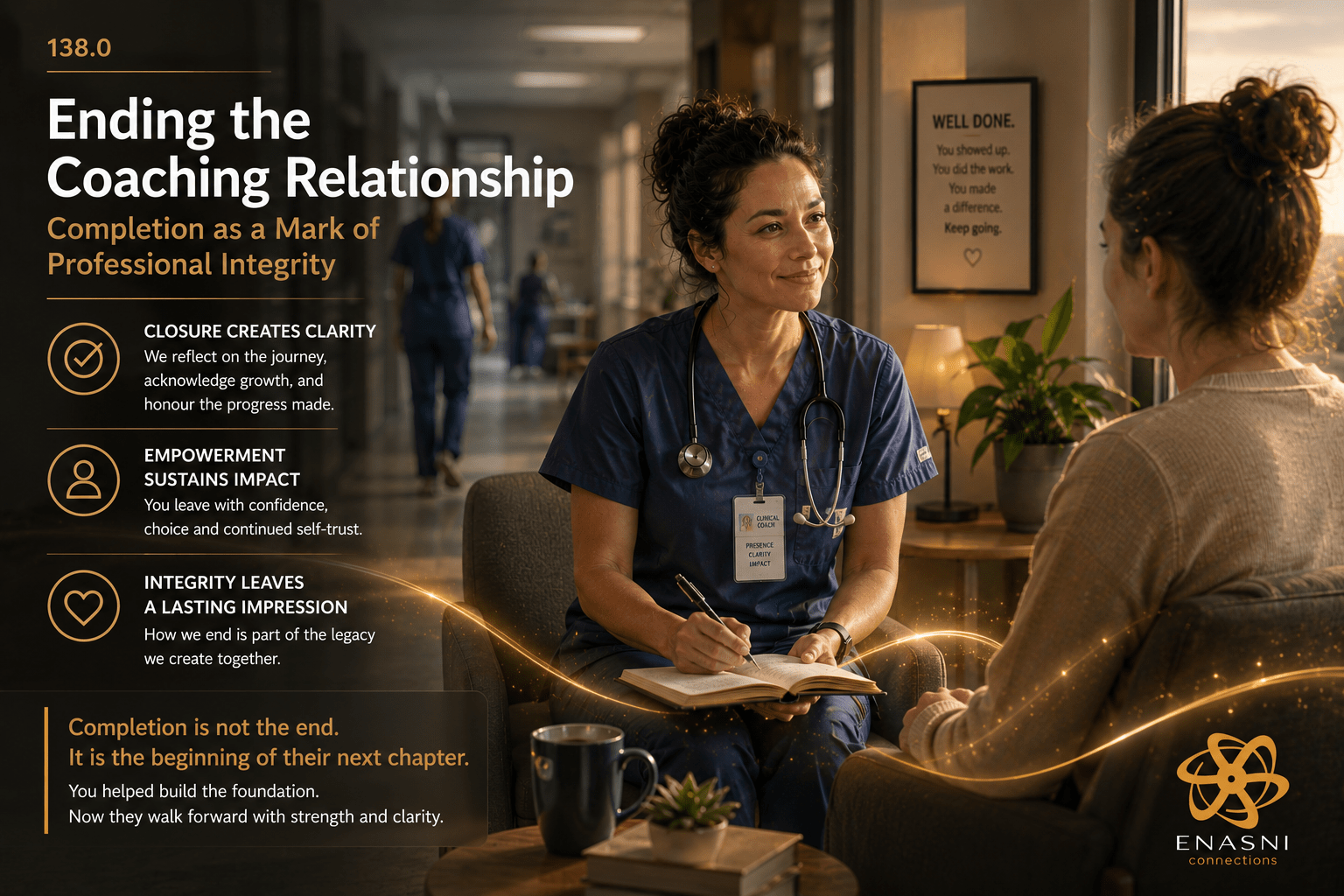
Completion as a Mark of Professional Integrity
Ending a coaching relationship matters because continuation is far removed from care on its own, and especially because how coaching ends often determines whether the work integrates or unravels.
This post clarifies how to end coaching relationships cleanly, ethically, and humanely — whether through planned completion or early termination — and why endings must be designed, discussed, and honoured rather than avoided from a wholeness perspective.
Endings Begin at the Intake
Ethical endings do not start at the end.
They bud at the very first interaction and mature by the intake session.
A simple but powerful question asked early:
How would you like us to end the coaching relationship?
This does several things:
- normalises completion
- removes awkwardness later
- reinforces client agency
- frames coaching as time-bound, not indefinite
Some clients want:
- a final recap and review session
- a clear pause point
- the option to return later
There is no correct answer.
What matters is asking.
Why Coaches Avoid Ending Conversations
Endings are often avoided because they trigger:
- discomfort
- fear of rejection
- identity attachment
- concern about appearing uncaring
Avoidance leads to:
- ghosting
- emotional drift
- ethical ambiguity
Clarity is kinder than continuation without alignment.
Planned Endings: Closing Well
When coaching reaches its natural conclusion:
- goals have been met
- clarity has stabilised
- momentum is self-sustaining
A planned ending might include:
- reviewing progress
- naming what has changed
- reinforcing client capability
- discussing how insights will be carried forward
Ending well affirms autonomy.
It says: you can continue without me.
Unplanned Endings: When Coaching Is No Longer Right
Sometimes coaching must end early.
This may occur when:
- alignment dissolves
- readiness changes
- capacity reduces
- the work moves outside coaching scope
One lived example involved ending a coaching relationship without a signed agreement, which allowed a clear, compassionate email outlining:
- why the fit no longer felt right
- observable reasons (A, B, C, D)
- care and concern for the client
- availability for support during transition
Importantly:
- no diagnosis was made
- no direction was imposed
- no suggestions were given about what the client “should” do
The message was simple:
This doesn’t feel like the right support for you at this moment .
This is professionalism, not abandonment.
Offering Support Without Overstepping
Ending ethically may include:
- offering reflective questions
- signposting support pathways
- holding a transition conversation
It does not include:
- rescuing
- fixing
- continuing unpaid emotional labour
- directing the client’s next steps
Support respects boundaries.
The Penultimate Session Matters
A useful practice is revisiting endings in the penultimate session:
How would you like us to close the relationship?
This:
- avoids abrupt endings
- gives emotional and cognitive space
- allows intentional completion
If the client plans to return later, the ending can still be honoured as complete for now.
Completion does not prevent reconnection.
Endings Preserve Dignity
A clean ending:
- protects the client’s dignity
- protects the coach’s integrity
- reinforces professional identity
- prevents dependency
Dragging on out of politeness is not kindness.
Clarity is.
In Essence
Ending a coaching relationship is not failure.
It is a sign the work has:
- completed
- changed shape
- or requires something different
Wholeness in coaching includes knowing when to stay — and when to step back.
Endings done well allow growth to continue without you.
Key Learning Points (KLPs)
- Endings should be discussed at intake
- Avoidance creates ethical drift
- Planned endings support integration
- Early termination can be ethical
- Support does not mean overstepping
- Penultimate sessions prepare closure
- Completion preserves dignity
Action Points (APs)
- Introduce the ending conversation early
- Revisit closure preferences near the end
- Practise writing clear, compassionate ending communications
Keywords
ending coaching relationship, coaching closure, ethical coaching endings, applied wholeness coaching, terminating coaching ethically, professional coaching boundaries, client transition support, Enasni Connections