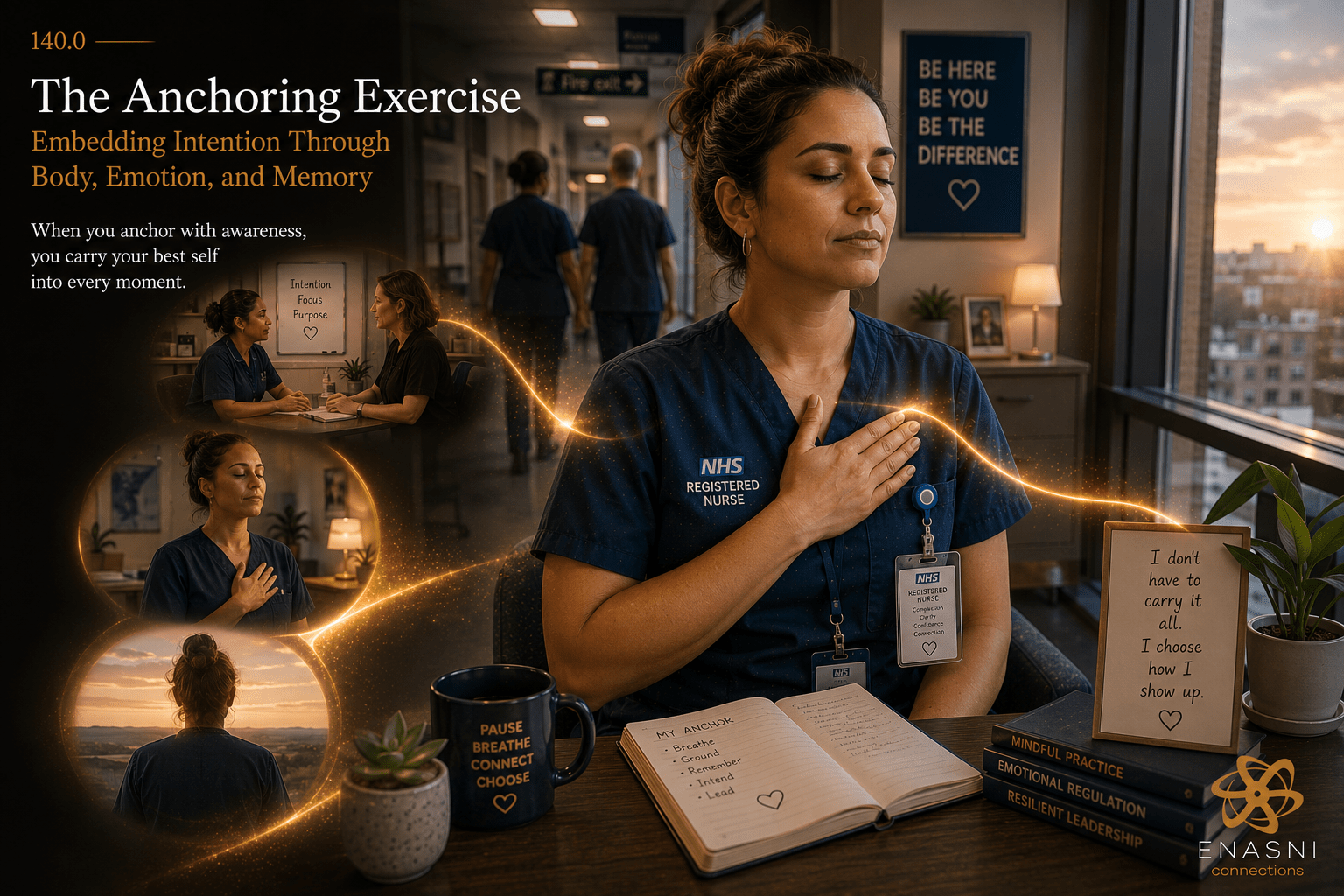
Embedding Intention Through Body, Emotion, and Memory
Anchoring matters because insight is far removed from embodiment on its own, and especially because change stabilises when intention is linked to felt experience rather than abstract thought.
This post clarifies how anchoring exercises work in coaching, how to use them responsibly, and how emotion, movement, and imagery can reinforce commitment without coercion from a wholeness perspective.
What Anchoring Actually Is
Anchoring is the process of:
- linking a desired state
- to a physical action
- paired with emotion and attention
The nervous system learns through association.
When a state is paired repeatedly with movement and feeling, recall becomes easier.
Anchoring is not motivation.
It is memory design.
Why the Body Must Be Involved
Cognition alone is fragile.
The body:
- remembers intensity
- responds to movement
- encodes emotion
By increasing heart rate, posture, and breath, anchoring:
- deepens recall
- increases salience
- reinforces meaning
The body becomes an ally rather than an afterthought.
A Simple Anchoring Sequence
The anchoring process may include:
- visualising a clear goal
- generating positive emotional charge
- engaging the body through movement
- pairing the moment with a distinct physical action
Examples include:
- jumping or stretching
- raising arms overhead
- clapping hands together
The exact movement matters less than the felt association.
Emotion as the Binding Agent
Emotion binds memory.
Positive emotion:
- reinforces approach behaviour
- reduces hesitation
- increases confidence
Statements such as:
- “Yes”
- celebratory exclamations
- affirming language
amplify the emotional signal.
The aim is not volume.
It is authentic intensity .
Choice and Consent Are Essential
Anchoring exercises must always be:
- optional
- invitational
- adapted to physical capacity
If high-energy movement is not suitable, alternatives include:
- seated movement
- breath-led gestures
- visualisation without physical exertion
Safety overrides enthusiasm.
Anchoring Is Not Performance
Anchoring is not about:
- forcing positivity
- bypassing difficulty
- pretending confidence exists
It works only when:
- the goal is genuinely meaningful
- the emotion is real
- the client consents fully
Artificial enthusiasm weakens the anchor.
When Anchoring Is Most Useful
Anchoring supports:
- commitment to action
- confidence before challenging steps
- recall of motivation during difficulty
It is most effective when paired with:
- clear goals
- realistic actions
- ongoing reflection
Anchoring reinforces — it does not replace — thoughtful planning.
Integrating Anchoring Into Coaching
Anchoring works best when:
- introduced with explanation
- followed by reflection
- revisited intentionally
The coach may ask:
- When might you need to recall this feeling?
- What cue will remind you of it?
This integrates anchor into lived context.
In Essence
Anchoring connects intention to experience.
When used with consent, clarity, and care, it helps the nervous system remember what matters — not as an idea, but as a felt truth.
Energy becomes accessible on demand.
Key Learning Points (KLPs)
- Anchoring links intention to felt experience
- The body strengthens memory encoding
- Emotion binds recall
- Consent and choice are essential
- Anchoring is optional, not universal
- Authenticity matters more than intensity
- Anchors support action, not avoidance
Action Points (APs)
- Introduce anchoring as an optional tool
- Adapt movement to client capacity
- Pair anchors with specific future actions
Keywords
anchoring exercise coaching, embodied coaching techniques, applied wholeness coaching, nervous system learning, goal embodiment, emotional anchoring, coaching tools awareness, Enasni Connections