

The landscape of human support is vast and layered. Each discipline — from counselling to coaching — carries its own philosophy, intention, and language. At first glance, they may appear similar. In truth, the distinctions lie in perspective, aim, technique, and the precision of word play that gives each its character.
From a wholeness perspective, this post answers the question: how does coaching differ from other support disciplines?
How Does Coaching Differ From Other Support Disciplines in Practice?
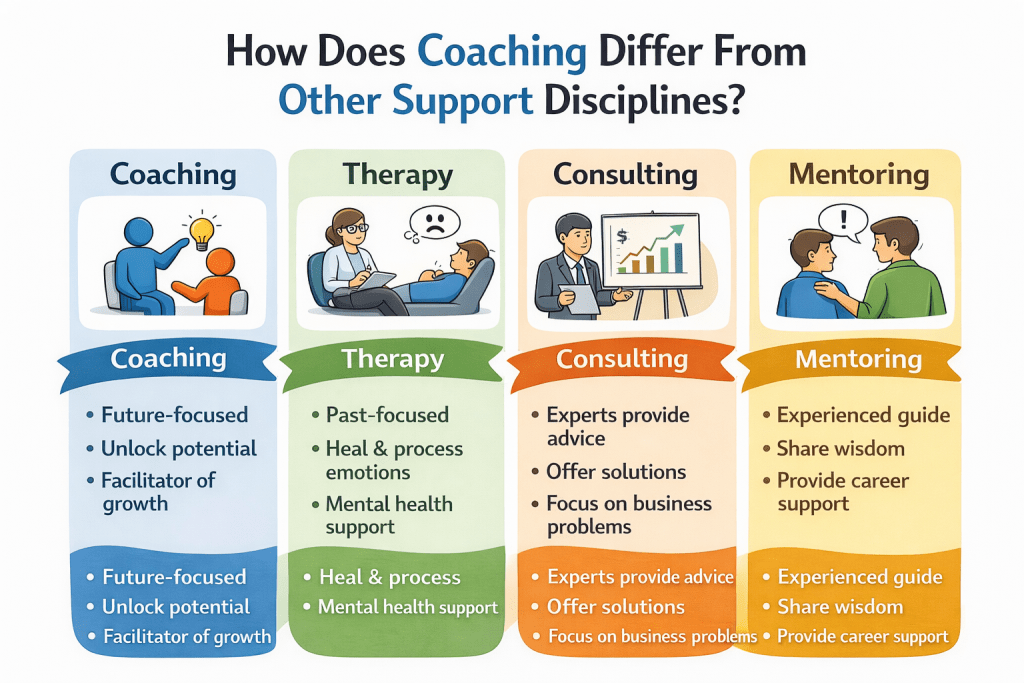
The Core Differences – To understand how does coaching differ from other support disciplines, we must examine intention, structure, and outcome.
Counselling – Works with humans who experience significant levels of distress that impact their daily activities in life.
Therapy – Works with humans who carry damage and dysfunction in significant amounts sufficient to interrupt the flow of daily activities in life.
Mentoring – Works with humans who seek direction from another human who has the experience and knowledge travelling the same journey.
Consultant – Works with humans who need diagnosis of a problem ahead as well as the solution(s) to that problem. More often than not this consultant also has what it takes to execute the solution.
Trainer – Works with humans who need to up-skill in any particular role.
Coach – Works with humans who desire to move forward in life and achieve their ambitions. Read blog post What is Coaching? for greater detail.
Clarity on how does coaching differ from other support disciplines supports intentional choice and aligned engagement.
The Driving Metaphor
The central question remains: how does coaching differ from other support disciplines? Sometimes, words become clearer through imagery. Imagine life as the journey, and the car as the human driving experience:
Counselling – listens to the human’s concerns and anxieties about driving the car and offers techniques to manage those anxieties and concerns.
Therapy – listens to the human uncover their past to decipher what type of dysfunction and/or damage is stopping them from driving the car.
Mentoring – listens to the human’s experience and knowledge about driving the car and offers them tips and hints from their own experience and knowledge about driving cars.
Consultant – listens the human express their inability to drive the car and identifies what is wrong as well as, gives clear logical solutions through practical intervention(s) or verbal advice on how to drive that car!
Trainer – observes and listens to the client driving the car and provides them specific skill training on identified gaps in driving skill set – e.g braking properly or accelerating properly.
Coach – listens to the client talk about where they would like to be in life when it comes to driving cars, and provides insights, asks questions, and challenges them thus helping them become the best driver they wish to be.
The Shared Ground
Though distinct, these disciplines share many of the same foundations.
They all:
- Enter confidential relationships.
- Build rapport.
- Use effective questioning.
- Use active +/- global listening.
- Enable the client to make progress.
The differences emerge in how these elements are applied. The act of entering a confidential relationship, for instance, holds a different depth and intent in therapy than in training, a different rhythm in coaching than in consulting.
How Does Coaching Differ From Therapy?
TThough distinct, coaching and therapy share many foundational elements.
They both:
- Enter confidential relationships.
- Build professional rapport.
- Use structured questioning.
- Apply active and reflective listening.
- Support individual progress.
The differences emerge in how these elements are applied. Confidentiality in therapy often holds clinical and legal depth, shaped by diagnostic responsibility and safeguarding frameworks. In coaching, confidentiality supports reflection and forward movement rather than treatment.
The intent also differs. Therapy frequently addresses healing, trauma, and emotional processing rooted in past experiences. Coaching focuses on clarity, direction, and measurable goals oriented toward the future.
The practitioner’s role shifts accordingly. A therapist may diagnose, treat, and intervene clinically. A coach does not diagnose or treat; instead, the coach facilitates structured thinking that enables clients to generate their own solutions.
The rhythm of sessions differs as well. Therapy may move at the pace of emotional integration. Coaching typically moves at the pace of decision-making and action.
Understanding how does coaching differ from other support disciplines becomes clearer when observing these applied distinctions rather than surface similarities.
Professional therapy bodies such as the British Association for Counselling and Psychotherapy (BACP) outline clear clinical standards and ethical frameworks for therapeutic practice.
Understanding how does coaching differ from other support disciplines becomes clearer when observing these applied distinctions rather than surface similarities.
How Does Coaching Differ From Mentoring?
Though distinct, coaching and mentoring share several overlapping foundations.
They both:
- Enter professional development relationships.
- Build trust over time.
- Use questioning and reflective dialogue.
- Encourage learning and growth.
- Support progress toward defined outcomes.
The differences emerge in how these elements are applied. Mentoring is typically experience-led. The mentor draws from personal career history, offering guidance, advice, and industry insight based on lived expertise. Coaching does not rely on the coach’s experience as the primary tool.
In mentoring, direction often flows from mentor to mentee. In coaching, direction is generated by the client. The coach facilitates structured thinking rather than providing answers.
Mentoring relationships frequently form within organisational or career pathways. Coaching can occur across personal, professional, and executive contexts without requiring subject-matter expertise from the coach.
Professional mentoring bodies such as the European Mentoring and Coaching Council (EMCC) outline competency frameworks that distinguish mentoring from coaching practice.
Understanding how does coaching differ from other support disciplines becomes clearer when recognising that mentoring transfers experience, whereas coaching activates independent thinking.
How Does Coaching Differ From Consulting?
Though distinct, coaching and consulting share several professional foundations.
They both:
- Enter structured professional engagements.
- Clarify problems and desired outcomes.
- Use analytical thinking.
- Work toward measurable progress.
- Support performance improvement.
The differences emerge in how these elements are applied. Consulting is expertise-driven. The consultant is engaged specifically for specialised knowledge, diagnosis, and recommended solutions. The consultant analyses the problem and provides expert guidance or implementation strategies.
Coaching, by contrast, is facilitation-driven. The coach does not position themselves as the subject-matter expert. Instead, coaching assumes the client holds the insight and capability to generate solutions, with the coach guiding structured reflection and accountability.
In consulting, the responsibility for recommendations lies with the consultant. In coaching, responsibility for direction and action remains with the client.
Professional bodies such as the Chartered Management Institute (CMI) outline consulting standards and competencies that emphasise expertise and advisory functions.
Understanding how does coaching differ from other support disciplines becomes clearer when observing that consulting delivers expert answers, whereas coaching develops independent decision-making capacity.
How Does Coaching Differ From Counselling?
Though distinct, coaching and counselling share several relational foundations.
They both:
Enter confidential and professional relationships.
Build trust and emotional safety.
Use structured questioning.
Apply active and reflective listening.
Support personal development and change.
The differences emerge in how these elements are applied. Counselling often focuses on emotional processing, mental health concerns, and navigating personal challenges rooted in past or present experiences. It may involve therapeutic techniques and is frequently guided by clinical or accredited professional standards.
Coaching, by contrast, is forward-focused and goal-oriented. Rather than exploring emotional distress in depth, coaching centres on clarity, decision-making, accountability, and measurable progress toward defined outcomes.
The practitioner’s role also differs. A counsellor may explore emotional patterns, coping strategies, and psychological wellbeing. A coach does not diagnose or treat; instead, the coach facilitates structured thinking that enables the client to define direction and action independently.
Professional counselling bodies such as the British Association for Counselling and Psychotherapy (BACP) provide frameworks that distinguish counselling practice from coaching methodologies.
Understanding how does coaching differ from other support disciplines becomes clearer when observing that counselling supports emotional processing, whereas coaching supports intentional forward movement.
How Does Coaching Differ From Training?
Though distinct, coaching and training share several performance-oriented foundations.
They both:
Aim to improve capability.
Operate within structured timeframes.
Clarify objectives and outcomes.
Support measurable progress.
Encourage skill development.
The differences emerge in how these elements are applied. Training is content-driven. The trainer delivers predefined knowledge, skills, or competencies based on an established curriculum. The flow of information typically moves from trainer to participant.
Coaching, by contrast, is insight-driven rather than content-driven. The coach does not deliver a fixed syllabus. Instead, coaching adapts to the client’s context, helping them generate clarity, identify obstacles, and design forward action aligned with personal or professional goals.
Training standardises knowledge across groups. Coaching individualises reflection and accountability.
Professional training frameworks, such as those outlined by the Chartered Institute of Personnel and Development (CIPD), emphasise structured learning and competency development within organisational settings.
Understanding how does coaching differ from other support disciplines becomes clearer when observing that training delivers information, whereas coaching activates internal decision-making capacity.
In Essence
Each path serves the human story from a unique vantage point. Coaching, in particular, thrives in the present and leans toward the future — a collaborative exploration of possibility. It assumes wholeness rather than seeking repair.
At Enasni, we see these disciplines as more than competitors, and as companions in the broader ecosystem of human development. Each has its place. Each serves a purpose. Development and Improvement benefits from all.