


Where Did Coaching Come From?
The question where did coaching come from? is more than historical curiosity. It reflects a deeper shift in how human development evolved across modern civilisation. continues to surface across disciplines, especially as coaching grows in professional credibility.
United States of America
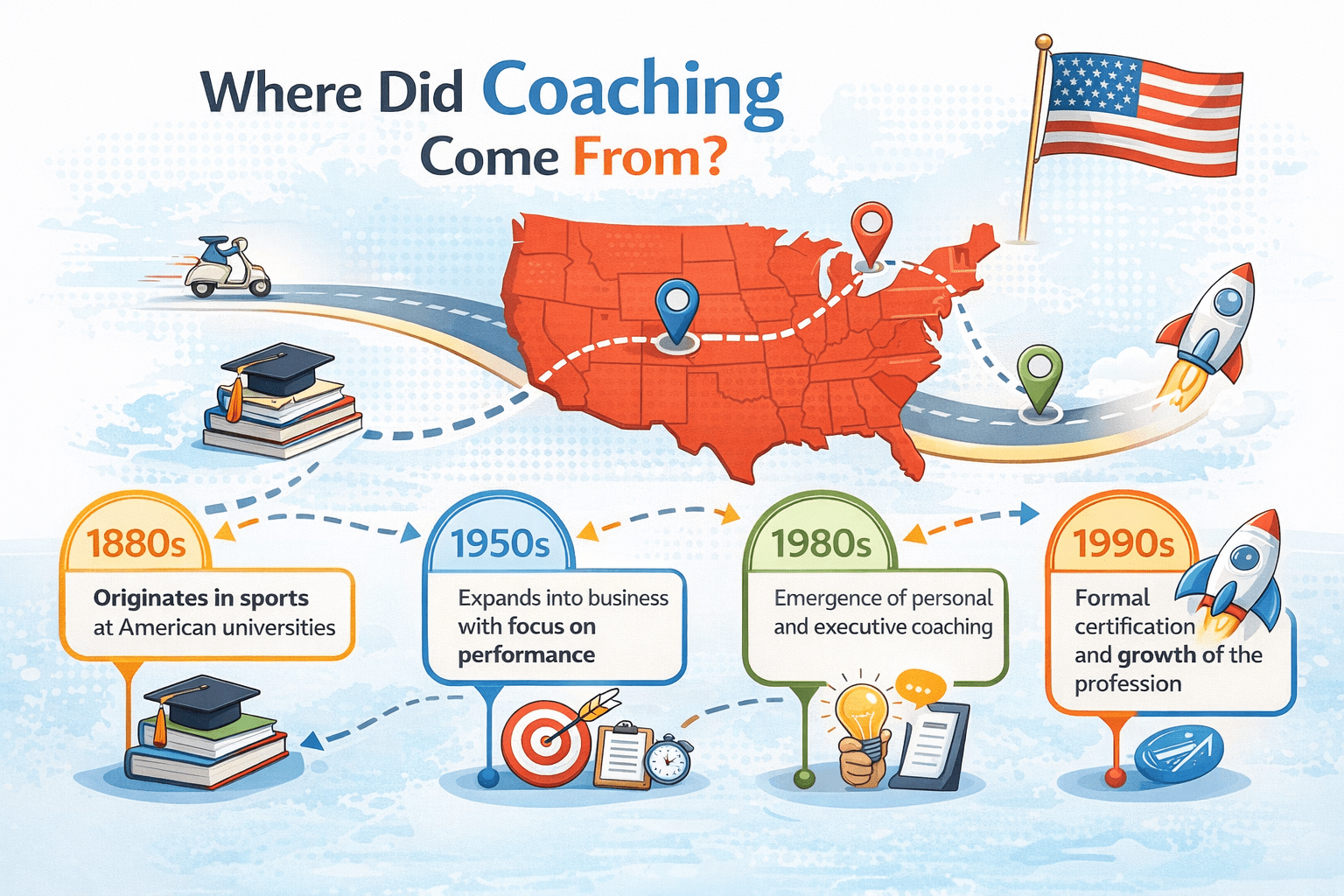
The Origins of Coaching in Modern Civilisations
As we ask where did coaching come from, the answer requires looking beyond one discipline. Coaching failed to appear suddenly; it evolved through cultural, psychological, and professional shifts over time.
Understanding where coaching came from means recognising the intersection between early self-development movements and changing societal expectations about personal responsibility and growth.
Personal development and improvement self-help techniques across the sports and medical industries evolved and merged in a variety of ways to form coaching as we know it today.
As communication became more modern, a demand in the professional market was born, asking for safe spaces for the human to openly express itself.
This demand was essentially the same demand we have today among healthcare professionals; the need for the individual to talk through issues and address the challenges faced in achieving the goal ahead.
Where Did Coaching Come From Before It Became Professional?
Historically, the societal unit of the family and local communities provided necessary support structures humans relied on to achieve goals.
To understand where coaching came from, we must examine the social and psychological systems that preceded it. By the 1930s, books on self-help boomed and became popularised.
Therapy, which was already in full swing, began expanding by focusing on specific conditions and medical specialties.
The difference between therapy and coaching is explored in greater detail in our article How Coaching Differs From Other Support Disciplines
This increased focus, led to increased dependency on service providers.
How Coaching Evolved Into a Professional Discipline
By the 1980s, personal development became broad, focusing on life itself as a whole rather than parts and embracing a holistic mindset.
This period marked a defining moment in answering the question of where coaching came from as a profession rather than a philosophy.
This also coincided with a rise in significant shifts within societies globally; fragmented family units, rising divorce rates between coupled humans, and growing wellbeing and wellness awareness across humanity.
All these shifts, forced therapists to re-evaluate their approach to client work.
Within a decade, aka, by the 1990s, coaching emerged like a newborn messiah baby, distinct in its practices, guiding its clients, who seek personal growth and fulfilment, through a safe process where at the end they see their desired goals and outcomes achieved.
What Coaching Means Today
Today, when reflecting on where coaching came from, it becomes clear that structured frameworks and reflective dialogue combined to form a modern discipline built on clarity and forward momentum.
In the end, what began as a response to medicalised and heavily structured approaches gradually transformed into a process where patients became clients. The focus shifted from diagnosis and treatment toward reflection, ownership, and forward movement.
Rather than positioning the individual as someone to be fixed, coaching began positioning the individual as someone capable of designing outcomes.
As coaching matured, this shift required structure — but not the clinical kind. A different form of structure emerged: one that supported clarity without control.
Frameworks such as the GROW Model provided a repeatable yet flexible pathway, guiding clients through defining Goals, examining current Reality, exploring Options, and committing to a Way Forward.
This structured methodology allowed coaching to become a professional discipline while preserving autonomy, agency, and forward-focused development.
Modern coaching as defined today is explored in detail in our article on What Is Coaching?
The focus in the coaching world morphed into creating a successful and fulfilled individual.
The journey explains not only where coaching came from, but why it continues to evolve as a structured, growth-oriented practice.
And, that is where coaching came from!
Key Takeaways (KTs)
- Coaching as a professional practice originated in the U.S.A, evolving from personal development and self-help techniques.
- The rising trajectory of modern comms, creates the demand for safe spaces where an individual human can openly express their whole self safely.
- Self-help books gained popularity in the 1930s, encouraging therapy as a practice to become more specialised, which unfortunately increased reliance on self providers.
- By the 1980s, holistic mindsets began sprouting globally, broadening personal development beyond the specificity of medical challenges.
- Coaching became distinct as a practice in the late 1980s, responding to societal shifts such as divorce frequencies, family fragmentation, heightened wellbeing focus.
- Coaching addresses life situations holistically, focusing on the individual’s overall success and fulfilment through present and future actions rather than their past.
- Coaching transformed therapy by shifting the focus from patient treatment to helping clients achieve personal growth and success.
- A key part of coaching is moving away from dependence on service providers to the empowerment of the individual human client to take control of their personal growth.
- Personal development and coaching came together to fill the gaps left behind by traditional community and family support systems, which became fragmented over time.
- Coaching today is now recognised as the primary delivery system for results that can have transformative impacts on human life.
Reader Action Points
Welcome To The Challenge Zone
- For every reader – How could you incorporate a holistic mindset into your day? (Come up with at least 10 options – no right or wrong)
- For the health professional – How could you focus yourself to take control of your personal growth, and reduce your dependence on a service provider this week?
- For coaches – How could you create a safe, open space for your clients to express themselves and work through their personal development goals?