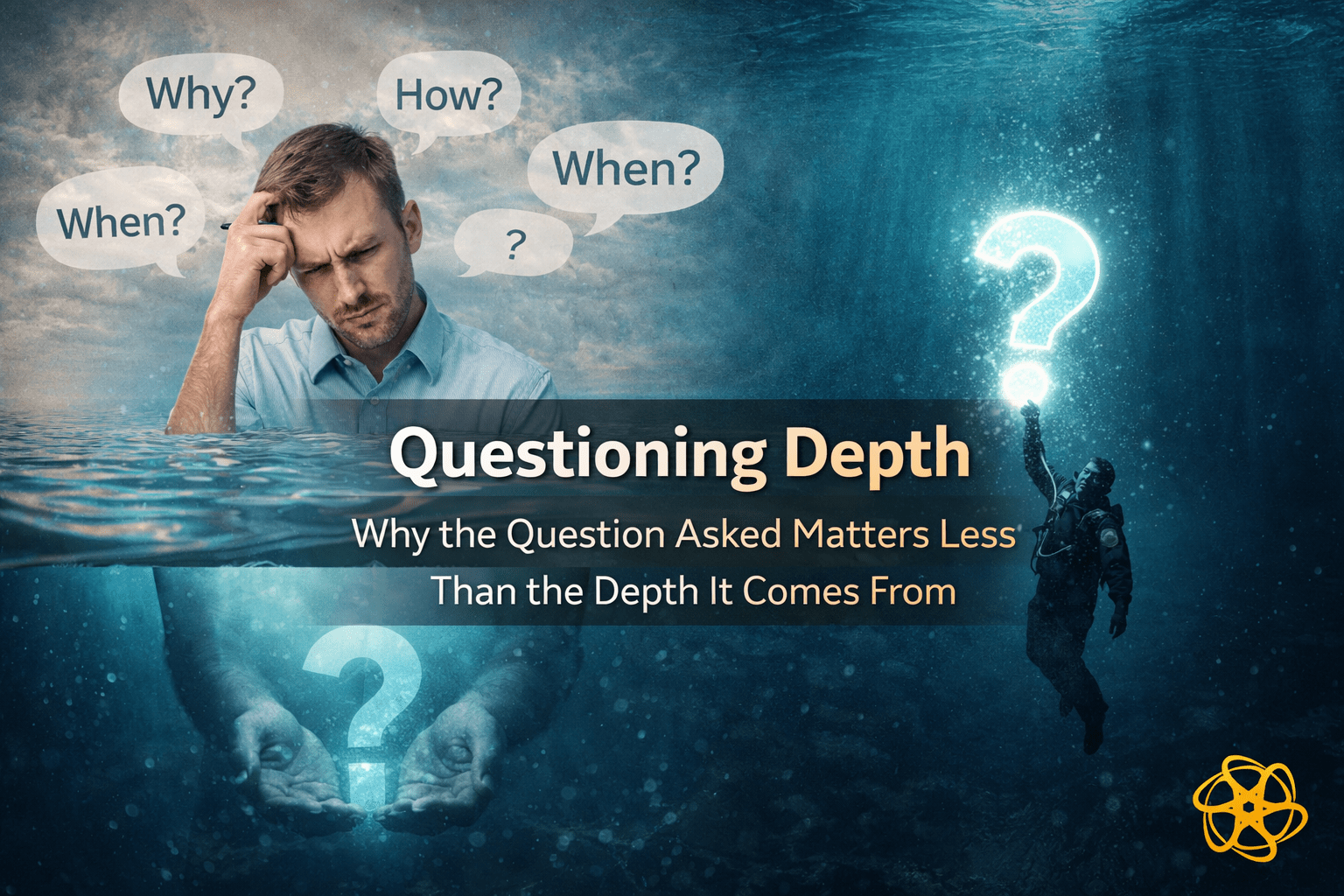
Why the Question Asked Matters Less Than the Depth It Comes From
Questioning depth matters because impact is far removed from clever phrasing, and especially because the depth of a question reflects the depth of listening behind it.
In coaching, questions are often treated as techniques to deploy. Lists are memorised. Frameworks are followed. Yet clients respond not to the structure of a question, but to the level of awareness from which it arises.
This post reframes questioning as an expression of presence rather than a method from a wholeness perspective.
1. Questions Are Not Neutral
Every question carries:
- an assumption
- a direction of attention
- a depth of perception
A surface-level question invites surface reflection.
A deeper question invites contact with meaning.
Depth shapes response.
2. Shallow Questions and Their Limits
Shallow questions tend to:
- focus on facts
- seek clarity
- move conversation forward quickly
Examples include:
- “What happened?”
- “What do you want to do next?”
These questions have value — but rarely create transformation.
They organise information, rather than identity.
3. Medium-Depth Questions: Pattern and Meaning
At this level, questions explore:
- patterns
- interpretations
- repeated outcomes
Examples include:
- “What do you notice about this pattern?”
- “What does this situation mean to you?”
These questions invite awareness and insight.
They begin to shift perspective.
4. Deep Questions: Identity and Choice
Deep questions touch:
- belief
- identity
- values
- permission
Examples include:
- “Who are you being when this happens?”
- “What feels at stake for you here?”
These questions slow time.
They invite reflection at the level where change stabilises.
5. Why Deep Questions Require Safety
Depth without safety overwhelms.
Deep questions misfire when:
- emotional charge is high
- regulation is low
- trust is insufficient
In these moments, depth feels invasive rather than supportive.
Judgement determines readiness.
6. Questioning Depth and Timing
Effective coaches match question depth to:
- client capacity
- emotional state
- stage of exploration
Depth increases as safety stabilises.
Mastery lies in sequencing, instead of intensity.
7. When Questions Become Interventions
At sufficient depth, a question:
- interrupts automatic patterns
- creates insight
- invites agency
The question itself becomes the change point.
Nothing else is required.
8. From Technique to Attunement
Questioning mastery emerges when:
- listening leads
- curiosity replaces agenda
- depth follows readiness
The best questions are seldom prepared.
They arise.
In Essence
Powerful questions are not powerful because of wording.
They are powerful because of where they come from.
Coaching depth grows as questioning becomes an expression of presence rather than performance.
Key Learning Points (KLPs)
- Questions carry assumptions and direction
- Shallow questions organise information
- Medium-depth questions reveal patterns
- Deep questions engage identity and belief
- Safety determines usable depth
- Timing matters more than intensity
- Presence generates powerful questions
Action Points (APs)
- Notice the depth of questions being asked
- Match question depth to client capacity
- Let listening guide questioning
Keywords
questioning depth, coaching questions, applied wholeness, coaching judgement, powerful questions, presence in coaching, identity inquiry, Enasni Connections