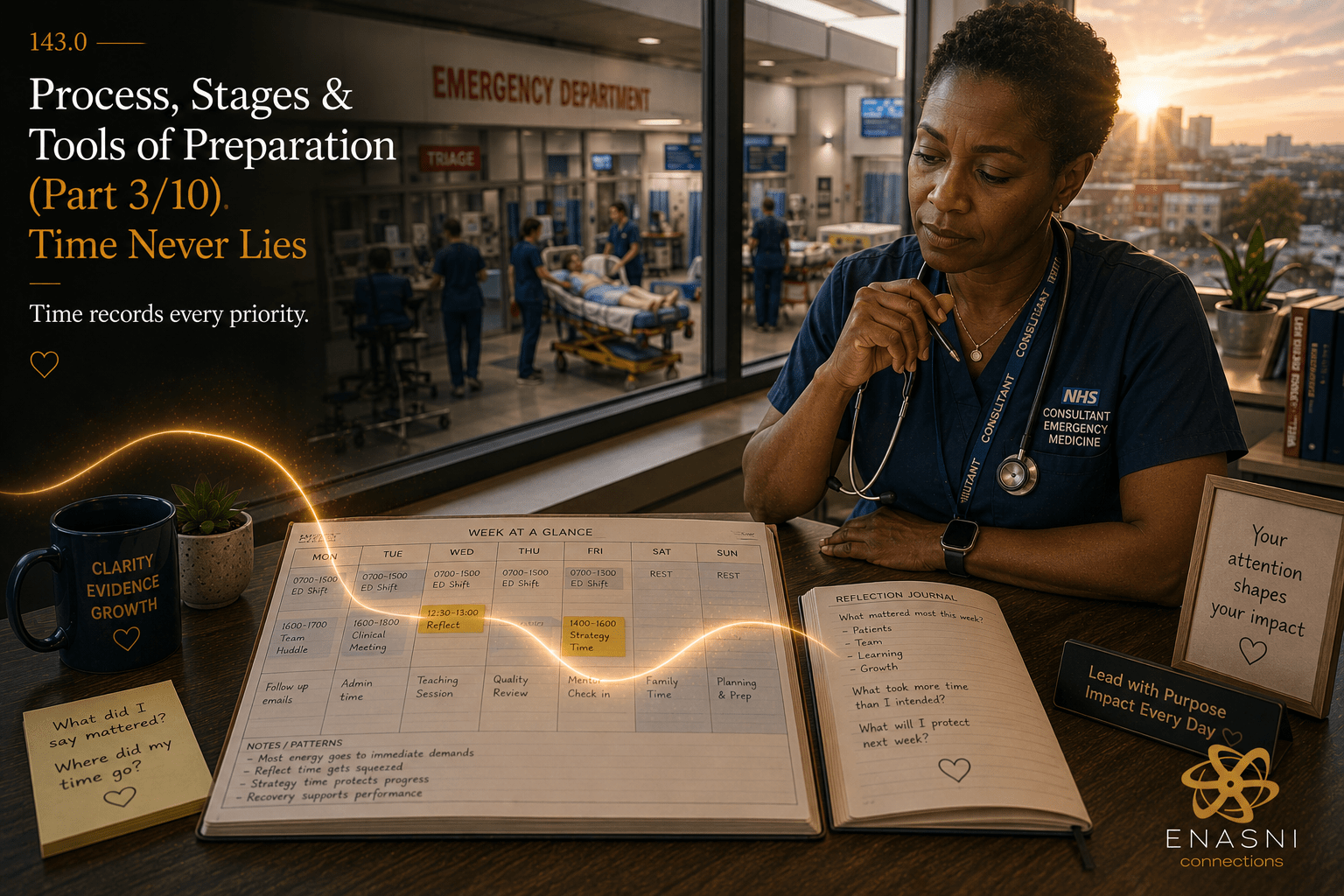
Time Never Lies
This stage of preparation matters because intention is far removed from behaviour on its own, and especially because how time is actually spent reveals priorities more accurately than what is said or hoped for.
This post clarifies the third preparation stage: using time awareness to surface unconscious priorities, wasted effort, and misaligned energy so preparation becomes grounded in reality rather than aspiration from a wholeness perspective.
Stage Three: How Time Is Really Spent
Every human receives the same daily allocation:
- 24 hours
- 1,440 minutes
- no extensions
- no exceptions
Time cannot be:
- negotiated
- borrowed
- saved
- replaced
Once spent, it is gone.
This exercise brings that fact into conscious awareness.
The 24-Hour Priorities Exercise
The invitation is simple — and confronting.
The client is asked to:
- think about a typical day or week
- list activities undertaken
- estimate hours and minutes spent on each
- ensure the total equals 24 hours
The constraint is the insight.
If the numbers do not add up, something is being avoided or underestimated.
Section A: How Time Is Spent at Work
Time is broken down beyond the headline label of “work”.
Examples include:
- travelling to and from work
- preparing for work
- tea, coffee, and lunch breaks
- looking for things
- doing tasks correctly
- correcting tasks done poorly
- work-related conversations
- non-work-related conversations
- meetings
- giving and receiving instructions
- preparing to leave work
What initially feels like “work” often fragments into dozens of hidden drains.
Awareness exposes where effort is being wasted.
Section B: How Time Is Spent in Leisure
Leisure is explored with equal honesty.
Activities may include:
- watching television
- reading
- hobbies
- exercise
- creative pursuits
- socialising (inside and outside the home)
- spiritual practice or faith
- meditation
- personal development
- health improvement
- family quality time
Leisure is not judged.
It is revealed.
Section C: How Time Is Spent on Personal Needs
Personal needs are often underestimated.
This section includes:
- washing and bathing
- hair, makeup, clothing
- dressing and undressing
- food preparation
- eating
- intimacy
- other personal activities
Time here matters.
It shapes energy, readiness, and capacity.
The Crucial Insight Step
Once each section is completed, the client is asked to:
- circle the two activities that take the longest in each section
These are not theoretical priorities.
They are lived priorities.
Time reveals what receives investment — regardless of declared values.
Reflective Questions That Matter
The exercise then moves into reflection:
- Which of the longest time blocks could be reduced?
- How could they be reduced realistically?
- Are the shortest time blocks adequate?
- Why or why not?
These questions invite choice, not shame.
Why This Exercise Is So Effective
This process:
- removes self-deception
- exposes invisible habits
- highlights misalignment
- grounds future planning
It often produces strong reactions.
That reaction is information.
From Awareness to Agency
Once time is seen clearly:
- priorities can be adjusted
- actions can be redesigned
- energy can be reclaimed
Change becomes practical rather than aspirational.
In Essence
Time tells the truth before words do.
When clients see how time is actually spent, preparation shifts from motivation to reality.
From there, choice becomes possible.
Key Learning Points (KLPs)
- Time allocation reveals real priorities
- Everyone has the same 24-hour limit
- “Work” and “leisure” hide many activities
- Personal needs significantly affect capacity
- Longest time blocks indicate unconscious priorities
- Reflection creates choice, not judgement
- Awareness precedes effective change
Action Points (APs)
- Complete a full 24-hour time breakdown
- Ensure totals equal 24 hours exactly
- Identify and reflect on the longest time blocks
Keywords
24 hour priorities exercise, time awareness coaching, preparation stage three coaching, applied wholeness coaching, energy management, behavioural awareness, coaching preparation tools, Enasni Connections