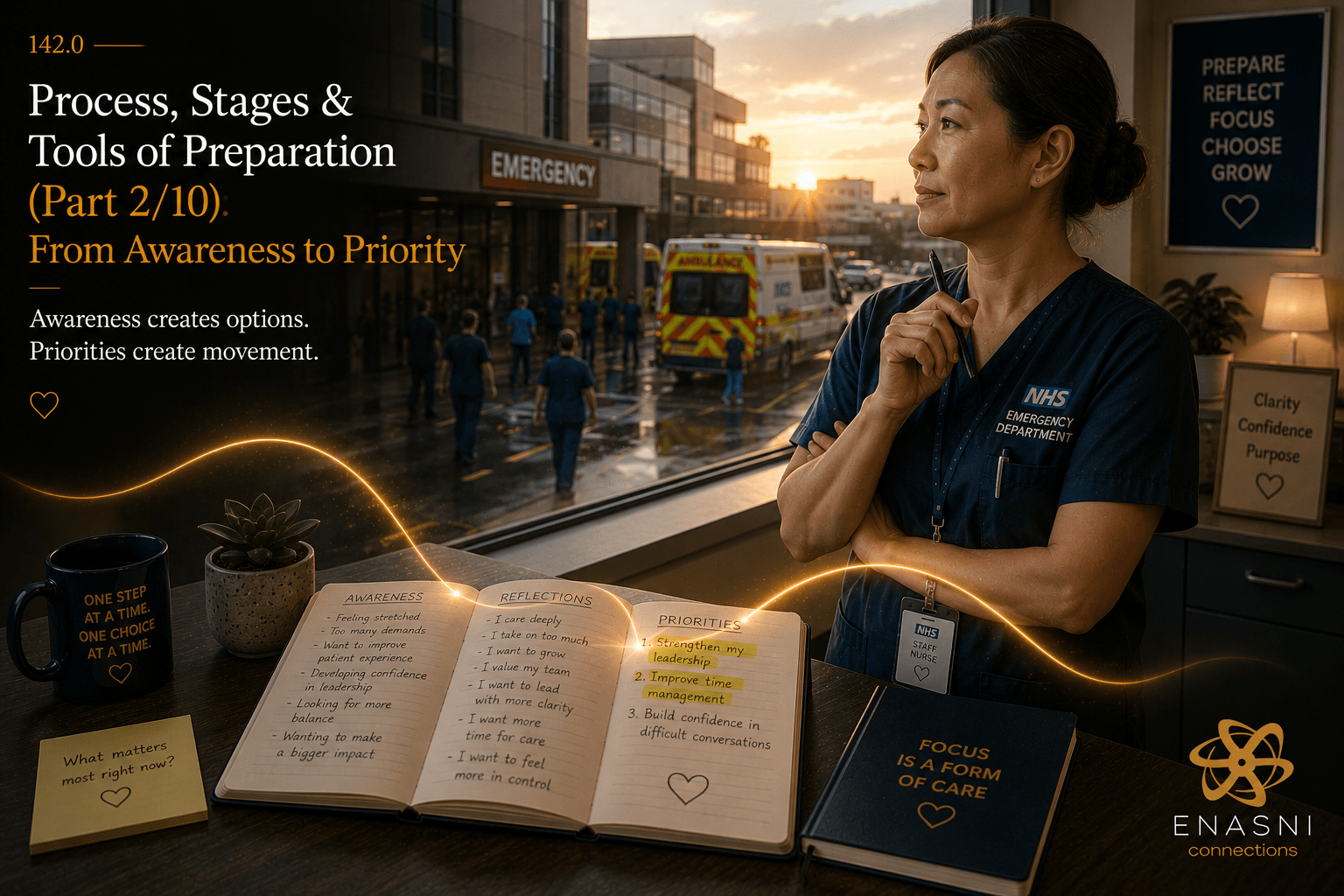
From Awareness to Priority
Preparation deepens at this stage because awareness is far removed from movement on its own, and especially because clarity only converts into change once priorities are consciously chosen rather than mentally held.
This post clarifies the second stage of preparation: how clients move from broad awareness into prioritised focus and committed action, using simple questions, visible reminders, and precise choice-making from a wholeness perspective.
Stage Two: Considering Priorities
Once reflection has begun, the next task is prioritisation.
Not everything can be done at once.
This stage invites the client to sort signal from noise and decide what truly matters now — not someday.
Priority-Framing Questions
The following questions are used to stimulate honest evaluation and perspective-shifting :
- What needs less attention right now?
- What needs more attention?
- Where would I like to spend more time?
- Where would I like to spend less time?
- What is missing in my work life that should be there?
- What is missing in my leisure life that should be there?
- Would my colleagues agree with how I see this?
- Would my family agree?
- What is most important to me right now?
- If there were no limits, what would I choose?
These questions are not analysed.
They are answered quickly and honestly, allowing patterns to surface.
Choosing Three — and Only Three
From the answers, the client selects:
- First priority
- Second priority
- Third priority
Ordered by importance.
Not urgency.
Not pressure.
Importance.
Limiting to three creates focus without overwhelm.
Making Priorities Visible
Each priority is then written out clearly and placed where it will be seen regularly:
- car
- wallet
- desk drawer
- locker
- mirror
- phone case
Visibility keeps intention alive.
What stays hidden fades.
Action Converts Priority Into Reality
Priorities alone change nothing.
Action is required.
A guiding principle applies:
If you do what you have always done, you will get what you have always got.
Change requires new behaviour, not better intention.
Designing Action (Could vs Will)
For each priority, the client identifies:
- Three actions they could take in the next seven days
- One action they will take
This distinction matters.
“Could” expands possibility.
“Will” establishes commitment.
Specificity is essential.
Vague actions produce vague results.
Outcome Over Activity
The focus is not on effort.
It is on outcome.
The question is not:
- Did I do something?
But:
- Did what I did improve the situation?
Reflection after action matters as much as the action itself.
Why This Works Over Time
Returning to this exercise weeks or months later often reveals:
- actions already completed
- priorities already integrated
- change already in motion
This builds confidence grounded in evidence.
The work does not need repeating.
It needs refreshing.
From Personal Practice to Coaching Tool
This exercise is intentionally simple so it can:
- be adapted
- be personalised
- be reused with clients
It becomes part of a living coaching toolkit, not a fixed script.
Clients can own it.
Coaches can share it without attachment.
In Essence
Prioritisation is not about doing more.
It is about choosing deliberately and acting precisely.
When priorities are visible and actions are specific, progress becomes unavoidable — not because pressure increases, but because clarity does.
Key Learning Points (KLPs)
- Awareness must be narrowed into priorities
- Not everything can be addressed at once
- Limiting to three priorities increases focus
- Visibility sustains intention
- Action converts clarity into change
- “Could” expands options; “will” creates commitment
- Outcomes matter more than effort
Action Points (APs)
- Use priority questions to surface patterns
- Limit focus to three ranked priorities
- Design one specific action per priority
Keywords
coaching priorities exercise, preparation stage two coaching, goal prioritisation coaching, applied wholeness coaching, action planning tools, coaching preparation process, client focus and clarity, Enasni Connections