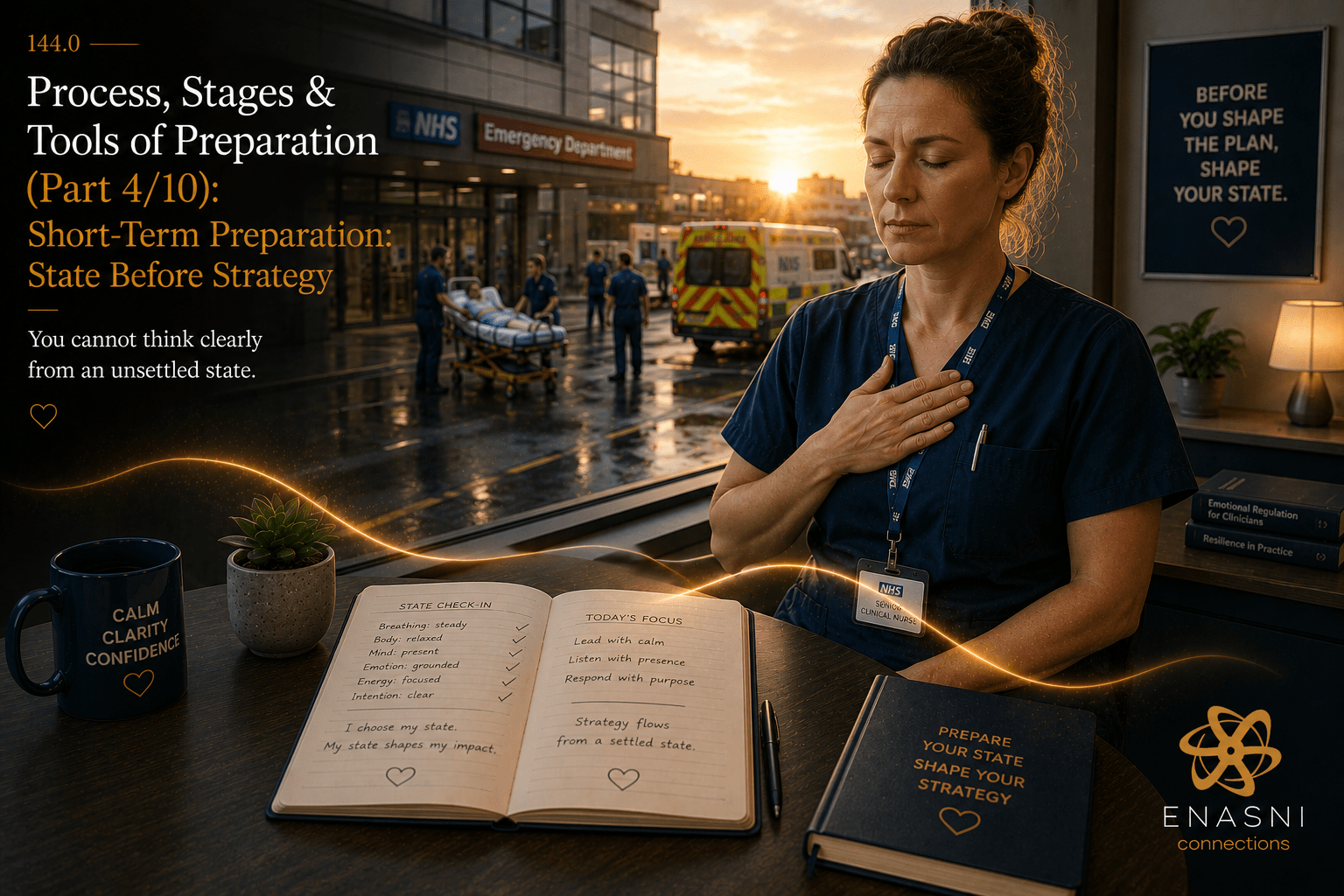
Short-Term Preparation: State Before Strategy
Short-term preparation matters because technique is far removed from impact on its own, and especially because the coach’s internal state shapes the session more powerfully than the words spoken.
This post clarifies short-term or immediate preparation — what happens in the minutes (or seconds) before a session — and why preparation is about regulation, presence, and intention rather than ritualised performance from a wholeness perspective.
Short-Term Preparation Is Not a Script
There are no fixed questions to memorise.
Rigid pre-set questions often:
- over-staff the coaching process
- centre the coach rather than the client
- reduce responsiveness
Unless working in a group setting, where structure serves a different function, short-term preparation must remain light, flexible, and internal.
The Coach’s State Comes First
Immediate preparation is primarily about state management.
A few seconds or minutes may be enough.
Preparation may occur:
- in a common room
- in a corridor
- between sessions
- while walking
What matters is not location, but intentional pause.
Breath as the First Tool
Slow, deliberate breathing:
- settles the nervous system
- widens attention
- reduces urgency
This is not meditation as performance.
It is regulation as readiness.
Some coaches prefer meditation.
Others do not.
There is no correct method — only what genuinely works for the individual coach .
Re-Anchoring to Purpose
A simple internal reminder is often enough:
- What is the purpose of this session?
- What does the client want to move toward?
The answer is consistent:
walking alongside the client while they move closer to their desired future
Preparation reconnects the coach to service, not control.
Silence as a Skill to Remember
Short-term preparation often includes a reminder:
- allow silence
- do not rush
- let the client think
Silence is not absence.
It is space for emergence.
Remembering silence before the session prevents over-talking during it.
Music, Environment, and Focus
Some coaches use:
- music
- playlists
- environmental cues
These are valid if they regulate rather than stimulate.
The purpose is not hype.
It is clarity.
The Myth of “Giving 100%”
A critical correction emerges here.
The idea of “giving 100%” is unrealistic.
A more honest stance:
giving 99.9% — because that is what is sustainably available
Coaching does not require depletion.
It requires presence within limits.
There are moments for enthusiasm.
There are moments for quiet steadiness.
Professionalism is discernment, not intensity.
Mood Is Not a Binary Switch
Being upbeat is not mandatory.
Being flat is not failure.
There are infinite expressions of self.
The question becomes:
What state will best support movement right now — in this session, this phase, this journey?
That answer changes.
Short-term preparation is how the coach aligns to it.
Practical Setup Still Matters
Before the session begins:
- previous notes are set aside
- a fresh record sheet is ready
- distractions are minimised
This supports:
- clear review
- clean attention
- accurate listening
Preparation reduces cognitive clutter.
Inviting Client Preparation
Short-term preparation also includes encouraging clients to prepare:
- mentally
- physically
- environmentally
Clients who arrive intentionally:
- settle faster
- engage deeper
- use time more effectively
Preparation is shared — not imposed.
In Essence
Short-term preparation is not about performance.
It is about state, intention, and readiness.
When the coach arrives regulated and present, the session does not need forcing — it unfolds.
Key Learning Points (KLPs)
- Short-term preparation is state-based, not scripted
- Breath is a primary regulation tool
- There is no single “right” preparation method
- Silence must be remembered before sessions
- Energy should be regulated, not maximised
- Professional presence has many valid expressions
- Simple setup supports clean attention
Action Points (APs)
- Introduce a brief pause before each session
- Use breath or music only if it genuinely regulates
- Prepare environment and materials intentionally
Keywords
short term coaching preparation, coach state management, session readiness coaching, applied wholeness coaching, presence in coaching, nervous system regulation, coaching preparation tools, Enasni Connections