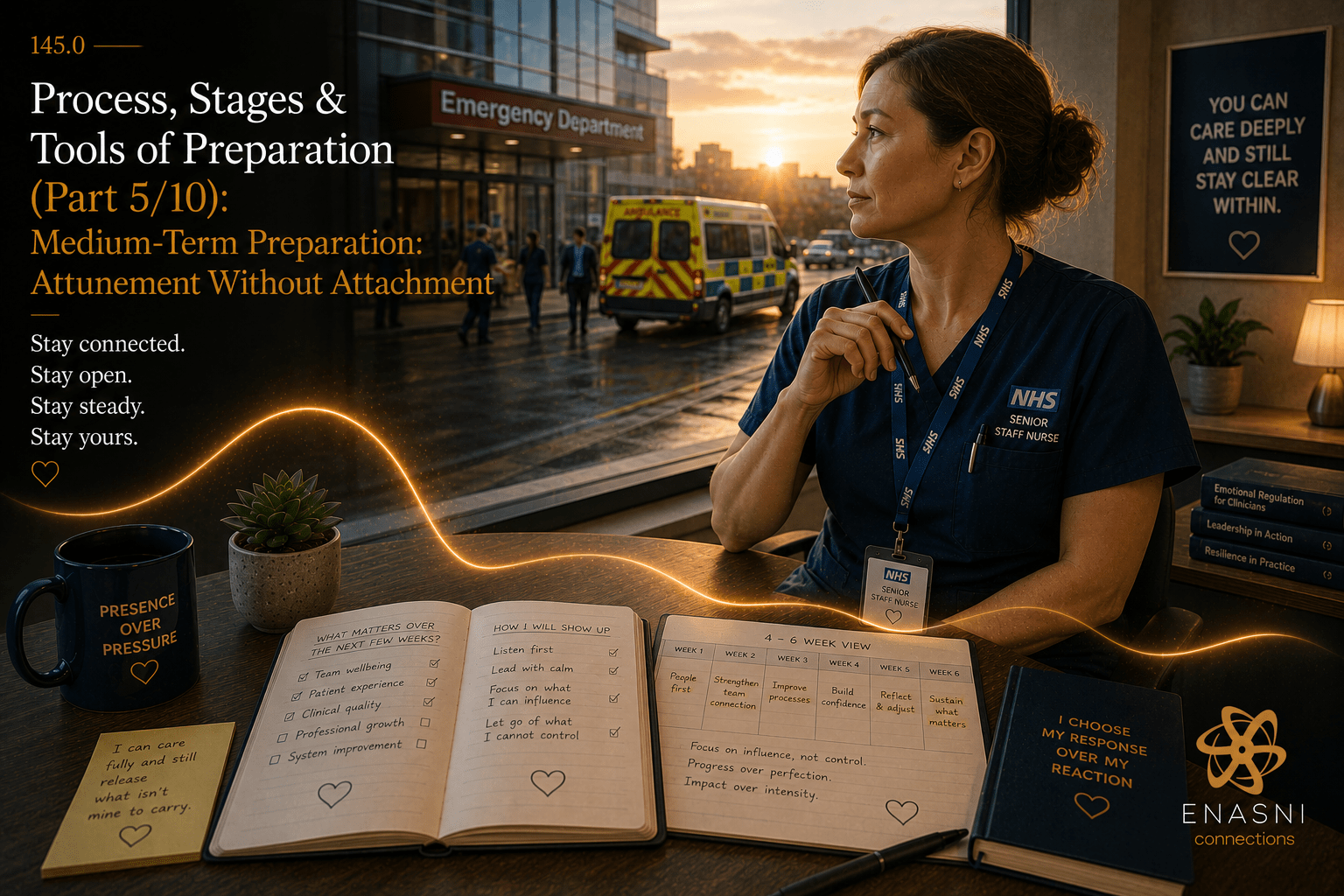
Medium-Term Preparation: Attunement Without Attachment
Medium-term preparation matters because familiarity is far removed from attunement on its own, and especially because effective coaching requires the coach to arrive informed but not overloaded.
This post clarifies medium-term preparation — how the coach prepares between sessions and across a relationship — ensuring the coach is client-specific, present, and aligned without becoming directive or over-involved from a wholeness perspective.
What Medium-Term Preparation Actually Is
Medium-term preparation sits between:
- immediate, state-based preparation, and
- long-term reflective development
It is the quiet re-orientation that happens:
- before a session day
- between sessions
- when reviewing a client’s arc
It is not exhaustive review.
It is selective attunement.
The Principle: Less Is Often Better
A key insight emerges clearly:
The less I know, the better — but I still need to know some things.
Medium-term preparation avoids:
- re-living the client’s story
- rehearsing interventions
- mentally “working” the client
Instead, it focuses on essentials only.
Over-preparation creates bias.
Under-preparation creates drift.
Judgement sits in the middle.
What the Coach Briefly Re-Engages With
Preparation may include a short review of:
- the client’s stated goals
- recent challenges
- achievements made
- values that matter to them
- areas they habitually avoid or postpone
This is not analysis.
It is orientation.
A brief handshake, not a grip.
Championing, Not Carrying
The stance here is clear:
The client has all the answers.
The coach’s role is to:
- champion
- reflect
- hold attention
- ask clean questions
Medium-term preparation supports this stance by preventing the coach from:
- pre-deciding solutions
- forming agendas
- slipping into advice
Preparation reinforces trust in the client’s capacity.
Mental Preparation as Relationship Investment
Medium-term preparation also includes a subtle relational act:
choosing to think about the client in a way that reinforces belief in their success
This is not magical thinking.
It is intentional orientation.
It increases:
- confidence
- rapport
- relational safety
The client feels met, not managed.
Staying in the Client’s World
An important nuance is remembering how the client experiences reality.
This may include recalling:
- whether the client thinks visually
- whether metaphors resonate
- specific language they use repeatedly
If a client uses imagery such as “crossroads,” the coach stays with that imagery rather than introducing new conceptual frames.
This honours coherence.
Reviewing Progress Without Attachment
Medium-term preparation includes recalling:
- long-term goals
- progress already made
- actions taken since last session
This is not for evaluation.
It is for continuity.
The coach remembers movement without owning it.
Avoiding Over-Investment
A critical boundary is named here.
Medium-term preparation is not:
- obsession
- rumination
- emotional investment beyond role
The coach offers:
- focus
- presence
- professionalism
Not self-sacrifice.
The phrase “100% devotion” is reframed as clean, focused presence, not depletion .
Where Medium-Term Preparation Happens
This preparation often occurs:
- in quiet moments
- briefly, not extensively
- in ordinary environments
It does not require ritual.
It requires intentional attention.
In Essence
Medium-term preparation is the art of being ready without being full.
When the coach arrives lightly informed, deeply respectful, and genuinely attuned, the session belongs to the client — exactly where it should.
Key Learning Points (KLPs)
- Medium-term preparation supports continuity
- Over-preparation creates bias
- Brief orientation is sufficient
- Clients hold their own answers
- Attunement is relational, not analytical
- Remember the client’s language and metaphors
- Presence matters more than knowledge
Action Points (APs)
- Review client notes briefly, not exhaustively
- Re-orient to goals, values, and progress
- Enter sessions as champion, not problem-solver
Keywords
medium term coaching preparation, client attunement coaching, preparation stages coaching, applied wholeness coaching, coaching presence, professional judgement, client specific coaching, Enasni Connections