From Topic to Session Outcome: The Structure That Holds Direction
Goal-setting requires structure because intention is far removed from traction on its own, and especially because without a clear sequence, coaching conversations drift, fragment, or collapse back into discussion.
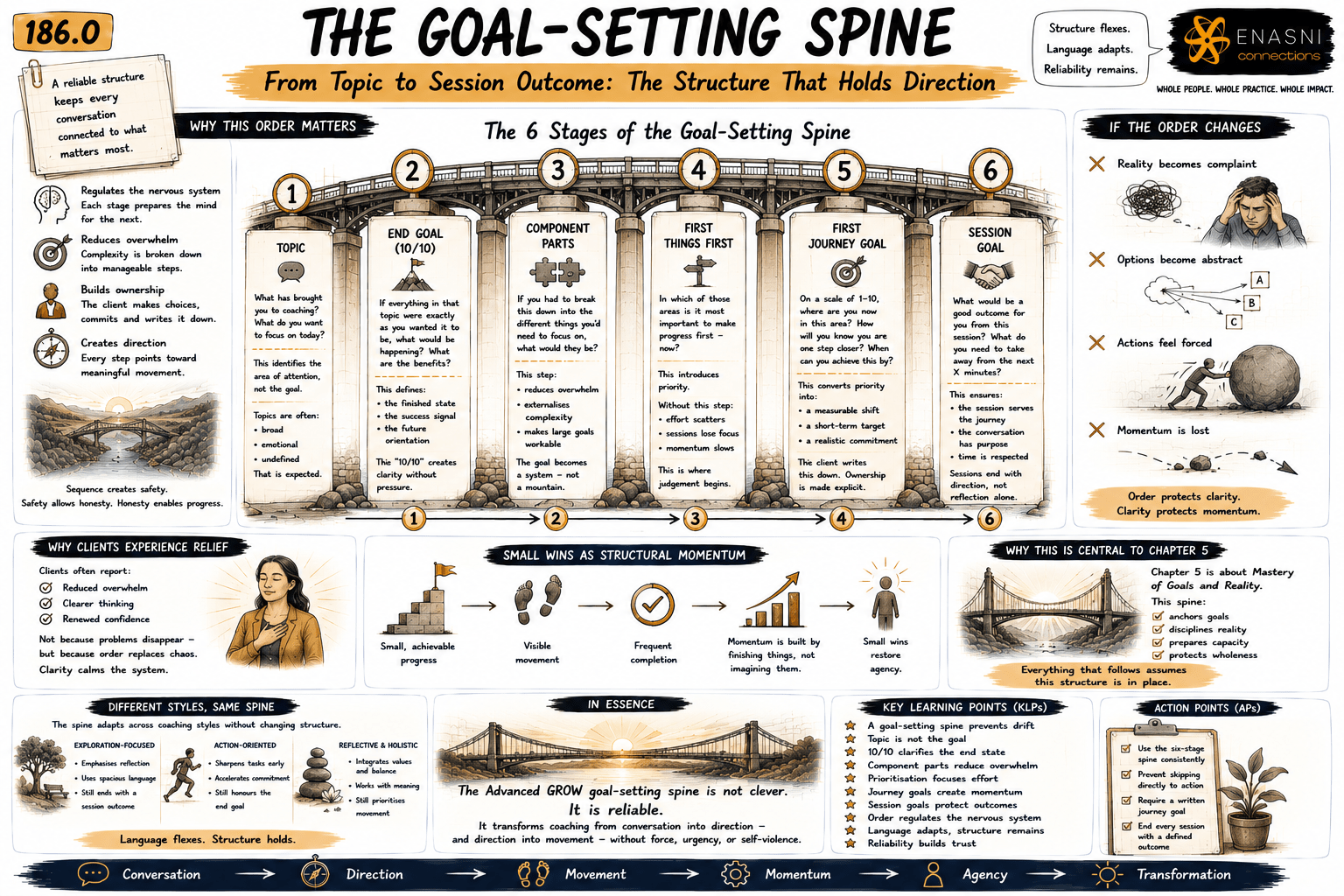
This post sets out the Advanced GROW Goal-Setting Spine — the repeatable structure that moves a client from topic, to clarity, to prioritisation, to action — and shows how different coaching styles adapt the same spine without breaking it from a wholeness perspective.
Why a Spine Matters
A spine is not a script.
It is a structural order that:
- keeps responsibility with the client
- prevents premature action
- protects against overwhelm
- ensures sessions end with movement
Without a spine:
- goals remain abstract
- sessions feel “useful” but not effective
- progress becomes inconsistent
The Advanced GROW spine solves this.
The Core Goal-Setting Sequence (Advanced GROW)
The spine consists of six non-negotiable stages:
1. Topic
What has brought you to coaching? What do you want to focus on today?
This identifies the area of attention, not the goal.
Topics are often:
- broad
- emotional
- undefined
That is expected.
2. End Goal (10/10)
If everything in that topic were exactly as you wanted it to be, what would be happening? What are the benefits?
This defines:
- the finished state
- the success signal
- the future orientation
The “10/10” creates clarity without pressure.
3. Component Parts
If you had to break this down into the different things you’d need to focus on, what would they be?
This step:
- reduces overwhelm
- externalises complexity
- makes large goals workable
The goal becomes a system — not a mountain.
4. First Things First
In which of those areas is it most important to make progress first — now?
This introduces priority.
Without this step:
- effort scatters
- sessions lose focus
- momentum slows
This is where judgement begins.
5. First Journey Goal
On a scale of 1–10, where are you now in this area? How will you know you are one step closer? When can you achieve this by?
This converts priority into:
- a measurable shift
- a short-term target
- a realistic commitment
The client writes this down.
Ownership is made explicit.
6. Session Goal
What would be a good outcome for you from this session? What do you need to take away from the next X minutes?
This ensures:
- the session serves the journey
- the conversation has purpose
- time is respected
Sessions end with direction, not reflection alone .
Why the Order Cannot Be Reversed
Each stage prepares the nervous system for the next.
If the order is disrupted:
- reality becomes complaint
- options become abstract
- actions feel forced
Sequence creates safety.
Safety allows honesty.
Honesty enables progress.
Different Styles, Same Spine
The spine adapts across coaching styles without changing structure.
Exploration-Focused
- emphasises reflection
- uses spacious language
- still ends with a session outcome
Action-Oriented
- sharpens tasks early
- accelerates commitment
- still honours the end goal
Reflective & Holistic
- integrates values and balance
- works with meaning
- still prioritises movement
Language flexes.
Structure holds .
Why Clients Experience Relief
Clients often report:
- reduced overwhelm
- clearer thinking
- renewed confidence
Not because problems disappear — but because order replaces chaos.
Clarity calms the system.
Small Wins as Structural Momentum
The spine privileges:
- small, achievable progress
- visible movement
- frequent completion
Momentum is built by:
finishing things, not imagining them.
Small wins restore agency.
Why This Is Central to Chapter 5
Chapter 5 is about Mastery of Goals and Reality.
This spine:
- anchors goals
- disciplines reality
- prepares capacity
- protects wholeness
Everything that follows assumes this structure is in place.
In Essence
The Advanced GROW goal-setting spine is not clever.
It is reliable.
It transforms coaching from conversation into direction — and direction into movement — without force, urgency, or self-violence.
Key Learning Points (KLPs)
- A goal-setting spine prevents drift
- Topic is not the goal
- 10/10 clarifies the end state
- Component parts reduce overwhelm
- Prioritisation focuses effort
- Journey goals create momentum
- Session goals protect outcomes
- Order regulates the nervous system
- Language adapts, structure remains
- Reliability builds trust
Action Points (APs)
- Use the six-stage spine consistently
- Prevent skipping directly to action
- Require a written journey goal
- End every session with a defined outcome
Keywords
advanced GROW goal setting, coaching goal spine, journey goals coaching, session outcomes coaching, applied wholeness coaching, goal prioritisation structure, Enasni Connections