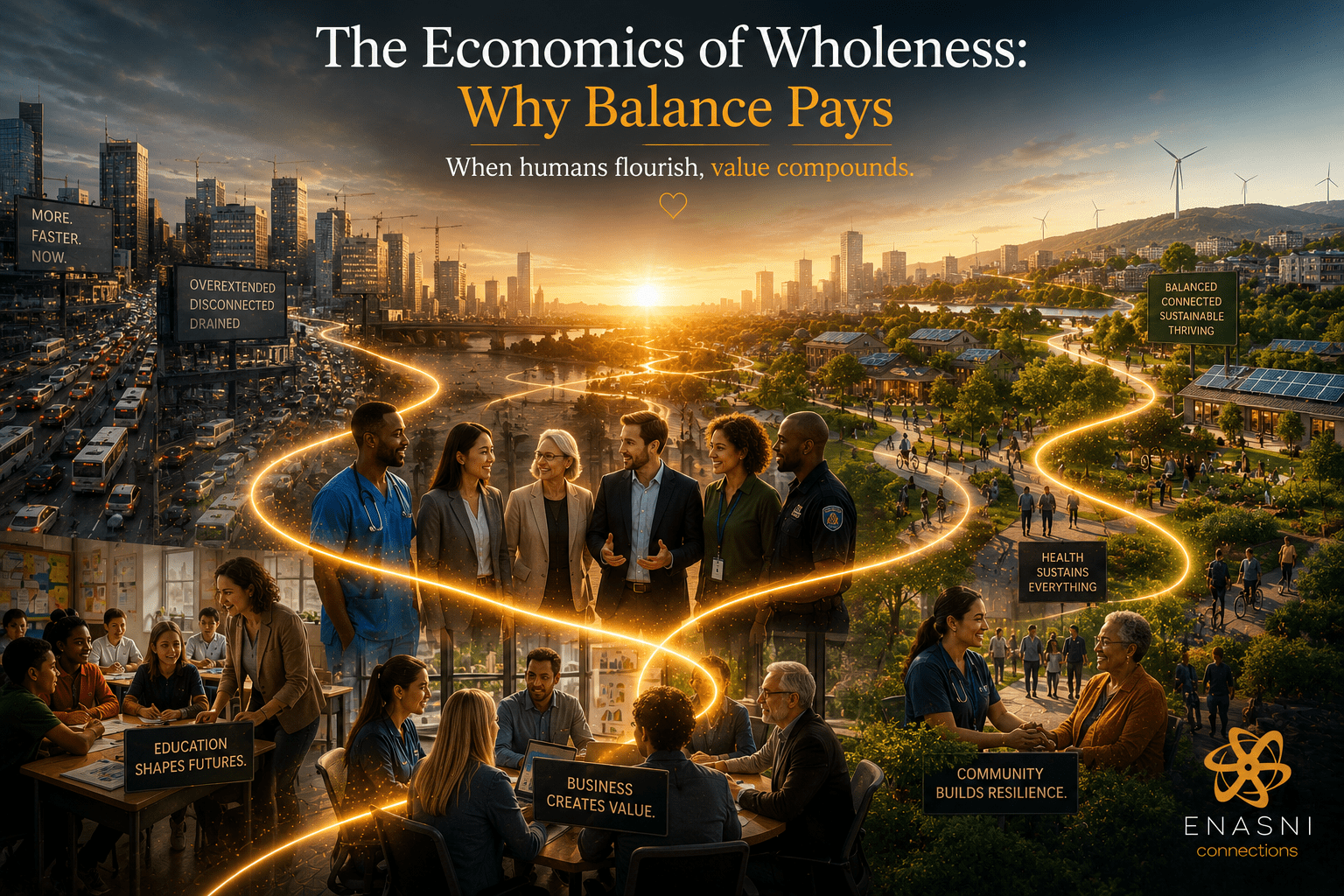
The economics of wholeness asks a deeper question: what kind of growth can continue without depleting the people, systems, and relationships that create it?
Modern economics often measures success in growth — faster, bigger, more. Yet growth without coherence eventually collapses under its own weight.
Wholeness offers another measure: sustainability, flow, and the consistent creation of value without depletion.
When individuals, organisations, and societies operate from wholeness, waste decreases, creativity rises, and wholeness becomes a form of capital in itself. This post explores the angle of what lies behind The Economics of Wholeness from a wholeness perspective.
The Economics of Wholeness and the Hidden Cost of Fragmentation
Stress, turnover, and inefficiency are more than emotional losses; they are financial ones. Research from Harvard Business School on employee wellbeing, productivity, and firm performance supports the economic case for treating human wellbeing as a performance factor. Every unfocused meeting, every reactive decision, every burnt-out employee carries a price tag. In the UK alone, workplace stress and burnout cost the economy billions each year in lost productivity and healthcare expenses. Behind those numbers are people — bright, capable minds operating far below potential because the system forgot to breathe.
Breath returns with coaching.
Wholeness does not slow productivity. It prevents collapse.
The Wholeness Dividend
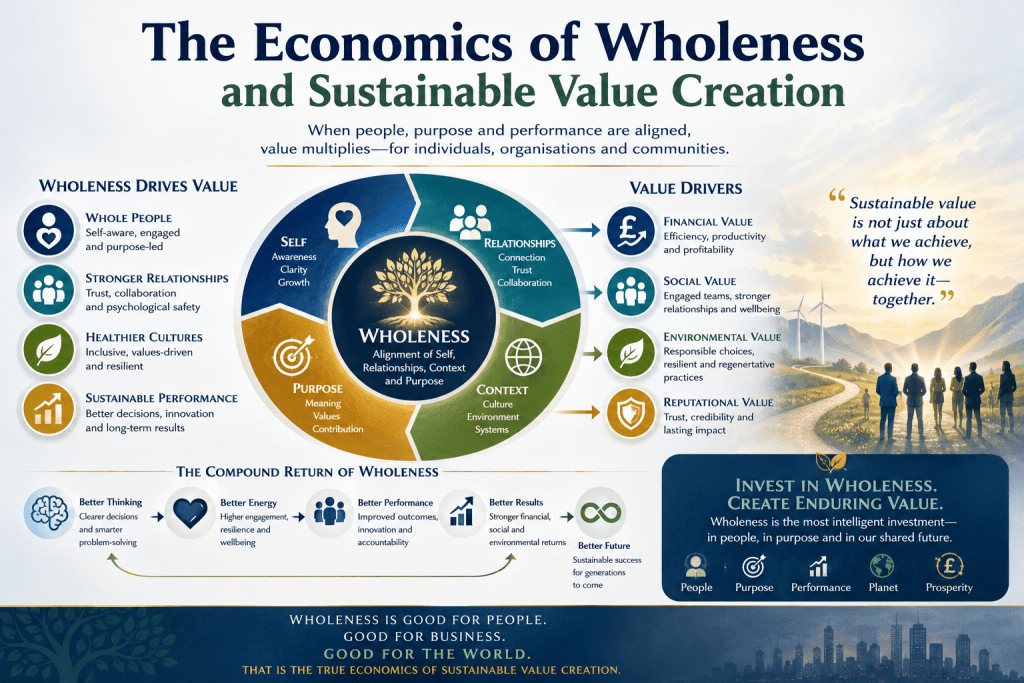
Balance creates returns. When teams are well-regulated, trust becomes currency. When decision-making is grounded in reflection rather than panic, risk decreases. When individuals feel purpose in their work, retention and innovation rise together.
Research across sectors — from healthcare to tech — consistently shows that wellbeing and profitability are not opposites. They are partners in long-term value creation.
A “whole” workplace:
- Reduces absenteeism by fostering total psychological safety.
- Increases creative output by lowering unnecessary cognitive overload.
- Strengthens community ties, improving brand loyalty and social reputation.
The result? The kind of quiet efficiency where people want to stay, contribute, and grow for decades.
Wholeness economics recognises that long-term prosperity emerges when human wellbeing, organisational performance, and sustainable value creation reinforce one another.
The Strategic Importance of Wholeness Economics
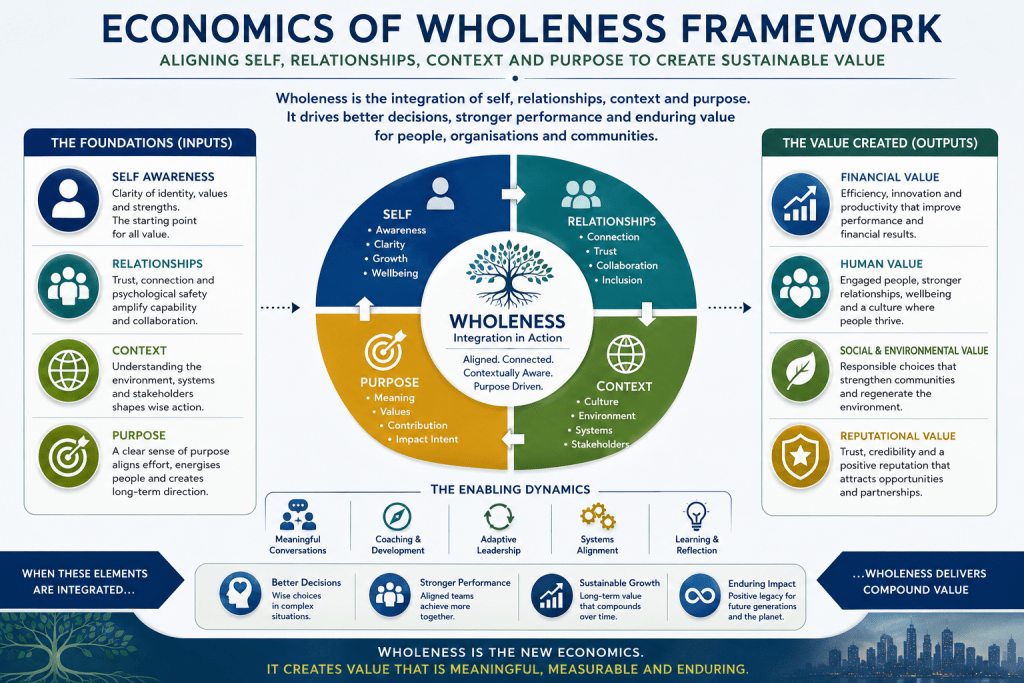
Traditional economic models often measure success through financial outputs alone. The economics of wholeness expands this perspective by recognising that sustainable value is created through the interaction of people, relationships, systems, purpose, and performance.
When these elements operate in alignment, organisations experience stronger engagement, better decision-making, increased innovation, and greater resilience during periods of change.
Within coaching, wholeness economics provides a practical framework for understanding how personal wholeness (wellbeing) and organisational outcomes influence one another. Improvements in self-awareness, communication, trust, and psychological safety often translate into measurable gains in productivity, retention, collaboration, and service quality. These outcomes create a positive feedback loop where healthier individuals contribute to healthier organisations, which in turn create environments that support continued growth.
The framework also highlights the importance of long-term thinking. Rather than focusing solely on immediate results, wholeness economics encourages investment in the conditions that sustain performance over time.
This includes leadership development, coaching cultures, reflective practice, learning systems, and environments that support both human and organisational flourishing.
From this perspective, sustainable value creation becomes more than an economic objective. It becomes a practical expression of alignment between purpose, people, performance, and contribution.
The result is value that extends beyond financial measures to include social impact, cultural strength, wholeness, and long-term organisational effectiveness.
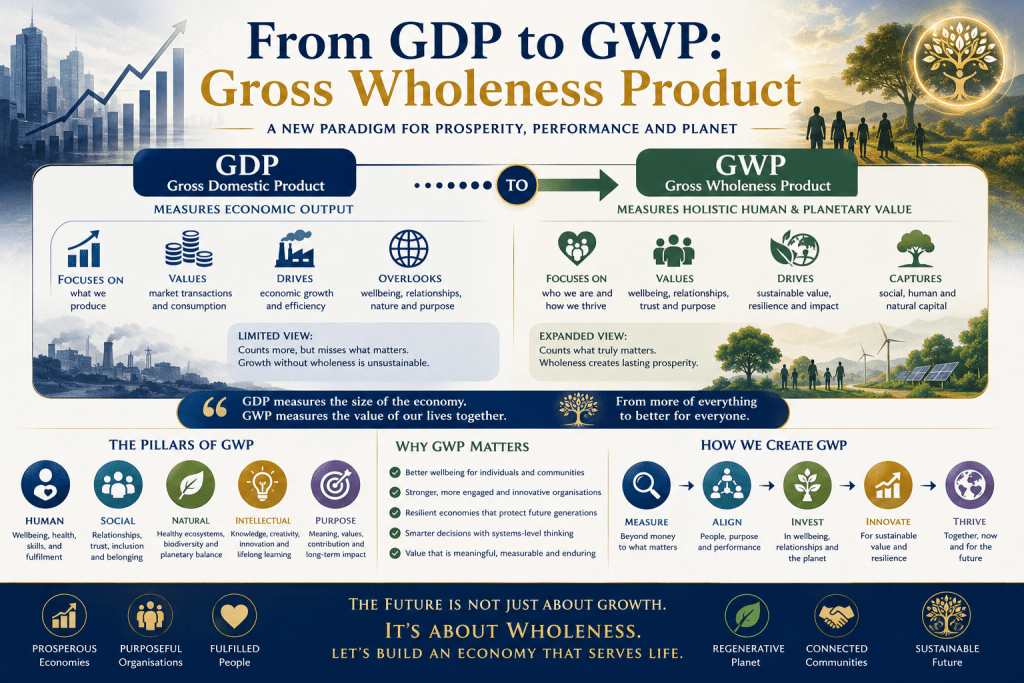
From GDP to GWP: Gross Wholeness Product
Imagine if economies measured alignment as seriously as output.
If the true indicator of progress was less about consumption, and more about coherence.
What would change if:
- Every organisation tracked energy flow alongside revenue?
- Every government assessed citizen wellbeing as a core economic indicator?
- Every leader asked, “How much of our success is sustainable?”
This is from a utopia; it is sound design. Systems last when energy flows freely. Economies thrive when humans within them do. That is research backed by common sense.
In summary, the economics of wholeness provides a practical framework for measuring value beyond short-term output. By considering sustainability, human capacity, coherence, and long-term contribution, the economics of wholeness creates stronger foundations for growth and resilience.
Key Learning Points
- Economic performance and human wellbeing are interdependent.
- Fragmentation creates invisible costs — emotional, social, and financial.
- Wholeness generates tangible returns through engagement, innovation, and retention.
- Balance within systems reduces volatility and waste.
- A sustainable future economy must measure value beyond profit — toward purpose.
Action Points
- Conduct wellbeing audits to identify the hidden costs of stress and inefficiency.
- Redesign workflows to prioritise clarity and rest as performance assets.
- Include wellbeing and coherence metrics in organisational reporting.
- Educate leaders to view emotional regulation as part of economic strategy.
In Essence
Wholeness is less anti-growth than one may think. It is more about growth with rhythm.
The economics of wholeness challenges the assumption that growth and wholeness sit at opposite ends of a spectrum.
Sustainable performance emerges when human capacity, organisational effectiveness, and long-term value creation reinforce one another. In this sense, wholeness is not separate from economics; it is an economic strategy that reduces waste, strengthens resilience, and improves the return generated by human potential.
It is what happens when energy, purpose, and profit align.
At Enasni, we believe a balanced economy begins with balanced people — and that true prosperity is measured not only by what is made, but by what remains whole.
A key facet of why we run our company back to front.