

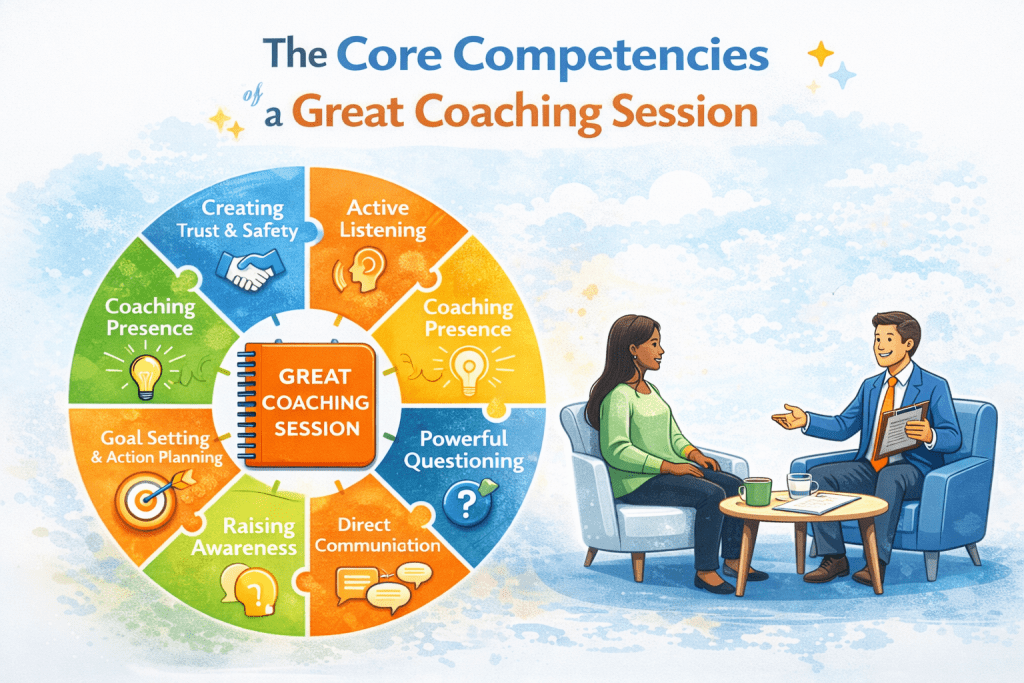
The Core Competencies of A Great Coaching Session
Every effective coaching session rests on a quiet foundation of structure, skill, and presence. The most successful coaches are seldom those who say the most, but those who hold the space most skilfully — listening deeply, asking purposefully, and keeping the client’s growth at the centre.
From a wholeness perspective, the core competencies of a great coaching session function as unified expressions of presence, regulation, discernment, and relational depth, working in concert to create meaningful movement. The origins of coaching reflect this integrated design, shaping the cultivation of the coach’s character and capacity so fully that the convergence of these qualities often generates what clients describe as “magic.”
Together these integrations work together to generate clarity, trust, and forward momentum.
Setting the Tone
A professional session begins with respect and clarity. This is called contracting.
Review the previous session, acknowledge progress, and create a calm environment where the client feels both seen and supported. This first moment sets the emotional temperature for the rest of the conversation.
The Framework in Motion
The core competencies of a great coaching session are not accidental. They are developed through deliberate practice, reflection, and supervision. Understanding the core competencies of great coaching sessions allows coaches to move from instinct to mastery.
When the core competencies of a great coaching session are embodied consistently, clients experience clarity, safety, and momentum. These competencies form the invisible architecture behind sustainable transformation. Research on psychological safety and performance from Harvard Business Review reinforces the importance of relational depth and emotional attunement in high-impact professional conversations.
At Enasni, we often use the GROW model — a reliable compass for structuring conversations around Goal, Reality, Options, and the Way Forward. It offers direction without dictating the journey. The coach ensures each Goal is SMART— Specific, Measurable, Achievable, Relevant, and Time-bound — while helping the client explore where they are now in their current Reality, what paths exist by opening the field of Options, and which actions will carry them ahead to share a concrete Way Forward.
Yet, coaching is much broader than one model. Many powerful frameworks — CLEAR, OSKAR, T-GROW, Co-Active, Solution-Focused, and others — illuminate the same human development & improvement process from different angles. Each brings its own philosophy, language, and rhythm.
The art lies not in allegiance to a single structure but in knowing when and how to draw from each. Great coaches move fluidly between models, weaving them intuitively based on what the client needs in the moment.
Because coaching is much more than a checklist — it’s a dialogue of awareness, alive and responsive — where method serves meaning. The best coaches move fluidly between these stages, adapting to where the client naturally leads.
The Human Touch
Every technique lives or dies by rapport.
A great coach listens at Level 3 — beyond the words, attuned to tone, emotion, and silence. They reflect back the whole person without omission of component parts, such as what they hear, with precision and care, helping clients see their own values, strengths, and limiting beliefs more clearly.
This is global listening.
Active listening is Level 2.
Passive listening Level 1.
Listening to Reply is Level 0.
Encouragement matters. Challenge matters too. The skill is knowing when to nudge and when to wait.
Key Learning Points
- Start each session professionally, reviewing past discussions and setting a respectful tone.
- Establish clear SMART goals that define the client’s direction.
- Explore current reality and brainstorm options for achieving the goal.
- Maintain flexibility within the GROW model to suit the flow of conversation.
- Use purposeful, open-ended questions to deepen reflection.
- Build rapport through active listening and empathy.
- Handle limiting beliefs with sensitivity and respect.
- Provide clear, evidence-based feedback and co-create a tangible action plan.
Action Points For The Coach
- Begin each session with clarity and continuity from the last.
- Ask open, purposeful questions that promote self-exploration.
- End with a clear, time-bound action plan to strengthen accountability.
In Essence
Coaching excellence is less about control; it’s more about rhythm.
When structure and empathy meet, growth happens naturally. The coach becomes both compass and calm — guiding, rather steering.
At Enasni, this is what mastery looks like: presence in practice, precision in process, and deep respect for the human story unfolding before you whilst remembering neither is worse or better than the other.
The integration described here closely aligns with the International Coaching Federation’s Core Competencies framework, which outlines the relational and ethical foundations of effective coaching practice.
The core competencies of a great coaching session shape every interaction. When the core competencies of a great coaching session are understood and practiced consistently, depth replaces surface conversation.
Mastery begins with honouring the core competencies of a great coaching session as foundational, rather than optional.