
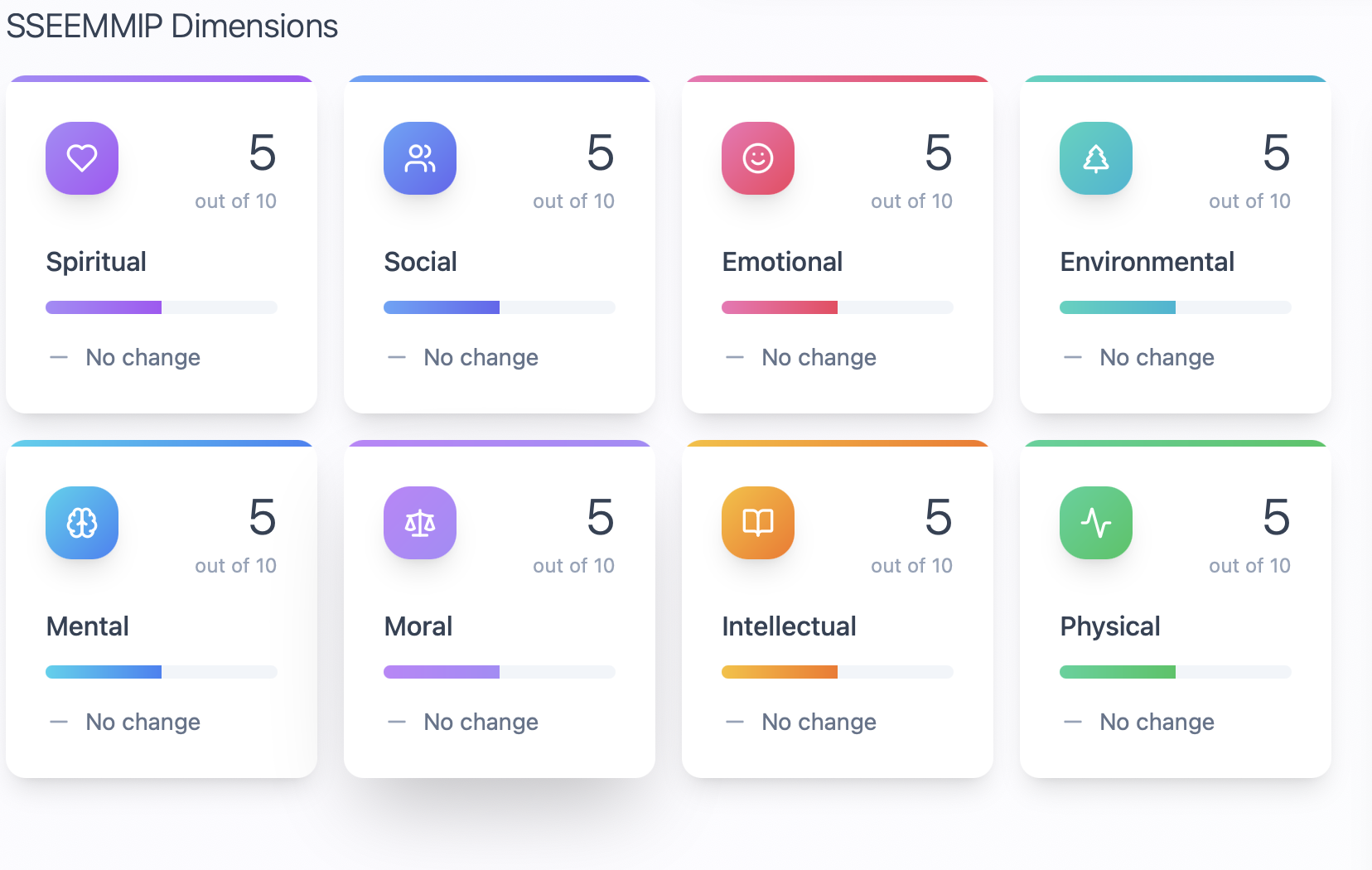
Eight domains. One human system.
Stress does not operate in isolation. Experience moves simultaneously across spiritual meaning, social context, emotional state, environment, mental load, moral alignment, intellectual demand, and physical capacity. Fragmented interventions fail because they treat these domains separately.
SSEEMMIPTM Integration treats the human system as interconnected and dynamic. A shift in one domain influences the others. Regulation work therefore considers all eight domains together, rather than targeting symptoms in isolation.
Within The Package, SSEEMMIPTM Integration ensures stress signals are interpreted accurately, regulation efforts remain balanced, and capacity is restored without creating imbalance elsewhere. The result is coherence, stability, and sustainable functioning across real life, instead of just within sessions.
SSEEMMIPTM Integration — Domain Breakdown
Eight domains operating as one system
Spiritual
Sense of meaning, purpose, and coherence. Stress increases when values, purpose, or inner alignment are disrupted.
Social
Relationships, roles, support, and belonging. Stress amplifies through isolation, conflict, or unclear relational boundaries.
Emotional
Emotional range, processing, and regulation capacity. Suppressed or overloaded emotional states destabilise the wider system.
Environmental
Physical surroundings, workload conditions, sensory input, and structural context. Poor environments sustain stress regardless of mindset.
Mental
Cognitive load, attention, rumination, and decision demand. Excessive mental strain narrows perception and response options.
Moral
Alignment between actions and ethical standards. Moral friction creates hidden stress, especially in high-responsibility roles.
Intellectual
Learning demand, complexity, problem-solving, and information processing. Under- or over-stimulation both contribute to imbalance.
Physical
Sleep, energy, health, and recovery capacity. Physical depletion reduces tolerance across all other domains.
Integration principle
No domain operates alone. Regulation restores balance by addressing interactions between domains rather than isolating symptoms.
SSEEMMIPTM Interaction Logic
How the eight domains influence each other
Stress moves through the human system as a chain, not limited by a single point. A shift in one domain alters load, capacity, and behaviour in others. Regulation therefore focuses on interaction, decoupling from isolation.
Spiritual ↔ Moral
Loss of meaning increases ethical friction. Ethical conflict erodes sense of purpose. Alignment stabilises both.
Spiritual ↔ Mental
Meaning reduces cognitive overload. Meaning loss amplifies rumination and decision fatigue.
Social ↔ Emotional
Relational safety expands emotional regulation. Social conflict heightens emotional reactivity.
Social ↔ Moral
Role pressure can force moral compromise. Moral strain often surfaces through relational tension.
Emotional ↔ Physical
Emotional overload disrupts sleep and energy. Physical depletion lowers emotional tolerance.
Mental ↔ Emotional
Excessive thinking intensifies emotional charge. Emotional flooding narrows cognitive flexibility.
Environmental ↔ Physical
Poor environments drain physical capacity. Physical strain reduces environmental tolerance.
Environmental ↔ Mental
High noise, clutter, or demand increase cognitive load. Clear environments support mental clarity.
Intellectual ↔ Mental
Sustained complexity increases mental fatigue. Intellectual stagnation reduces engagement and focus.
Intellectual ↔ Emotional
Learning pressure can create anxiety. Mastery and progress stabilise emotional state.
System effect
Unregulated stress propagates across domains. Regulation at one point can stabilise multiple domains when interactions are understood.
Core principle
SSEEMMIPTM Integration works in favour of restoring balance across interactions, echoing a quiet refusal of fixing domains in isolation.
What SSEEMMIPTM Integration means for clients in 06 or 12 session Packages
SSEEMMIPTM Integration determines how sessions are experienced, rather than just what is discussed.
The difference between 06 and 12 sessions is depth1, pacing2, and system coverage3.
In the 06-Session Package
Focus remains on primary stress-bearing domains.
Sessions identify which domains are carrying the highest load and which are compensating. Regulation work targets the three most influential interactions first, creating stability without overextending capacity.
Clients experience:
- Clear identification of dominant stress domains
- Reduced overwhelm through prioritisation
- Faster stabilisation and functional relief
- Practical regulation tools applied where impact is highest
Outcome: stability and clarity within a contained timeframe.
In the 12-Session Package
Work expands to full system integration.
Sessions allow time to explore secondary and hidden interactions between domains. All domains are explored – client led. Patterns linked to values, roles, environment, and long-term behaviour are addressed alongside immediate stress responses.
Clients experience:
- Deeper understanding of how domains interact over time
- Regulation across work, relationships, and identity
- Rebuilding of capacity rather than short-term relief
- Stronger resilience under sustained pressure
Outcome: coherence, sustainability, and reduced relapse risk.
Across both Packages
Sessions are not split into “spiritual,” “emotional,” or “physical” silos. Each session works across domains simultaneously, with emphasis adjusted according to load, capacity, and progression stage.
Core result: stress regulation that fits real life, instead of theoretical categories.
How SSEEMMIPTM Integration is tracked
Learn more
Tracking focuses on patterns, shifts, and stability, not isolated scores. Progress is observed across sessions using structured reflection, practitioner mapping, and client-reported signals.
What is tracked
- Dominant stress-bearing domains
- Cross-domain interactions that amplify or relieve load
- Regulation capacity over time
- Early warning signals and recovery speed
- Consistency of integration between sessions
How tracking works
At each session, current stress signals are reviewed against previous patterns. Changes in one domain are examined for impact on others. This allows regulation work to remain targeted and adaptive rather than fixed.
Why this matters
Tracking reveals whether change is temporary or stabilising. It also prevents overworking one domain while others quietly carry the load.
Digital support (in development)
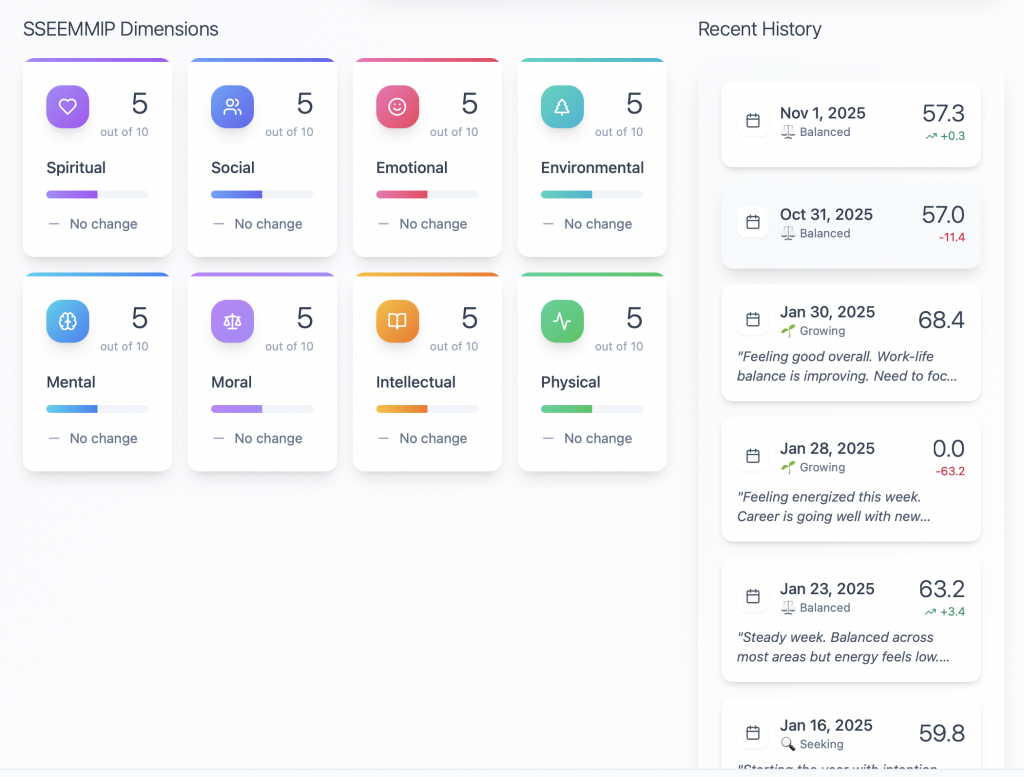
A dedicated Base 44 produced Enasni Wholeness Tracking app is in development to support this process. The app will allow clients to:
- Log stress signals across SSEEMMIPTM domains
- Visualise interaction patterns over time
- Track regulation capacity and recovery trends
- Support continuity between sessions
Until launch, tracking is practitioner-led and session-embedded, ensuring clarity, safety, and consistency using PDF tools.
Core principle
What is measured guides what is regulated. SSEEMMIPTM tracking keeps the work precise, humane, and sustainable.