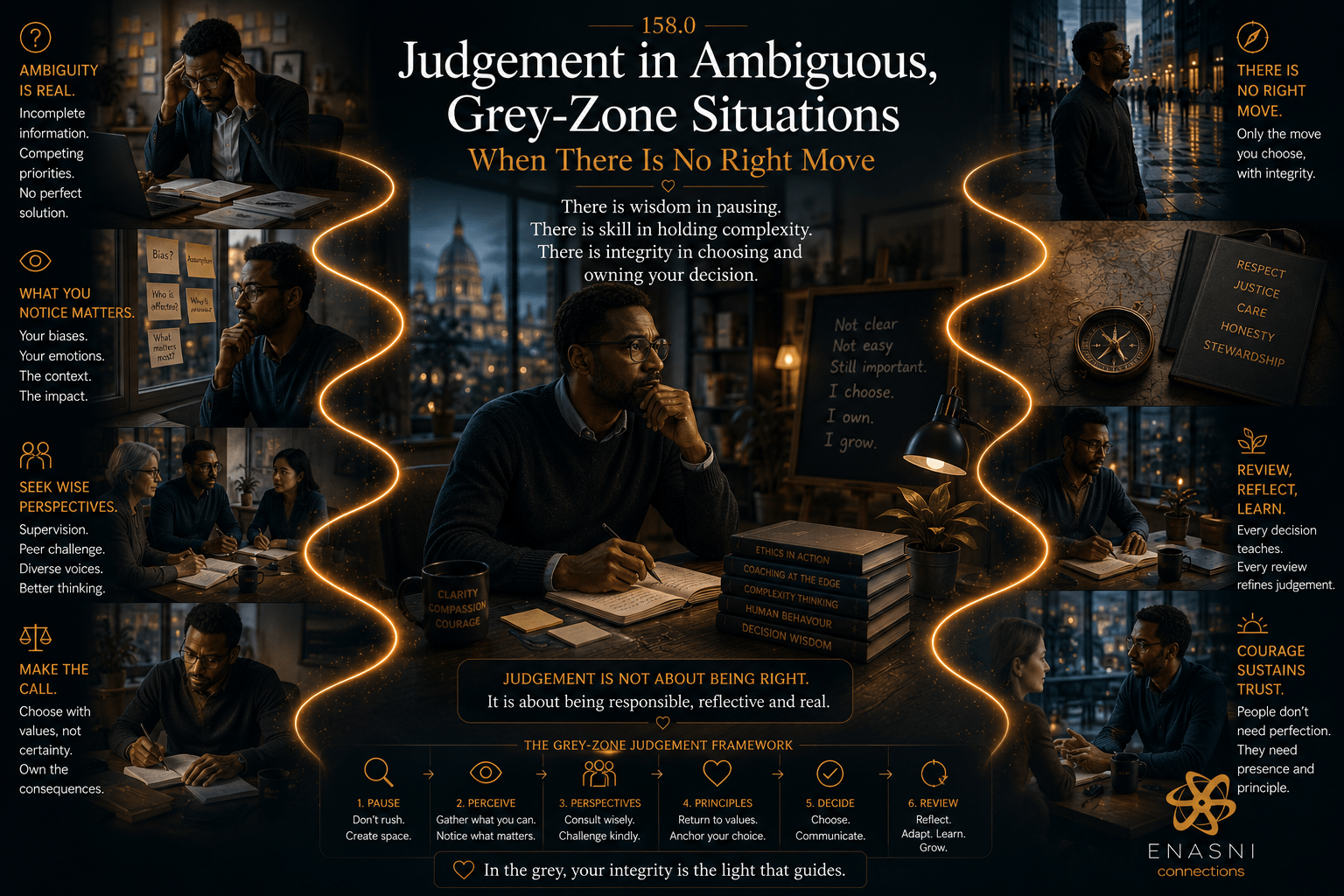
When There Is No Right Move
Judgement matters because clarity is far removed from wisdom on its own, and especially because many of the most consequential coaching moments arise where guidance is unclear, frameworks are insufficient, and certainty would be dishonest.
This post explores how professional judgement operates when situations sit in ethical, emotional, or relational grey zones — and why the ability to not know yet is often the most skilful response from a wholeness perspective.
Why Grey Zones Are Inevitable
Coaching does not happen in controlled conditions.
It happens where:
- goals conflict
- values compete
- emotions intensify
- progress stalls
- clients change direction
- external pressures intrude
No model resolves these moments cleanly.
Grey zones are not errors.
They are where real practice lives.
The Limits of Frameworks
Frameworks provide orientation.
They do not replace judgement.
In grey zones:
- tools offer multiple valid paths
- ethical codes require interpretation
- supervision raises questions rather than answers
Relying rigidly on frameworks at this point often:
- oversimplifies reality
- avoids responsibility
- creates false certainty
Judgement begins where frameworks end.
The Pressure to Act
Ambiguity creates discomfort.
Common reactions include:
- premature advice
- excessive questioning
- unnecessary referrals
- over-structuring
- avoidance masked as patience
Action relieves the coach’s discomfort — not always the client’s need.
Judgement involves noticing this impulse and not obeying it automatically.
Holding Without Fixing
One of the hardest skills to develop is holding space when:
- the client is distressed
- there is no clear next step
- progress feels stalled
Holding is not passivity.
It is active containment.
It communicates:
- trust in the client’s process
- tolerance for complexity
- respect for timing
Often, movement emerges after holding — not before it.
Ethical Ambiguity
Some situations sit between clear ethical lines:
- dual roles developing gradually
- dependency not yet explicit
- boundaries stretched but not crossed
- competence questioned without certainty
These moments require:
- supervision
- reflection
- pacing
- humility
Immediate resolution is rarely possible.
Judgement is the willingness to stay engaged without pretending clarity exists.
Emotional Noise vs Meaningful Signal
Grey zones are noisy.
Emotional charge can obscure signal.
Judgement involves asking:
- What belongs to the client?
- What belongs to the coach?
- What is mine to hold elsewhere?
Separating these prevents reactive decisions.
This separation is learned — not instinctive.
When Not Acting Is the Intervention
Some of the most ethical decisions involve:
- delaying action
- naming uncertainty
- inviting reflection
- revisiting later
This can feel counterintuitive.
Especially in cultures that value speed and solutions.
Judgement recognises that timing is an intervention.
The Role of Supervision in Grey Zones
Grey zones should not be navigated alone.
Supervision provides:
- perspective without urgency
- challenge without judgement
- containment for uncertainty
Supervision does not remove ambiguity.
It helps the coach remain whole inside it.
Judgement Develops Through Exposure
Judgement cannot be taught directly.
It develops through:
- repeated exposure
- mistakes and repair
- reflection
- supervision
- time
This is why mastery cannot be rushed.
Grey zones shape professionals.
In Essence
Judgement is not about being right.
It is about being responsible inside uncertainty.
When coaches resist the urge to simplify what is complex, they create conditions where genuine movement becomes possible — not through force, but through presence.
Key Learning Points (KLPs)
- Grey zones are inherent in coaching
- Frameworks guide but do not decide
- Urgency often belongs to the coach
- Holding is an active skill
- Ethical ambiguity requires pacing
- Supervision supports judgement
- Judgement develops over time
Action Points (APs)
- Notice impulses to act prematurely
- Name uncertainty transparently when appropriate
- Take ambiguous situations to supervision
Keywords
coaching judgement, ambiguous coaching situations, ethical grey zones coaching, applied wholeness coaching, professional decision making, uncertainty in coaching, coaching mastery, Enasni Connections