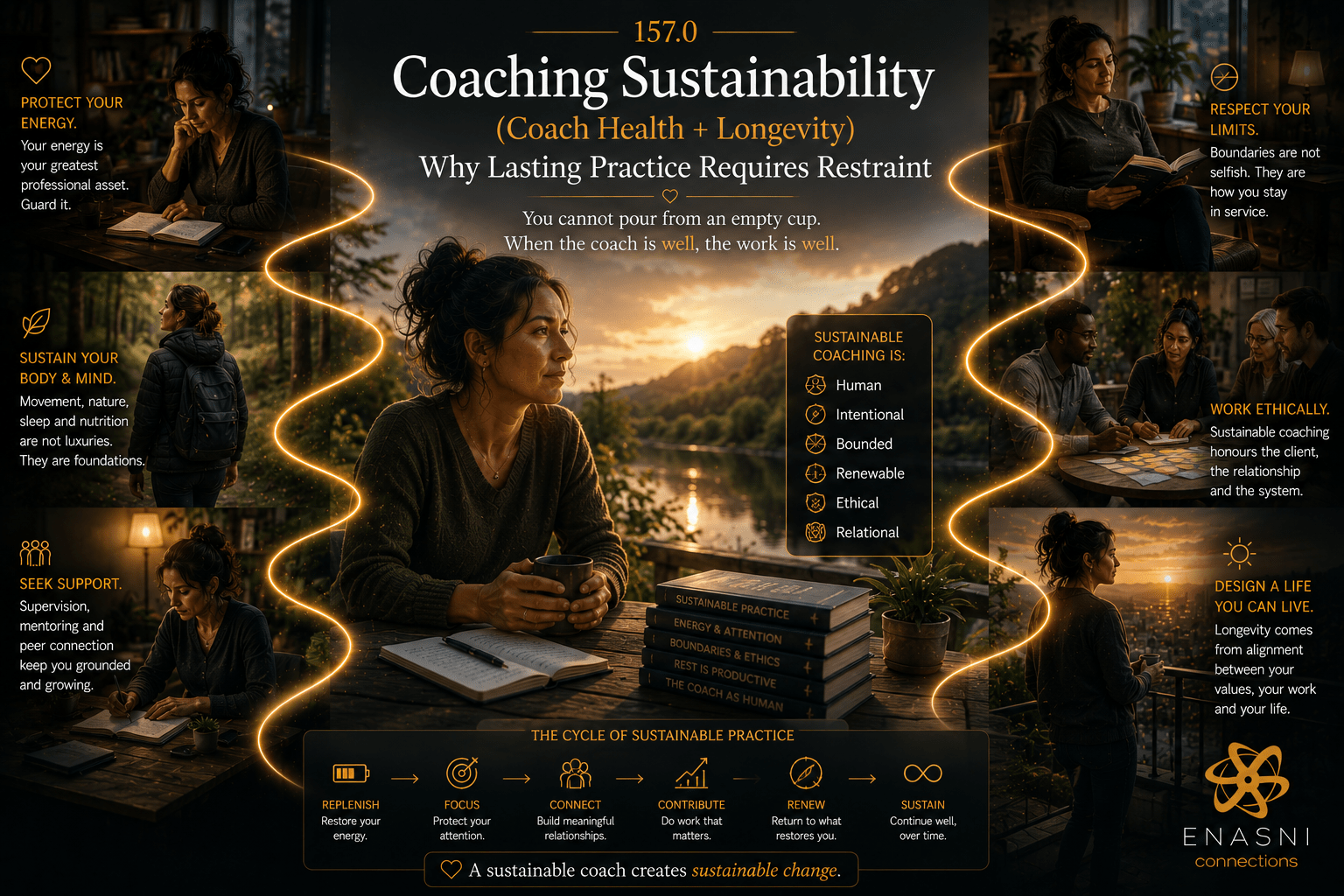
Why Lasting Practice Requires Restraint
Coaching sustainability matters because passion is far removed from longevity on its own, and especially because a depleted coach cannot offer clean presence, sound judgement, or ethical containment over time.
This post explores sustainability as a professional responsibility — how coaches protect health, energy, and clarity so practice remains steady, humane, and effective across years rather than burning brightly and briefly from a wholeness perspective.
The Myth of Endless Capacity
Many coaches enter practice believing:
- more availability equals more care
- more sessions equals commitment
- exhaustion is a temporary phase
This myth is reinforced by:
- helping identities
- service-oriented values
- early enthusiasm
In reality, capacity is finite.
Ignoring this does not increase impact.
It shortens careers.
Sustainability Is an Ethical Issue
Coach health is not separate from client safety.
Fatigue affects:
- listening accuracy
- emotional regulation
- boundary clarity
- ethical judgement
A coach who is consistently depleted is not just tired.
They are less fit to practise.
Sustainability protects both sides of the relationship.
Caseload Reality Over Idealism
Sustainable caseloads vary.
They depend on:
- session depth
- emotional intensity
- client population
- other professional roles
- personal circumstances
There is no universal number.
What matters is:
- honest monitoring
- willingness to reduce load
- responsiveness to warning signs
More clients is not a mark of success.
Clarity is.
Emotional Labour Must Be Acknowledged
Coaching involves invisible labour:
- holding uncertainty
- containing distress
- witnessing identity shifts
- staying present without fixing
This labour accumulates.
Without outlets such as supervision, reflection, and rest, it leaks into:
- irritability
- numbness
- over-involvement
- withdrawal
Naming emotional labour restores agency.
Rhythm, Not Hustle
Sustainable practice has rhythm.
This includes:
- days without sessions
- varied session intensity
- protected recovery time
- seasonal adjustment
Constant intensity erodes judgement.
Rhythm restores it.
Burnout Is Often Delayed
Burnout rarely arrives suddenly.
It builds through:
- minor boundary drift
- skipped breaks
- emotional over-extension
- rationalised fatigue
By the time burnout is named, damage is often advanced.
Early signals deserve attention:
- dread before sessions
- loss of curiosity
- reduced empathy
- mental fog
These are signals — not failures.
Stopping Is Sometimes the Ethical Choice
There are times when:
- reducing workload
- pausing practice
- referring clients
- taking leave
is not avoidance.
It is professionalism.
Sustainability includes knowing when to stop.
Longevity Is Built Quietly
Long careers are not dramatic.
They are characterised by:
- consistency
- humility
- adaptability
- learning
- restraint
Longevity is not achieved by intensity.
It is maintained through careful self-stewardship.
Wholeness Requires Limits
Wholeness does not mean availability without end.
It means:
- integrated energy
- aligned values
- realistic pacing
- coherent identity
Limits are not evidence of weakness.
They are evidence of wholeness.
In Essence
Coaching sustainability is not self-care as indulgence.
It is self-care as ethics.
When coaches protect health, rhythm, and capacity, practice remains trustworthy — not because effort increases, but because judgement remains intact.
Key Learning Points (KLPs)
- Capacity is finite
- Sustainability protects client safety
- Caseloads must be monitored honestly
- Emotional labour accumulates
- Rhythm matters more than intensity
- Burnout develops gradually
- Stopping can be ethical
Action Points (APs)
- Review current caseload and energy impact
- Identify early burnout indicators
- Build rest and rhythm into practice
Keywords
coaching sustainability, coach health and longevity, applied wholeness coaching, burnout prevention coaching, ethical coaching practice, emotional labour coaching, professional rhythm, Enasni Connections