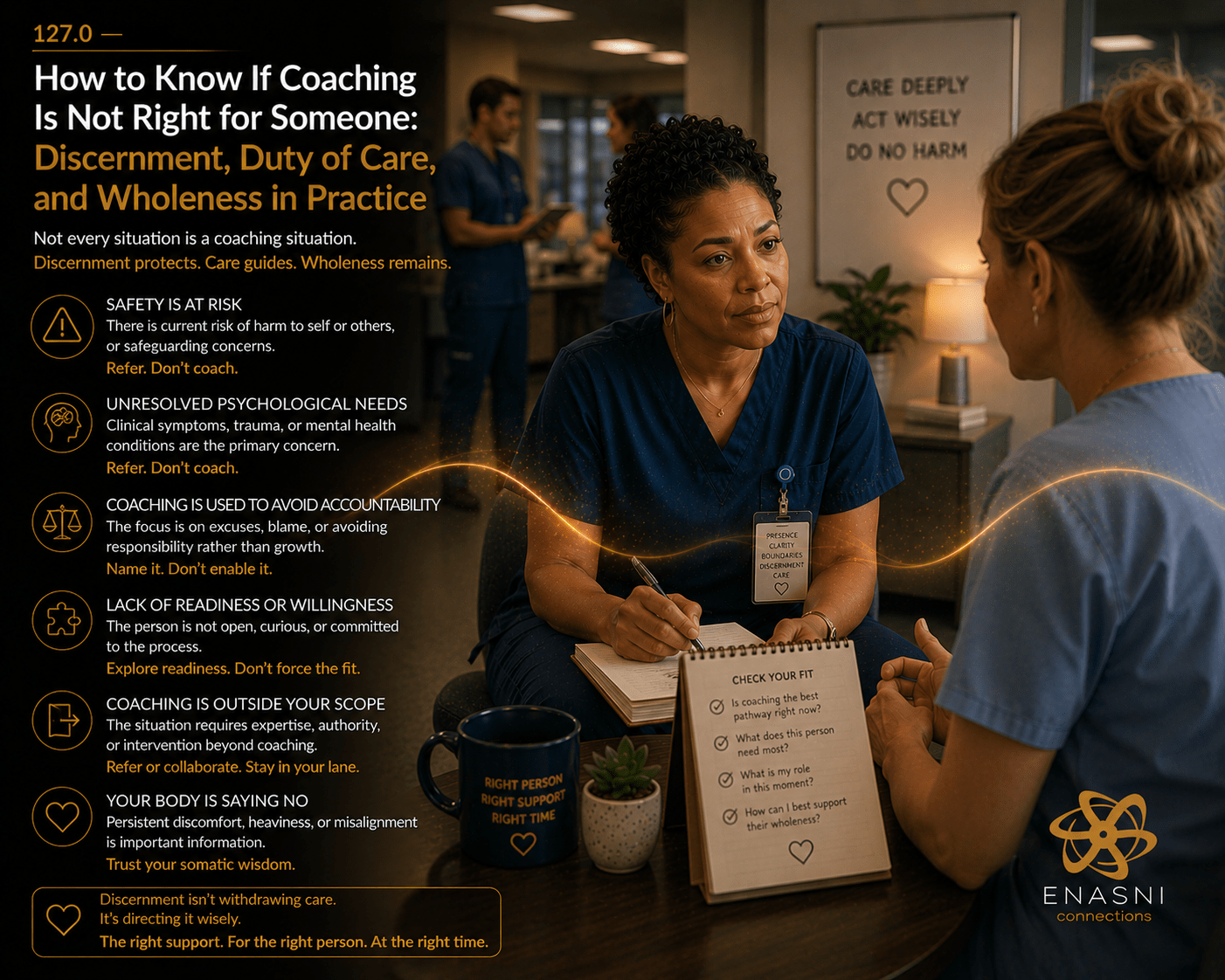
Discernment, Duty of Care, and Wholeness in Practice
Knowing whether coaching is right for someone matters because good intention is far removed from good care, and especially because coaching must never override safety, dignity, or appropriate clinical support — from a wholeness perspective.
This post clarifies how to discern readiness for coaching, how to recognise when coaching is not the right intervention, and how ethical responsibility must always take precedence over continuation of work — from a wholeness perspective.
Coaching Is Not Always the Right Support
Coaching assumes a baseline of:
- psychological stability
- capacity for reflection
- ability to engage with goals
- responsibility for action
When these foundations are compromised, continuing coaching is not supportive — it is unsafe.
Wholeness requires accurate discernment, not persistence.
Early Signals That Coaching May Not Be Appropriate
A single indicator may not require action.
A pattern of indicators requires immediate attention.
The following are signals that coaching may no longer be the appropriate support .
Key Indicators to Notice
1. Loss of Pleasure and Hope
- reduced ability to experience enjoyment
- persistent sadness, hopelessness, or helplessness
- repeated statements that life is awful and nothing can be done
This reflects diminished capacity for future-oriented work.
2. Withdrawal From Meaningful Life Engagement
- declining interest in previously enjoyed activities
- disengagement from goals, dreams, or desires
- frequent “why bother” statements
Coaching requires a minimum orientation toward possibility.
3. Cognitive Disruption
- intrusive thoughts
- inability to concentrate
- difficulty completing agreed actions
- confusion about what got in the way
This suggests compromised executive capacity.
4. Sleep and Energy Disturbance
- chronic insomnia or excessive sleep
- waking during the night and inability to return to sleep
- exhaustion affecting daily functioning
Persistent fatigue reduces coaching capacity.
5. Appetite and Behavioural Changes
- loss of appetite or compulsive eating
- eating without pleasure
- withdrawal from shared meals
These shifts often reflect deeper dysregulation.
6. Guilt, Unworthiness, and Survivor Beliefs
- guilt about being alive when others have suffered or died
- beliefs that they do not deserve a good life
- reluctance to pursue goals due to perceived unworthiness
These beliefs require therapeutic containment.
7. Despair and Hopelessness
- statements that life is not worth living
- missed sessions without explanation
- desire to quit because “nothing matters”
This is not resistance — it is collapse.
8. Hypervigilance or Exhaustion
- inability to relax
- exaggerated startle response
- constant alertness or extreme fatigue
The nervous system is not in a state to support coaching.
9. Increased Irritability or Aggression
- frequent anger or outbursts
- belligerence or argumentative behaviour
- thoughts or actions about harming self or others
- impulsive, risky behaviour without regard for consequence
This requires immediate reassessment.
10. Thoughts of Death or Suicide
- fascination with dying
- statements that death would be acceptable or preferable
- references to methods, plans, or desire to “leave”
- marked personality shift to coldness or withdrawal
This requires immediate action.
What Ethical Action Requires
When indicators of self-harm or suicide appear:
- take the client seriously
- express care and concern
- state clearly that safety comes first
- explain that confidentiality must be broken
- contact emergency services (A&E / 999 in the UK)
This is not betrayal at all.
This is duty of care.
All observations must be:
- documented
- referred
- followed up urgently
Referral Is Not Failure
Everyone may experience one or two of these indicators briefly.
When multiple indicators are present and persistent, referral to:
- a psychotherapist
- a community mental health team
- clinical services
is required.
Coaching must stop.
Wholeness demands appropriate support, not inappropriate persistence.
In Essence
Coaching is powerful — and therefore bounded.
True professionalism lies in knowing:
- when to proceed
- when to pause
- and when to step aside
Wholeness in coaching is not about doing more.
It is about doing what is right, safe, and human — from a wholeness perspective.
Key Learning Points (KLPs)
- Coaching requires baseline psychological capacity
- Patterns matter more than isolated indicators
- Loss of hope undermines coaching readiness
- Intrusive thoughts and collapse signal referral
- Suicide risk requires immediate escalation
- Confidentiality does not override safety
- Ethical discernment is core coaching competence
Action Points (APs)
- Learn and recognise warning indicators clearly
- Document and refer without delay
- Build referral pathways before they are needed
Keywords
is coaching right for the client, coaching readiness assessment, applied wholeness coaching, ethical coaching boundaries, mental health referral, duty of care in coaching, coaching judgement, Enasni Connections