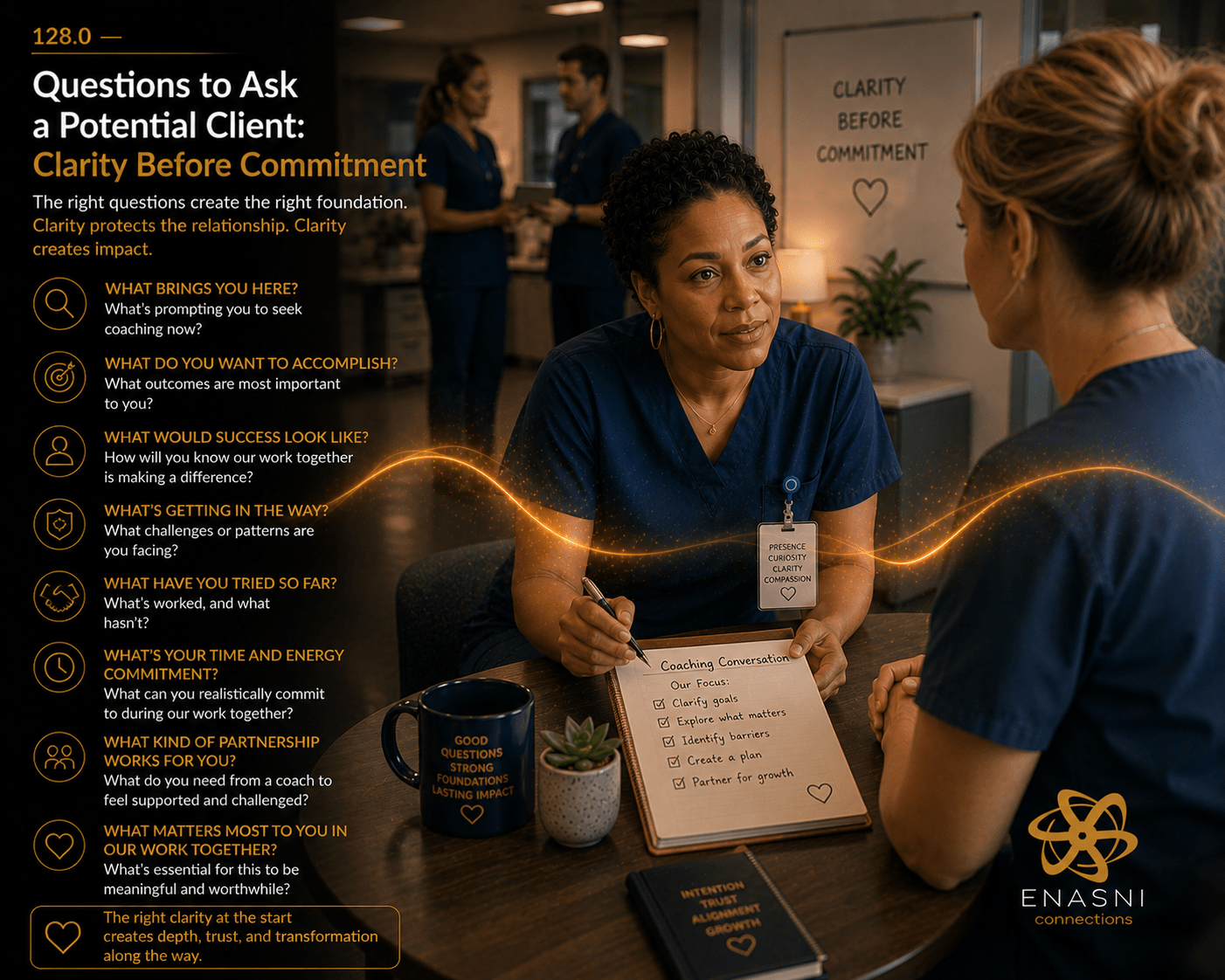
Clarity Before Commitment
Asking the right questions matters because alignment is far removed from assumption, and especially because the intake conversation determines safety, suitability, and effectiveness long before coaching begins.
This post clarifies which questions support discernment, readiness, and mutual clarity during early contact and intake, ensuring coaching begins on clean ground from a wholeness perspective.
Why Intake Questions Matter
Intake questions are not screening tools in a transactional sense.
They are orientation tools.
They help:
- clarify understanding
- surface expectations
- assess readiness
- establish responsibility
- prevent misalignment
Good questions reduce future friction.
Core Orientation Questions
These questions establish shared understanding and language :
- What do you understand coaching to be?
- Have you had coaching before?
- If yes, how did you find that experience?
These questions reveal:
- assumptions
- prior conditioning
- potential misconceptions
They allow early calibration.
Purpose and Intention Questions
These questions clarify why coaching is being sought:
- What would you like to use coaching for?
- What is it that has brought you to coaching now?
- How do you think coaching might help you?
The aim is not to refine goals yet, but to understand orientation toward change.
Expectation and Outcome Questions
These questions surface implicit expectations:
- What do you expect to achieve through coaching?
- What would make this experience feel worthwhile for you?
Listening here prevents:
- unrealistic expectations
- outcome pressure
- role confusion
Expectation clarity protects both client and coach.
Context and Disclosure Questions
These questions support ethical awareness:
- What do you think I may need to know about you?
This creates space for:
- relevant context
- health considerations
- life circumstances
Disclosure is invited, not demanded.
Practical and Logistical Questions
These questions establish feasibility:
- How did you hear about me?
- How soon would you like to start?
- What days and times work best for you for coaching sessions?
Practical clarity supports continuity and commitment.
How These Questions Fit the Intake Checklist
These questions:
- complement the intake form
- inform the intake session
- support contracting and readiness assessment
They are not asked rigidly or all at once.
They are used relationally and responsively.
The Coach’s Responsibility in Asking
The coach’s role is to:
- listen without evaluation
- notice patterns rather than answers
- assess suitability honestly
- pace the conversation appropriately
Questions are information-gathering — not interrogation.
In Essence
Asking thoughtful intake questions is not about control.
It is about clarity, consent, and coherence.
When early questions are well chosen, coaching begins with trust rather than correction.
Key Learning Points (KLPs)
- Intake questions orient both client and coach
- Understanding coaching assumptions prevents misalignment
- Purpose questions reveal readiness
- Expectation clarity protects the relationship
- Disclosure must be invitational
- Practical questions support sustainability
- Questions should be used relationally
Action Points (APs)
- Integrate these questions into the intake checklist
- Use questions flexibly rather than as a script
- Reflect on patterns across client responses
Keywords
intake questions for coaching, potential client questions, coaching intake process, applied wholeness coaching, coaching readiness assessment, ethical coaching intake, professional coaching practice, Enasni Connections