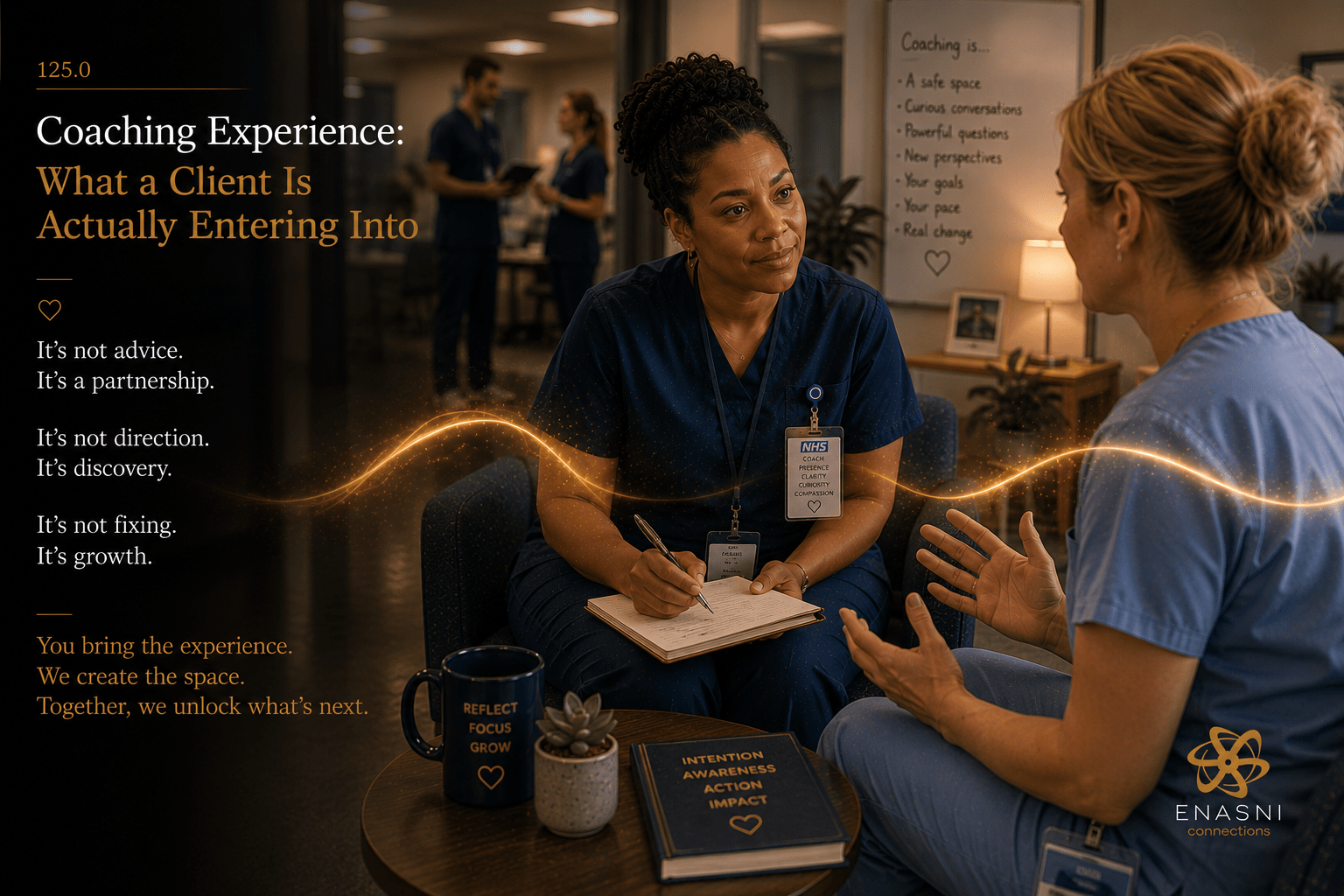
What a Client Is Actually Entering Into
Coaching experience matters because expectations are far removed from outcomes on their own, and especially because the quality of experience determines safety, clarity, and traction from the very beginning — from a wholeness perspective.
This post clarifies what the coaching experience is like in practice, how it unfolds, what is expected from both sides, and why experience is not a vague promise but a deliberately designed container — from a wholeness perspective.
What “Coaching Experience” Really Means
The coaching experience is not a single session.
It is not a technique.
It is not a motivational conversation.
The coaching experience is the entire relational, structural, and developmental journey a client enters into — how contact begins, how clarity forms, how safety is established, and how responsibility is shared .
A Coaching Experience That Evolves With the Client
The coaching experience is intentionally tailored.
It deepens as understanding deepens.
The more a coach knows the client, the more refined, accurate, and impactful the sessions become. This is not personalisation for comfort — it is personalisation for precision and power.
Sessions are designed to:
- feel safe
- increase clarity
- surface personal power
- support grounded action
This is not about dependency.
It is about seeing reality more clearly.
How the Coaching Experience Begins
Before the first session, the experience already starts.
Typically, this includes:
- initial emails and orientation
- light health and context checks
- a short questionnaire (no more than ten questions)
- reflective reading to prepare the ground
This stage is not administration.
It is priming the system for effective work.
Mapping Life Before Moving It
A core part of the early experience is the Wheel of Life.
This provides:
- a visual map of current life areas
- clarity on strengths and pressure points
- a shared reference for future work
Clients gain immediate insight into:
- what is stable
- what is strained
- what needs attention
This creates shared language and orientation before any depth is introduced .
The Intake Session as Foundation
The intake session is booked in advance and treated as foundational.
This session covers:
- what coaching is — and is not
- what to expect from the relationship
- contracting and boundaries
- questions and concerns
- initial clarity and direction
The aim is not intensity.
The aim is orientation, safety, and agency.
Clients leave the intake with:
- understanding
- realistic expectations
- an initial action or reflection
What Is Expected of the Client
The expectation is simple — and significant:
Be all in.
This does not mean perfection.
It means:
- honesty
- engagement
- willingness to reflect
- responsibility for action
Coaching works when participation is active, not passive.
Wholeness requires ownership.
The Role of the Coach in the Experience
The coach’s responsibility is to:
- design a safe, coherent container
- adapt sessions as understanding deepens
- maintain ethical and professional boundaries
- support clarity rather than control outcomes
The coach does not carry the client.
The coach holds the process.
Why Experience Is the Backbone of Professional Judgement
A well-designed coaching experience:
- reduces confusion
- prevents dependency
- protects dignity
- enables sustainable change
Judgement develops not through technique, but through repeated exposure to real human process within a clean structure — from a wholeness perspective.
In Essence
The coaching experience is not accidental.
It is designed, paced, and lived.
When the experience is coherent, the work becomes lighter, deeper, and more effective — not because effort increases, but because wholeness is built into the process itself.
Key Learning Points (KLPs)
- Coaching experience begins before the first session
- Structure creates safety, not rigidity
- Tailoring improves precision over time
- The Wheel of Life provides shared orientation
- Intake sessions establish ethical foundations
- Client responsibility is essential
- Experience shapes judgement through lived practice
Action Points (APs)
- Clarify what experience is being offered, not just sessions
- Design onboarding as part of the coaching work
- Set clear expectations for client participation
Keywords
coaching experience, applied wholeness coaching, client coaching journey, intake session design, coaching structure, professional coaching practice, ethical coaching container, Enasni Connections