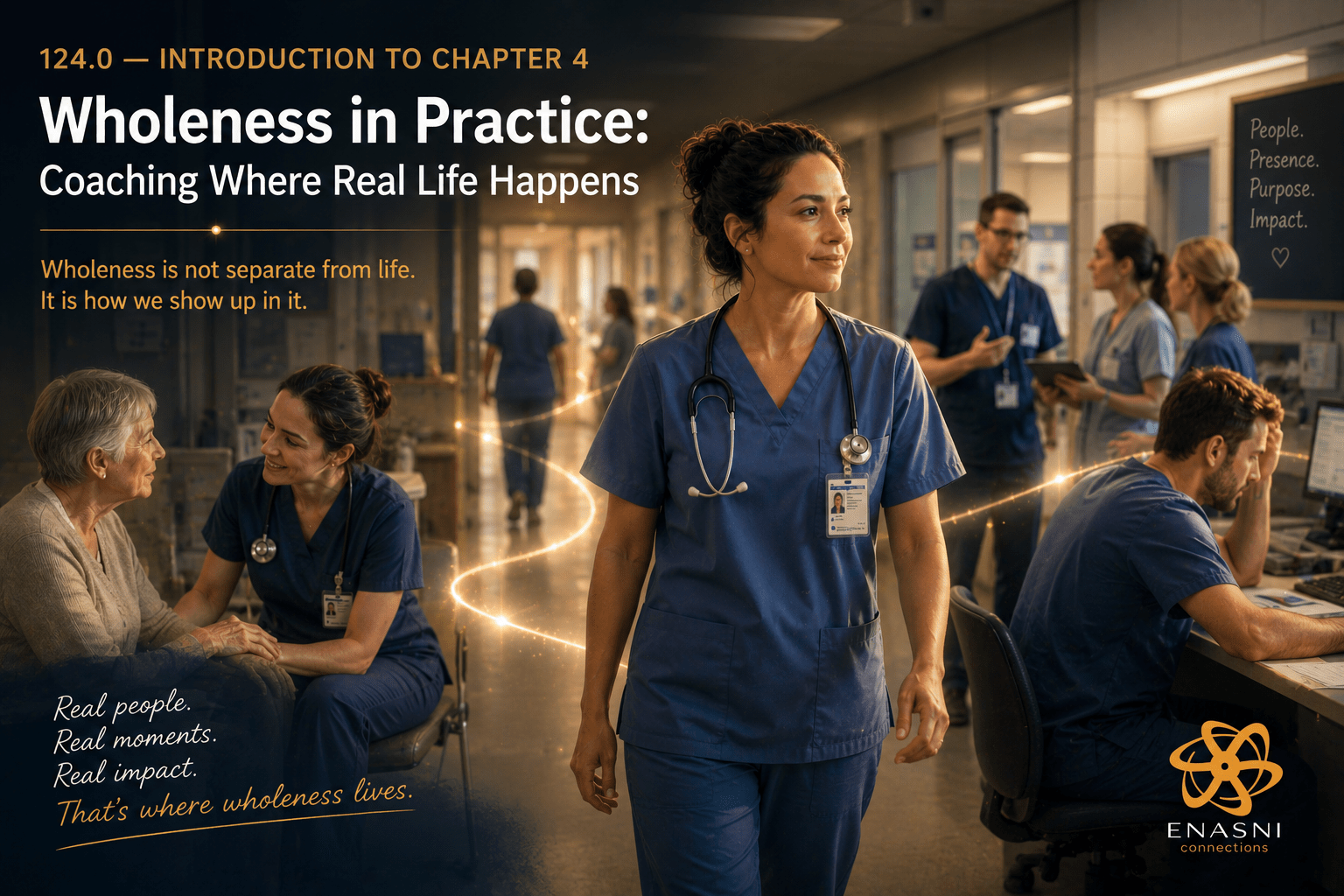
Wholeness in Practice: Coaching Where Real Life Happens
Chapter 4 matters because coherence is far removed from abstraction, and especially because coaching only proves its value when it meets humans in real, complex, lived conditions.
Chapter 3 established mastery at the level of:
- presence
- judgement
- identity
- regulation
- ethical grounding
Chapter 4 now turns toward application.
This chapter explores how wholeness-informed coaching operates across the full lifecycle of real coaching relationships — from first contact to closure, from structure to intuition, from ethics to endurance.
What Chapter 4 Is About
Chapter 4 is where coaching:
- leaves the conceptual space
- enters lived professional reality
- meets money, boundaries, contracts, endings, and responsibility
This is not theory anymore.
This is coaching in motion.
Key Domains Covered in Chapter 4
1. The Coaching Relationship in Practice
- What actually constitutes a successful coaching relationship
- How trust forms over time
- Why coherence matters more than chemistry
Wholeness here means relational stability, not emotional fusion.
2. Intake, Contracting, and Ethical Grounding
- How to assess readiness honestly
- When coaching is not the right intervention
- Contracting as ethical containment, not bureaucracy
- Payment, scope, responsibility, and clarity
Wholeness demands clean edges.
3. Session Flow and Professional Judgement
- Running intake sessions
- Preparing without over-controlling
- Reviewing progress without performance pressure
- Knowing when to intervene — and when not to
This is where judgement replaces scripts.
4. Progress, Review, and Adaptation
- Tracking progress without reductionism
- Adjusting approach as the client system evolves
- Recognising when coaching has done its work
Wholeness values completion, not dependency.
5. Endings, Ethics, and Sustainability
- Ending coaching relationships well
- Ethical responsibility at closure
- Avoiding unconscious attachment or drift
- Maintaining professional rhythm over time
Endings are not failures.
They are signs of integrity.
6. Coaching as a Lived Profession
- Developing sustainable cadence
- Balancing depth with practicality
- Reading, development, supervision, and reflection
- Knowing what comes next — for both coach and client
Wholeness here means a profession that does not consume the practitioner.
How This Chapter Builds on Wholeness
Wholeness in Chapter 4 is not philosophical.
It is operational.
It shows up as:
- clarity instead of confusion
- boundaries instead of burnout
- rhythm instead of intensity
- completion instead of endless work
This chapter answers a different question:
What does wholeness look like when coaching meets reality?
In Essence
Chapter 4 is where coaching becomes durable.
Not just effective in sessions — but ethical, sustainable, and fit for the complexity of human life.
This is wholeness in practice, not principle.
Welcome to Chapter 4.
Keywords
chapter 4 introduction, applied wholeness coaching, coaching in practice, ethical coaching lifecycle, professional coaching delivery, coaching judgement in action, sustainable coaching practice, Enasni Connections