

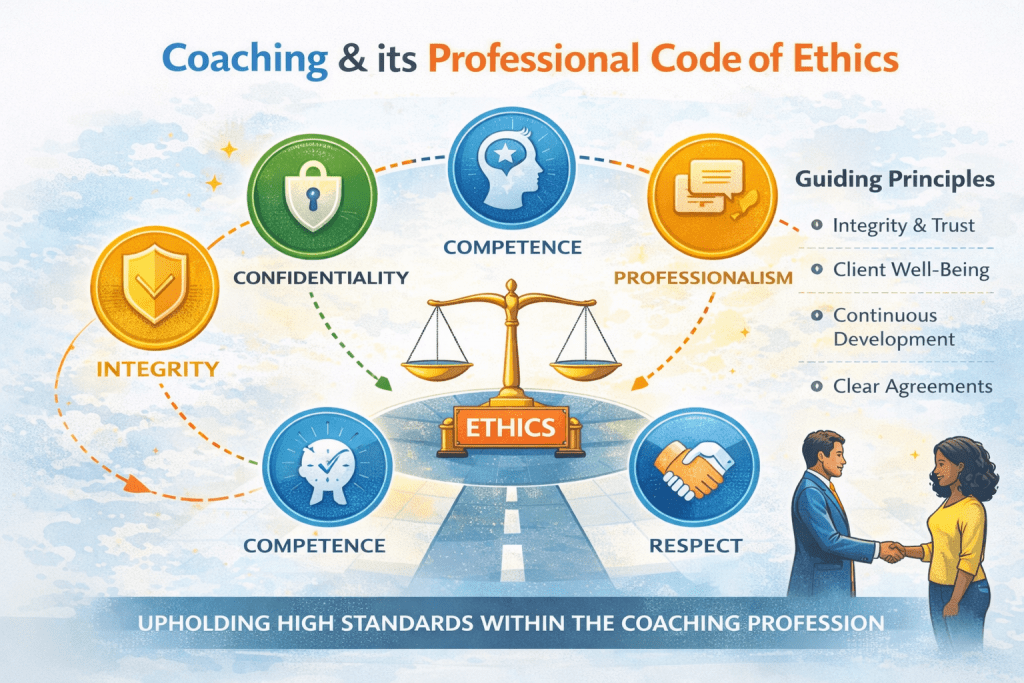
Coaching and its Professional Code of Ethics define the moral backbone of professional coaching practice.
They give the discipline its integrity — a shared standard that protects the client, honours the profession, and sustains public trust.
Ethics is the quiet backbone of professional coaching. It’s what gives the practice its integrity — a shared standard that protects the client, honours the profession, and keeps we as coaches aligned with truth.
At Enasni, we see ethics as rules to obey, and also as values to embody. They remind us who we are when no one is watching. Think values in action.
The evolution of coaching as a discipline and its historical development, explored in our piece on the origins of coaching practice, reveals how ethical structure matured alongside professional identity.
The Core of Ethical Practice
Coaching and its Professional Code of Ethics provide clarity in moments of complexity, guiding decisions with integrity and consistency.
It sets out the principles that govern every coach’s conduct — whether working with individuals, teams, or organisations. It’s a living commitment to accountability, respect, and responsibility.
Every serious coaching practice aligns itself with Coaching and its Professional Code of Ethics — a shared language of trust and integrity. While each organisation shapes its own emphasis, the heartbeat remains consistent: serve the client, honour the truth, and protect the profession.
5 Most Influential Codes in Modern Coaching:
Coaching and its Professional Code of Ethics operate as a living framework, shaping decision-making in real time. Without Coaching and its Professional Code of Ethics, consistency across the profession would weaken and trust would fragment.
- International Coaching Federation (ICF) – The global benchmark for coaching ethics, built around integrity, professionalism, confidentiality, and continuous development.
- European Mentoring & Coaching Council (EMCC) – Centres on competence, fairness, and humanity, highlighting reflective practice and supervision as ethical essentials.
- Association for Coaching (AC) – Promotes responsibility, equality, transparency, and the wellbeing of both coach and client within clear contractual boundaries.
- Institute of Leadership & Management (ILM) – Emphasises accountability, clarity of purpose, and ethical decision-making within organisational and leadership contexts.
- British Psychological Society (BPS) – Coaching Division – Applies psychological rigour to coaching ethics, ensuring evidence-based practice, safeguarding, and respect for individual differences.
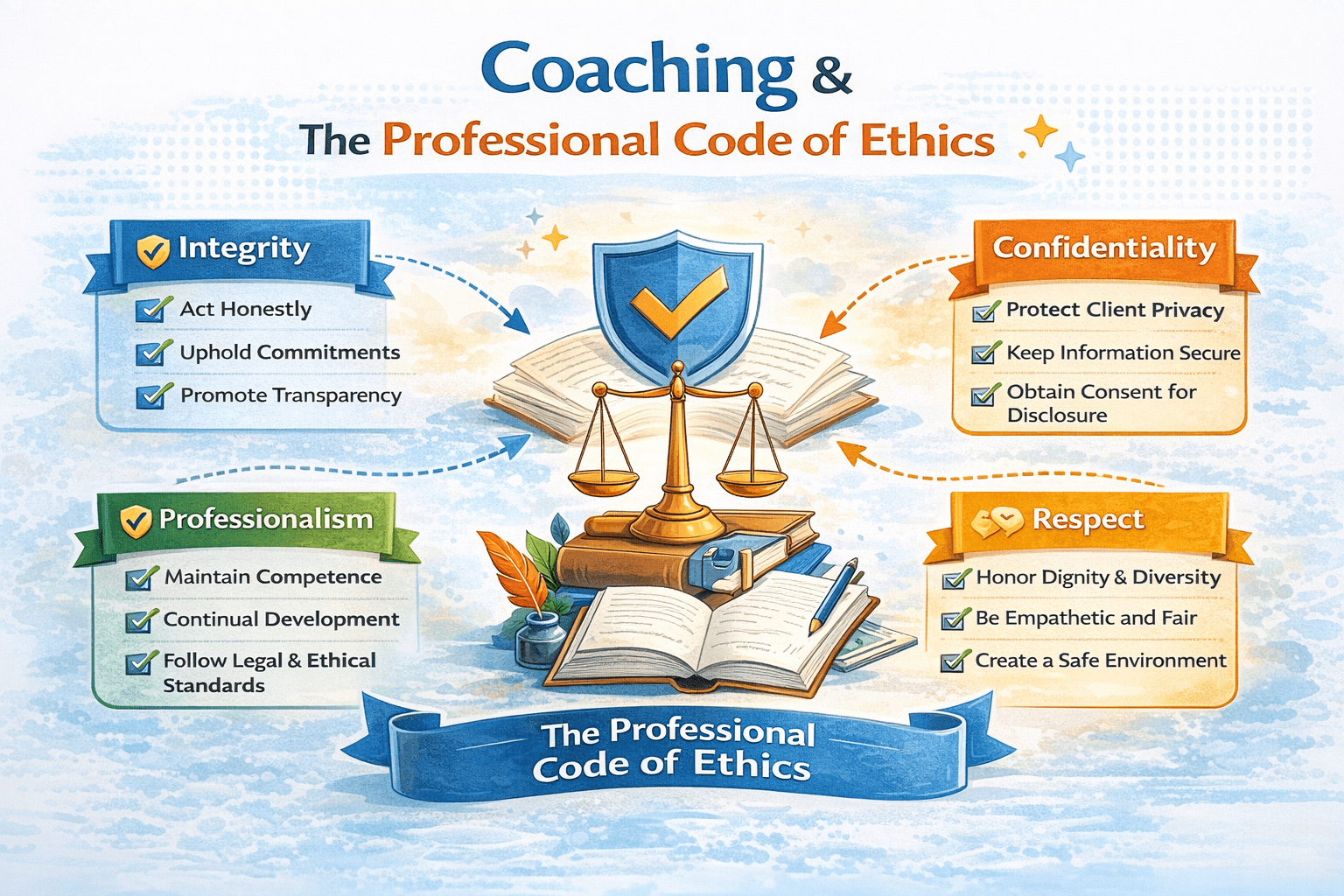
Though each differs in structure, together they form a collective standard aligned with Coaching and its Professional Code of Ethics, a standard that Enasni Connections upholds through every interaction.
To coach ethically, therefore, is to:
- Treat every client with dignity, confidentiality, and equality.
- Establish clear agreements before beginning work.
- Maintain professional boundaries grounded in mutual respect.
- Avoid any form of personal, professional, or financial exploitation.
- Keep accurate, secure records in line with data protection laws (GDPR).
- Be transparent about qualifications, experience, and fees.
- Avoid promising outcomes that cannot be guaranteed.
Ethics, in the end, is about compliance and, more importantly, about congruence. Within Coaching and its Professional Code of Ethics, values as a coach meet actions moment by moment in service of another’s growth.
Boundaries and Accountability
Every coaching relationship is a balance of care and professionalism.
Our empathy must always be framed by boundaries. Emotional connection is vital — entanglement is not.
Professional ethics protect both sides of the relationship. They clarify expectations, preserve autonomy, and ensure that trust remains unbroken.
And when dilemmas arise — as they inevitably do — the ethical code becomes the map that helps us as coaches navigate ambiguity with integrity.
The Continuous Practice of Integrity
Ethical awareness isn’t something a coach “masters.” It evolves alongside experience.
Each new client, culture, and challenge tests how those principles live in practice. That’s why ongoing professional development isn’t just encouraged — it’s essential.
It is how we stay accountable to both our clients and ourselves.
Key Learning Points
- Every coach must adhere to a professional code of ethics to protect clients and the integrity of the profession.
- Core principles include integrity, accountability, and respect in all interactions.
- Clear agreements and transparent communication are non-negotiable.
- Confidentiality and proper record-keeping uphold client trust and legal compliance.
- Coaches must avoid conflicts of interest and never promise outcomes that cannot be guaranteed.
- Ongoing professional development sustains ethical competence over time.
Action Points
- Establish clear coaching agreements before any session begins.
- Maintain professional boundaries and confidentiality in line with ethical and legal standards.
- Engage in continuous learning to refine ethical awareness and practice integrity.
In Essence
Ethics is often thought as the edge of coaching — those thinkers are incorrect; it is the ground it stands on.
Ethical clarity also shapes the qualities of a great coach, reinforcing presence, accountability, and trust in every interaction.
It reminds we, coaches that growth without integrity is hollow.
At Enasni Coaching, our promise is simple: to coach with the fruits of the spirit in a vessel of honour, respect, and transparency.
Because when ethics lead, trust follows — and true transformation becomes possible.