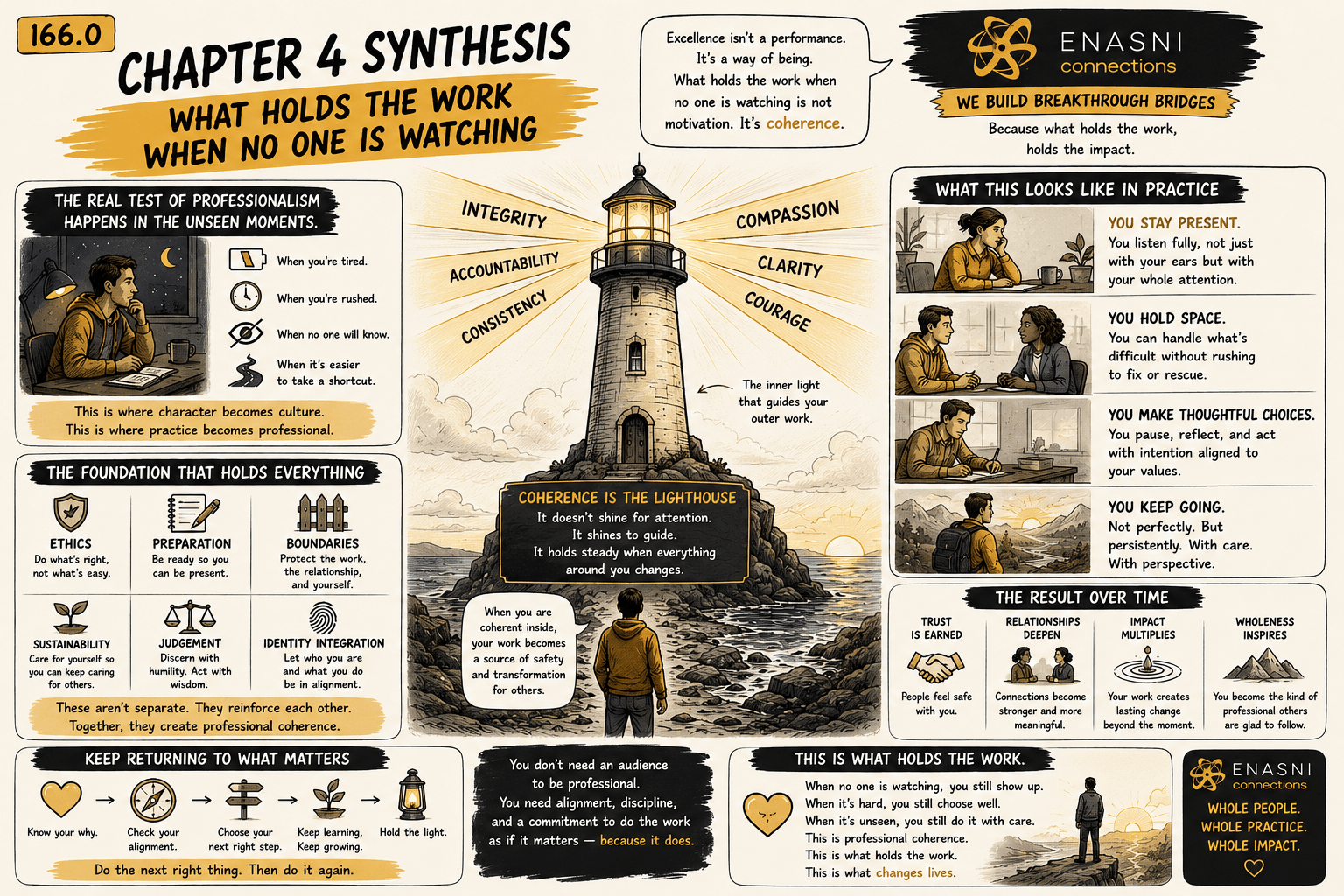
What Holds the Work When No One Is Watching
Chapter 4 matters because competence is far removed from trustworthiness on its own, and especially because what defines a profession is not what it teaches, but what it reliably holds under pressure.
This synthesis integrates the full arc of Chapter 4 into one organising stance — showing how ethics, preparation, boundaries, sustainability, judgement, and identity interlock to create practice that is stable, humane, and worthy of trust from a wholeness perspective.
From Technique to Containment
Across Chapter 4, a deliberate shift occurred:
- away from technique accumulation
- toward containment and responsibility
The work moved from how to do coaching to how coaching is held.
Containment emerged as the invisible infrastructure:
- ethics regulate power
- preparation transfers ownership
- boundaries preserve clarity
- supervision absorbs complexity
Without containment, skill becomes unsafe.
Ethics as Structural Integrity
Ethics were repositioned as:
- behavioural constraints
- role-based obligations
- client-protective systems
Morality became insufficient.
Good intentions were shown to be unreliable.
Ethics emerged as structural integrity — the load-bearing framework that allows coaching to exist without harm.
Preparation as the Architecture of Wholeness
Preparation unified the chapter.
It connected:
- responsibility with agency
- reflection with action
- energy with capacity
Preparation was no longer administrative.
It became the engineering layer where wholeness is built and maintained.
Wholeness stopped being conceptual.
It became operational.
Boundaries, Sustainability, and Supervision as One System
These were not treated as separate topics.
Together, they formed a protective triad:
- boundaries define limits
- sustainability preserves capacity
- supervision absorbs pressure
When one weakens, the others strain.
When all three are present, practice stabilises.
Judgement as the Core Professional Skill
Judgement replaced certainty.
Grey zones were named as inevitable, not exceptional.
The capacity to:
- pause
- tolerate ambiguity
- resist premature action
- hold responsibility
was revealed as the heart of mastery.
Judgement was shown to develop through exposure, not instruction.
Identity as a Living System
Professional identity was reframed as:
- shaped by exposure
- strained by pressure
- stabilised by reflection
Frontline and support professionals were shown to carry intensified identity load.
Wholeness required differentiation:
service without self-erasure
Identity matured when work became one expression of self — not the whole self.
Wellbeing and Wellness Found Their Proper Place
Wellbeing and wellness were de-centred without being diminished.
They became:
- wellbeing: a live signal
- wellness: maintenance infrastructure
Neither was sufficient alone.
Both were necessary.
Wholeness integrated them without elevating them into identity.
The Bridge as the Unifying Metaphor
The bridge held everything together.
It represented:
- movement without collapse
- access without rescue
- change without abandonment
From this metaphor flowed:
- the name Enasni Connections
- the tagline Building Breakthrough Bridges
Language aligned with practice.
The Coherent Stance That Emerged
By the end of Chapter 4, a clear stance stood:
- coaching is a bounded profession
- ethics override intention
- preparation creates agency
- boundaries protect dignity
- sustainability preserves judgement
- supervision contains complexity
- wholeness integrates rather than amplifies
Nothing here relies on intensity.
Everything relies on structure.
What Chapter 4 Ultimately Established
Chapter 4 did not ask:
How skilled are you?
It asked:
What can you hold — repeatedly, responsibly, and without collapse?
That question defines professionalism.
In Essence
Chapter 4 established that trustworthy practice is not built through force or inspiration.
It is built through:
- containment
- responsibility
- coherence
- restraint
Wholeness is not an outcome.
It is the condition that allows work to endure.
Key Learning Points (KLPs)
- Containment makes skill safe
- Ethics provide structural integrity
- Preparation operationalises wholeness
- Boundaries, sustainability, and supervision interlock
- Judgement matures through ambiguity
- Identity requires differentiation
- Wholeness integrates rather than intensifies
Action Points (APs)
- Assess practice for containment, not just competence
- Strengthen weak structural supports
- Prioritise what preserves judgement over time
Keywords
Chapter 4 synthesis, applied wholeness coaching, professional containment, coaching ethics and sustainability, coaching judgement, professional identity development, Enasni Connections