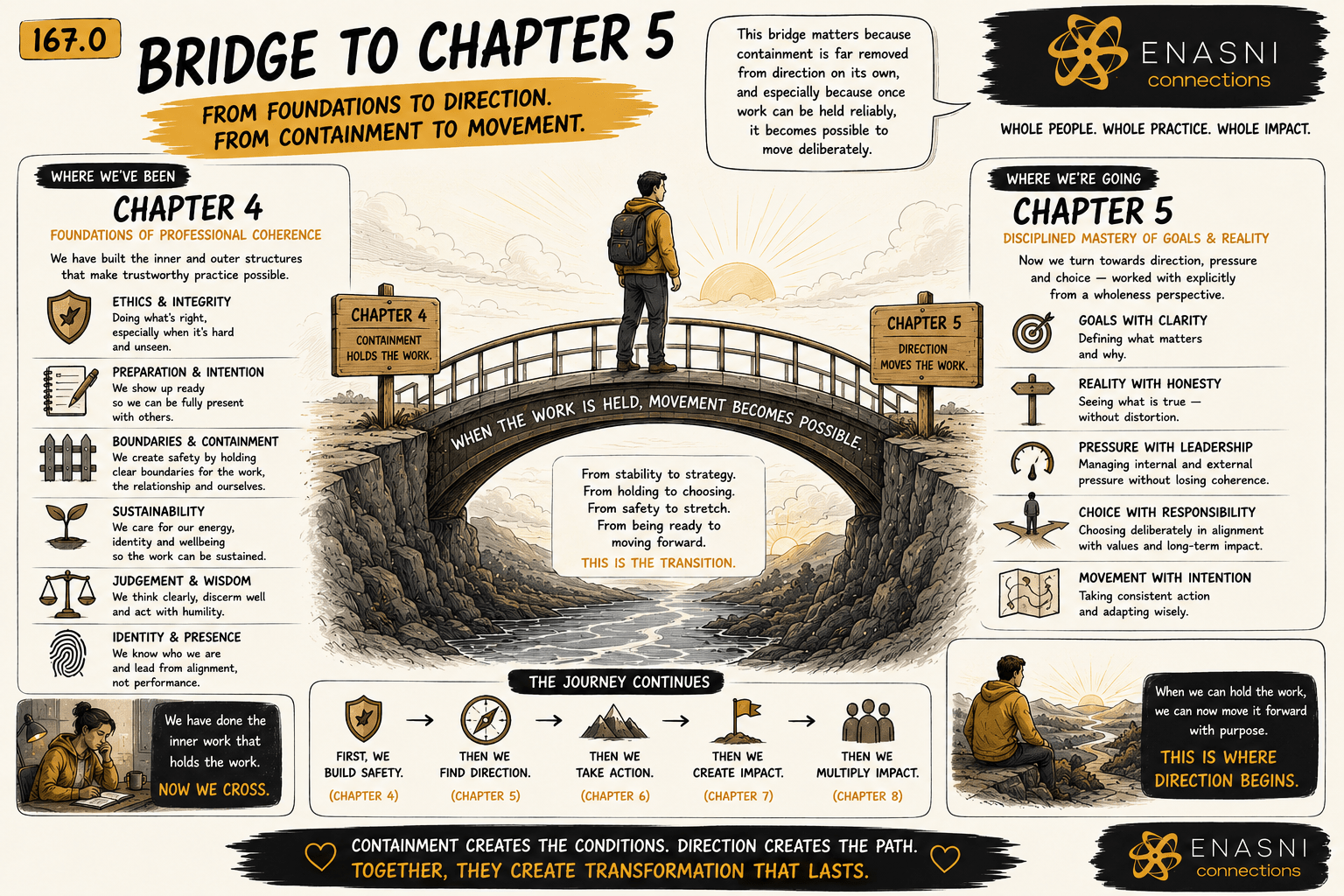
From Holding the Work to Directing It
This bridge matters because containment is far removed from direction on its own, and especially because once work can be held reliably, it becomes possible to move deliberately.
This post marks the transition from Chapter 4 into Chapter 5 — from the foundations of professional wholeness, ethics, preparation, judgement, and sustainability, into the disciplined mastery of Goals and Reality, where direction, pressure, and choice are worked with explicitly from a wholeness perspective.
What Chapter 4 Made Possible
Chapter 4 established the conditions for safe movement.
It clarified:
- how coaching is contained
- how ethics regulate power
- how preparation creates agency
- how boundaries preserve dignity
- how sustainability protects judgement
- how identity matures without collapse
By the end of Chapter 4, the work could be:
- held without urgency
- sustained without depletion
- trusted without supervision gaps
Only then does direction become responsible.
Why Direction Comes After Containment
Goals without containment create pressure.
Reality without preparation creates overwhelm.
Chapter 4 ensured:
- pressure could be tolerated
- ambiguity could be held
- responsibility could be carried
Chapter 5 builds on this by asking:
Now that the system is stable — where are we actually going?
Direction without stability is force.
Direction with stability is mastery.
Chapter 5 Focus: Mastery of Goals and Reality
Chapter 5 turns toward:
- how goals are formed responsibly
- how reality is assessed without distortion
- how pressure shapes decision-making
- how capacity limits direction
- how choice is clarified under constraint
Goals are no longer treated as motivation.
They are treated as structural commitments.
Reality is no longer resisted.
It is worked with.
Why Goals Are Ethical Constructs
Goals shape:
- behaviour
- identity
- energy allocation
- relational strain
Poorly formed goals damage wholeness.
Chapter 5 will explore:
- goals aligned with capacity
- goals shaped by reality rather than fantasy
- goals that integrate wellbeing, wellness, and responsibility
Mastery here prevents self-violence disguised as ambition.
Reality as Information, Not Obstacle
Reality will be treated as:
- feedback
- constraint
- orientation
Not as:
- something to bypass
- something to “overcome”
- something to reframe prematurely
Reality is the ground.
Goals that ignore it collapse.
Pressure as a Teacher
Chapter 5 will also examine pressure:
- how it narrows attention
- how it distorts goals
- how it reveals values
- how it exposes capacity limits
Pressure will be worked with — not eliminated.
This is where wholeness meets direction.
Integration With the Beyond Stress Themes
The early chapters of Chapter 5 will integrate the first ten themes from the Beyond Stress conversations:
- capacity
- regulation
- decision-making under load
- cognitive narrowing
- identity under pressure
These themes will not be added.
They will be applied.
What Changes at This Threshold
Up to now, the work has focused on:
- holding
- stabilising
- protecting
From here on, the work shifts to:
- choosing
- directing
- committing
Not faster.
Clearer.
In Essence
Chapter 4 taught how to hold the work.
Chapter 5 asks how to direct it without breaking what has been built.
This bridge exists to ensure movement happens with structure — not force.
The crossing begins here.
Key Learning Points (KLPs)
- Direction must follow containment
- Goals are structural commitments
- Reality is orientation, not resistance
- Pressure reveals capacity and values
- Wholeness enables responsible direction
Action Points (APs)
- Pause before setting new goals
- Assess whether containment is strong enough to support direction
- Prepare to work with reality rather than against it
Keywords
Chapter 5 bridge, mastery of goals and reality, applied wholeness coaching, direction and containment, ethical goal setting, working with reality, Enasni Connections