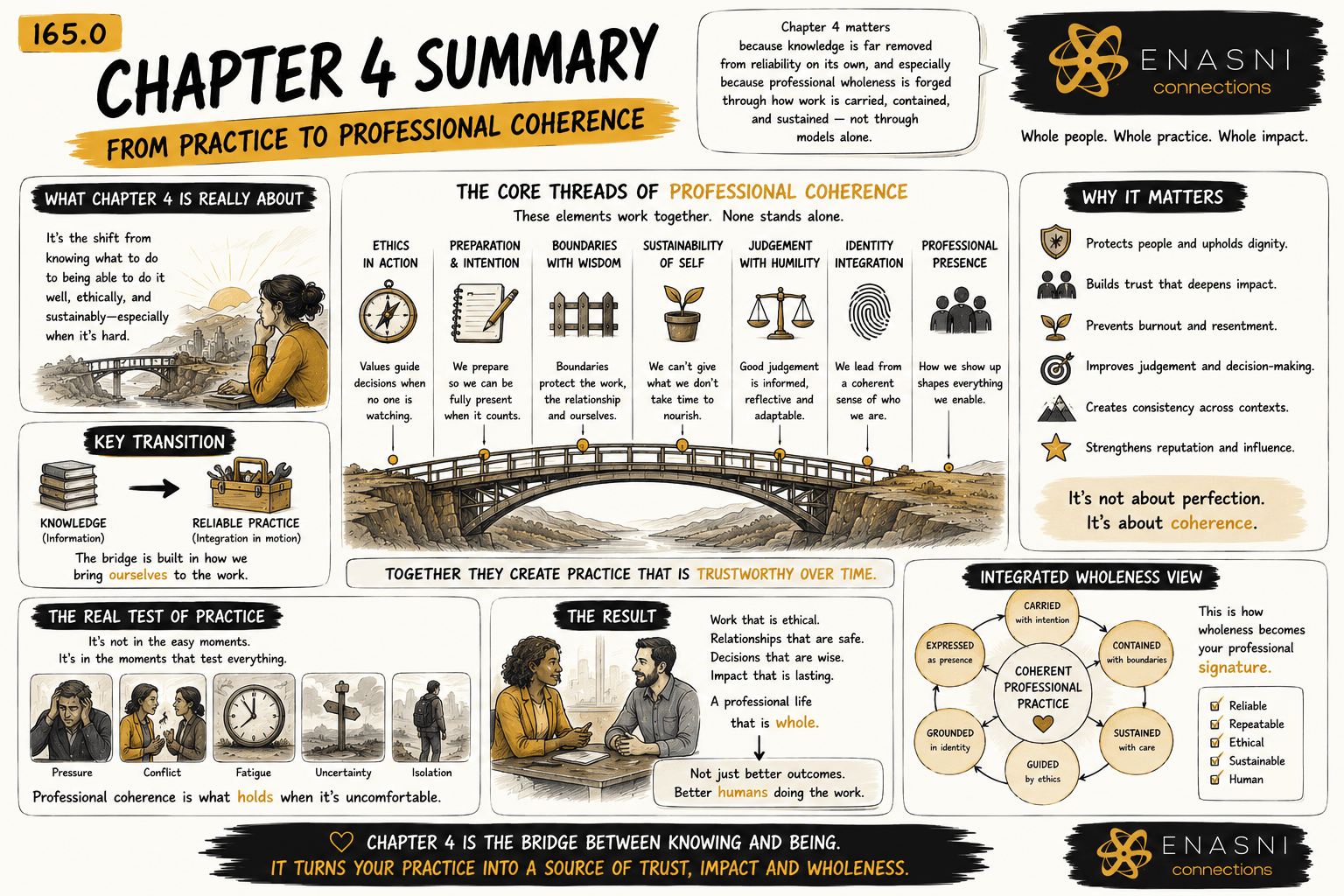
From Practice to Professional Coherence
Chapter 4 matters because knowledge is far removed from reliability on its own, and especially because professional wholeness is forged through how work is carried, contained, and sustained — not through models alone.
This summary gathers the core threads of Chapter 4 into a single integrated view, showing how ethics, preparation, boundaries, sustainability, judgement, and identity function together to create practice that is trustworthy over time from a wholeness perspective.
What Chapter 4 Set Out to Do
Chapter 4 did not aim to:
- teach more techniques
- expand theoretical frameworks
- motivate through intensity
Its purpose was to:
- ground coaching in lived reality
- stabilise professional judgement
- name what protects clients and practitioners
- articulate what sustains practice over time
The focus shifted from how to coach to how coaching is held.
The Coaching Lifecycle Was Made Explicit
The chapter walked through coaching as it actually unfolds:
- entering the relationship
- contracting and payment
- assessing suitability
- intake and preparation
- session flow and closure
- reviewing progress
- ending work cleanly
This lifecycle framing removed ambiguity.
Coaching was positioned as a bounded professional practice, not an open-ended relational space.
Ethics Moved From Theory to Lived Practice
Ethics were reframed as:
- power regulation
- boundary protection
- responsibility management
The distinction between morality and ethics clarified that:
- good intentions are insufficient
- character does not replace structure
- ethics exist to protect clients, not polish identity
Ethics became felt, operational, and unavoidable.
Preparation Was Reframed as Infrastructure
Preparation was no longer treated as admin.
It became:
- ownership transfer
- capacity protection
- coherence building
Across long-, medium-, and short-term preparation, responsibility was returned to the client, while the coach maintained clarity and containment.
Preparation emerged as the architecture of wholeness.
Boundaries, Sustainability, and Supervision Were Named
The chapter made explicit that:
- boundaries erode under pressure
- sustainability is an ethical obligation
- supervision is professional containment, not remediation
These elements were positioned as non-negotiable supports for long-term practice.
They protect:
- judgement
- capacity
- integrity
- clients
Judgement Took Centre Stage
Judgement was reframed as:
- the ability to hold ambiguity
- restraint in the absence of certainty
- responsibility without control
Grey zones were named as inevitable — and formative.
Mastery was shown to emerge through exposure, reflection, and time.
Identity Was Integrated, Not Idealised
Professional identity was explored as:
- evolving
- pressure-shaped
- vulnerable to over-identification
Particular attention was given to frontline and support roles, where emotional labour accelerates identity strain.
Wholeness was positioned as integration without self-erasure.
Wellbeing, Wellness, and Wholeness Were Differentiated
The chapter clarified:
- wellbeing as state and signal
- wellness as habit and maintenance
- wholeness as integration and coherence
None were elevated as sufficient alone.
Together, they formed a system — held in structure.
The Bridge Became the Central Metaphor
The bridge unified the chapter:
- change without collapse
- movement without rescue
- access without abandonment
This metaphor led naturally to:
- the name Enasni Connections
- the tagline Building Breakthrough Bridges
Language aligned with architecture.
What Chapter 4 Ultimately Delivered
Chapter 4 delivered:
- coherence over complexity
- responsibility over rescue
- sustainability over intensity
- judgement over certainty
It did not promise ease.
It delivered reliability.
In Essence
Chapter 4 established that professional wholeness is not achieved by adding more.
It is achieved by holding better:
- holding boundaries
- holding responsibility
- holding ambiguity
- holding identity
- holding the work over time
This is where practice becomes trustworthy.
Key Learning Points (KLPs)
- Coaching requires containment, not just skill
- Ethics regulate power, not intention
- Preparation is structural infrastructure
- Boundaries fail under pressure unless protected
- Sustainability is ethical, not optional
- Judgement matures through ambiguity
- Wholeness integrates rather than amplifies
Action Points (APs)
- Review practice for structural integrity
- Identify where containment needs strengthening
- Prioritise sustainability alongside competence
Keywords
Chapter 4 summary, applied wholeness coaching, professional coaching practice, ethics and boundaries coaching, coaching sustainability, professional judgement, Enasni Connections