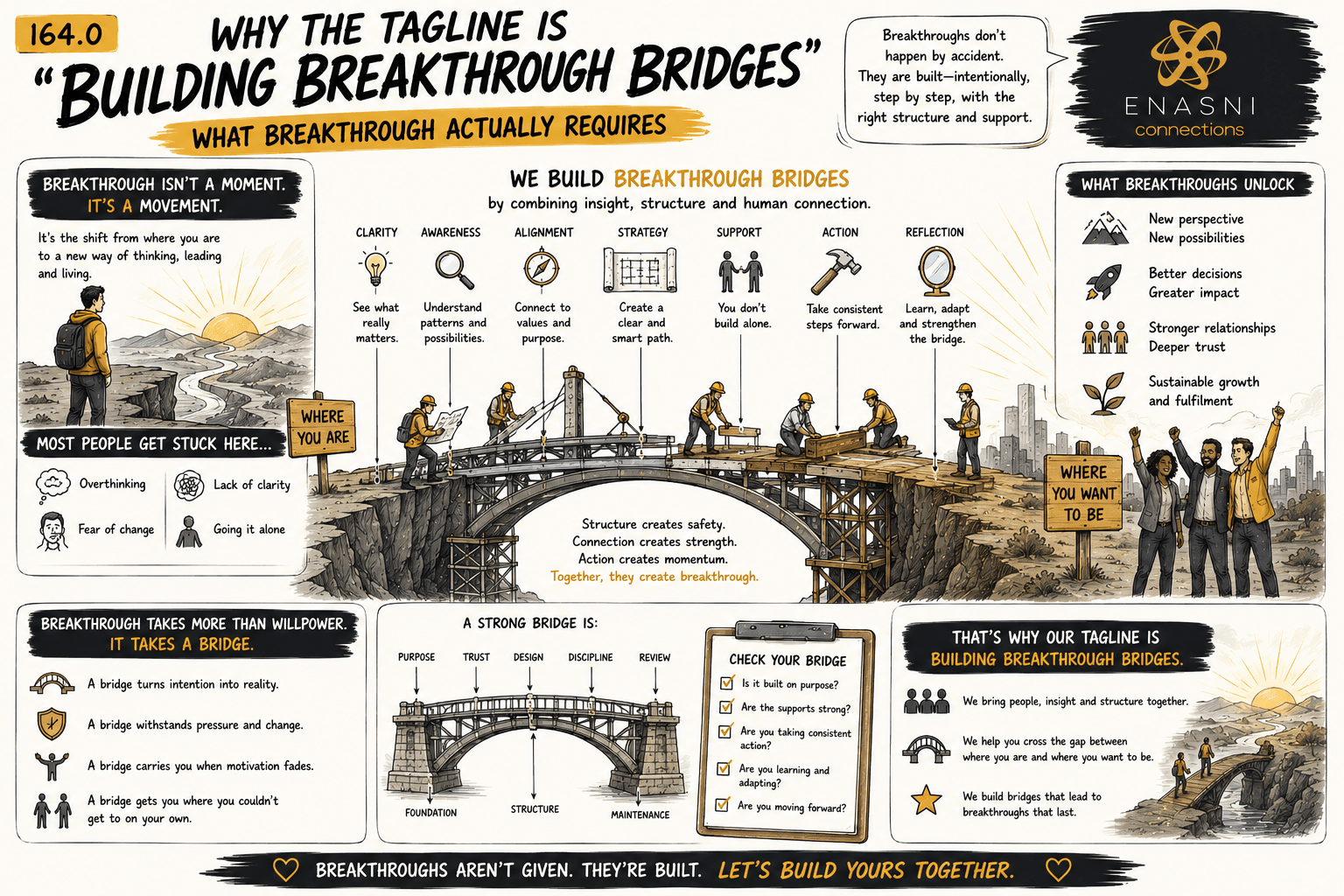
What Breakthrough Actually Requires
Taglines matter because aspiration is far removed from delivery on its own, and especially because language sets expectations about pace, responsibility, and what kind of change is being offered.
This post explains why the tagline Building Breakthrough Bridges was chosen — not as motivation, but as a precise description of how change is designed, stabilised, and sustained from a wholeness perspective.
Why “Breakthrough” Is Often Misunderstood
In popular culture, breakthrough implies:
- sudden change
- emotional intensity
- dramatic shifts
- instant relief
This framing creates fragility.
It suggests that change should be fast, effortless, and irreversible.
Real change does not work this way.
Breakthrough as Structural Shift
Within this work, breakthrough means:
- a structural reorganisation, not a mood lift
- a capacity shift, not a surge of motivation
- a new pathway, not a leap
Breakthrough occurs when something that was previously inaccessible becomes reliably reachable.
That requires structure.
Why Bridges Come Before Breakthrough
Breakthrough without a bridge collapses.
Insight without structure fades.
Motivation without capacity exhausts.
Emotion without containment overwhelms.
Bridges:
- distribute load
- allow repetition
- support return journeys
- prevent collapse under pressure
Breakthrough is what happens after a bridge is built — not before.
Why “Building” Is the Active Word
The tagline does not say:
- finding
- discovering
- unlocking
It says building.
Building implies:
- effort over time
- engineering rather than inspiration
- maintenance rather than spectacle
- responsibility rather than rescue
Nothing is handed over.
Everything is constructed to last.
Breakthrough Is Measured by Repeatability
A true breakthrough can be:
- revisited
- repeated
- relied upon
- scaled gently
If change only appears once, it is not a breakthrough.
It is an exception.
Bridges turn exceptions into systems.
Why the Tagline Includes Plural “Bridges”
There is never only one bridge.
Life requires movement across:
- identity shifts
- stress cycles
- professional demands
- relational changes
- health fluctuations
Multiple bridges are required for different loads.
The tagline acknowledges complexity without overwhelm.
Breakthrough Without Abandonment
A core principle sits beneath the tagline:
Nothing valuable should be discarded to move forward.
Breakthrough does not require:
- erasing the past
- rejecting identity
- bypassing responsibility
Bridges allow forward movement without disowning what already exists.
This preserves dignity.
Why the Tagline Is a Constraint
The tagline limits what the work will do.
It refuses:
- force
- shortcuts
- motivational pressure
- dependency creation
If something cannot be bridged responsibly, it is not pursued.
This protects clients — and the work.
Why This Tagline Appears Now
The tagline only makes sense after:
- ethics have been grounded
- preparation has been explained
- sustainability has been named
- judgement has been honoured
- wholeness has been clarified
Now “breakthrough” is no longer hype.
It is a structural outcome.
In Essence
Building Breakthrough Bridges means:
designing change that can be crossed more than once,
held under pressure,
and maintained over time.
Breakthrough is not intensity.
It is access — responsibly built.
Key Learning Points (KLPs)
- Breakthrough is structural, not emotional
- Bridges make change repeatable
- Building implies responsibility and time
- Plural bridges reflect complex lives
- Breakthrough does not require abandonment
- The tagline constrains the work ethically
Action Points (APs)
- Identify where insight lacks structure
- Replace “breakthrough moments” with load-bearing change
- Build repeatable pathways rather than one-time shifts
Keywords
Building Breakthrough Bridges, breakthrough meaning, applied wholeness philosophy, sustainable transformation, bridge metaphor change, ethical coaching architecture, Enasni Connections tagline