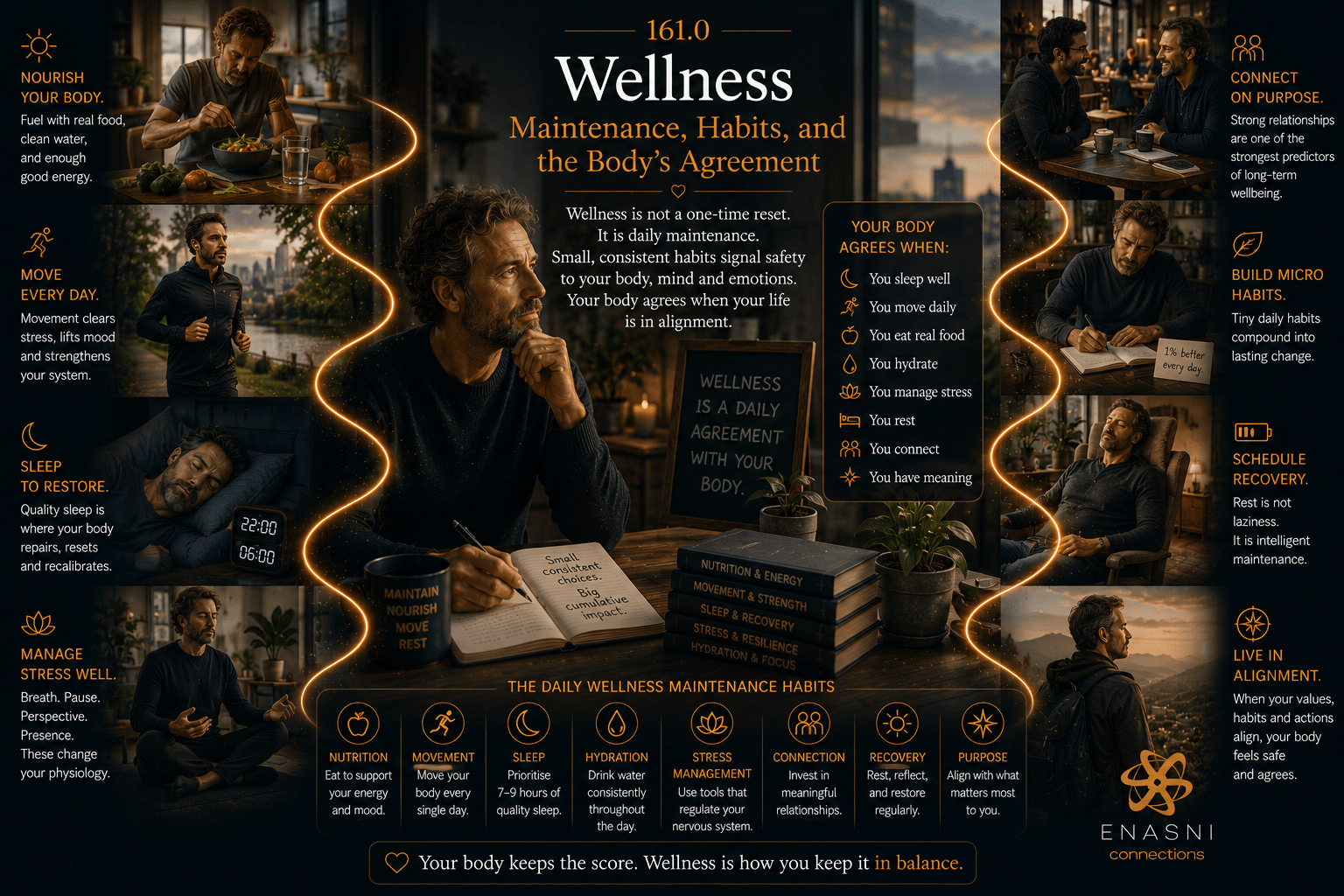
Maintenance, Habits, and the Body’s Agreement
Wellness matters because intention is far removed from capacity on its own, and especially because wellness provides the behavioural and physiological foundations that allow wellbeing to stabilise and wholeness to emerge.
This post clarifies what wellness actually refers to, how it differs from wellbeing, why it is often over-simplified, and where it sits within a wholeness-informed life and professional practice from a wholeness perspective.
What Wellness Actually Refers To
Wellness describes habitual maintenance.
It includes:
- sleep patterns
- nutrition
- hydration
- movement
- rest cycles
- substance use
- daily rhythms
Wellness answers:
How am I taking care of the system that carries me?
It is behaviour-based, not mood-based.
Why Wellness Is Foundational but Insufficient
Without wellness:
- energy drops
- cognition narrows
- emotional regulation weakens
- resilience collapses
However, wellness alone does not create:
- meaning
- direction
- coherence
- responsibility
A person can:
- exercise daily
- eat well
- sleep consistently
and still live reactively, misaligned, or fragmented.
Wellness maintains capacity.
It does not organise life.
The Risk of Reducing Wellness to Aesthetic Discipline
Modern wellness culture often emphasises:
- appearance
- optimisation
- discipline as virtue
- rigid routines
This reframes wellness as performance.
Performance-driven wellness:
- creates pressure
- invites comparison
- erodes sustainability
- disconnects behaviour from context
Wholeness requires adaptive wellness, not aesthetic compliance.
Wellness Without Context Becomes Fragile
Wellness practices that ignore:
- workload
- caregiving responsibilities
- trauma history
- financial pressure
- cultural context
often fail.
Not because the person lacks discipline — but because the system is misread.
Wellness must fit real life.
Otherwise, it collapses under pressure.
Why Wellness Cannot Replace Decision-Making
Improving wellness habits may increase capacity.
It does not resolve:
- misaligned goals
- unresolved boundaries
- unhealthy environments
- unsustainable roles
In these cases, wellness becomes a coping strategy — not a solution.
This is where people “do everything right” and still feel stuck.
The issue is not wellness.
It is structure.
Wellness as Agreement With the Body
At its healthiest, wellness is an agreement:
I will care for the system that carries my responsibilities.
This includes:
- knowing when to rest
- knowing when to move
- adjusting habits across seasons
- responding to stress signals early
Wellness is responsive, not rigid.
Wellness in Professional and Frontline Contexts
In high-pressure roles:
- wellness is often postponed
- basic needs are deprioritised
- depletion becomes normalised
This creates delayed cost:
- illness
- cognitive fatigue
- emotional volatility
- shortened careers
Wellness is not indulgence.
It is infrastructure.
Where Wellness Sits in the Bigger Picture
Wellness:
- supports nervous system regulation
- sustains energy and attention
- enables resilience
It does not:
- define identity
- guarantee wellbeing
- create wholeness
Wellness is the maintenance layer.
It keeps the system operational.
Wellness Requires Permission
Many people know what would help.
What they lack is permission:
- to rest without guilt
- to adjust routines
- to stop pushing through
Wellness improves when permission replaces punishment.
In Essence
Wellness keeps the system running.
It does not tell the system where to go.
When wellness habits are realistic, adaptive, and contextual, they sustain capacity.
When they are mistaken for purpose or identity, they collapse under pressure.
Key Learning Points (KLPs)
- Wellness is habit-based maintenance
- It supports but does not organise life
- Performance-driven wellness is fragile
- Context determines sustainability
- Wellness cannot replace decision-making
- Adaptive habits outperform rigid routines
- Wellness is infrastructure, not identity
Action Points (APs)
- Review wellness habits for realism and fit
- Identify one habit that supports capacity without pressure
- Adjust routines seasonally rather than rigidly
Keywords
wellness definition, wellness habits, applied wholeness, nervous system maintenance, sustainable wellness, professional capacity, health routines, Enasni Connections