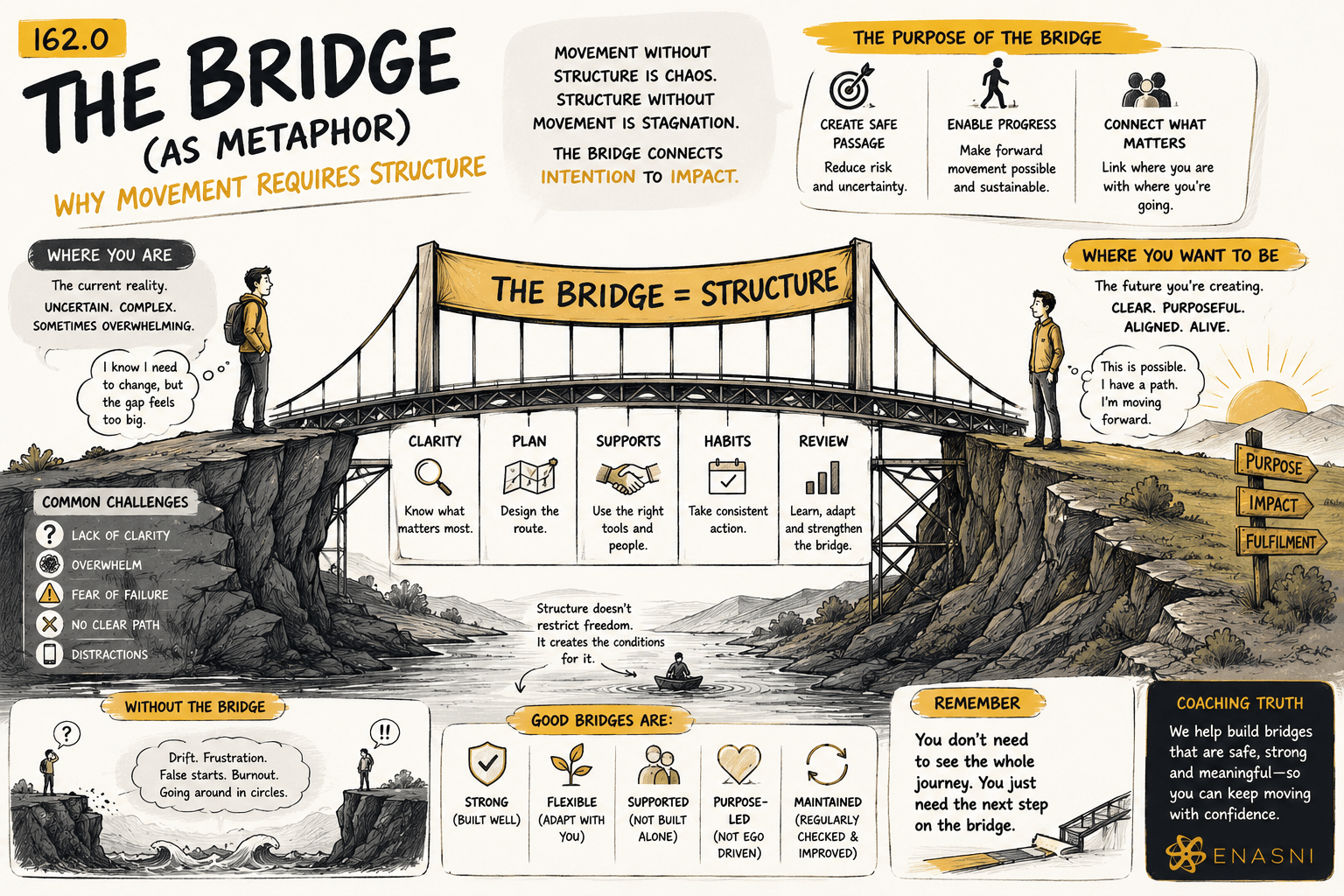
Why Movement Requires Structure
The bridge matters because intention is far removed from transition on its own, and especially because movement between states, identities, or realities requires structure that can carry weight, uncertainty, and return journeys.
This post explores the bridge as a working metaphor — not a symbol of escape, but a disciplined structure that allows passage between pressure and capacity, insight and action, wellbeing and wholeness from a wholeness perspective.
Why Bridges Exist at All
Bridges are built where:
- separation already exists
- terrain is unstable
- crossing repeatedly matters
- return is as important as arrival
They are not decorative.
They exist because direct passage is unsafe or impossible.
This mirrors human change.
The Problem With “Leaps” and “Breakthroughs”
Cultural language often celebrates:
- leaps
- jumps
- hacks
- sudden transformations
These imply:
- speed over safety
- intensity over integration
- arrival without return
Leaps collapse under load.
Bridges endure.
Bridges Are Engineered for Weight
A real bridge accounts for:
- load limits
- repeated use
- weather
- vibration
- unexpected stress
It does not assume ideal conditions.
Neither should human change.
Coaching, preparation, ethics, and structure exist to:
- distribute load
- prevent collapse
- allow gradual crossing
Wholeness requires load-bearing design.
Why Bridges Allow Return
One of the most overlooked functions of a bridge is return.
People need to:
- test new ground
- come back
- re-orient
- cross again
Change that does not allow return creates fragility.
Bridges support:
- experimentation
- pacing
- integration
This is why pressure-tested change lasts.
The Middle Matters Most
Most instability happens:
- not at the start
- not at the destination
- but in the middle
Bridges are designed to hold the middle.
Coaching often operates here:
- between old identity and new
- between insight and habit
- between safety and growth
Holding the middle is skilled work.
Bridges Are Maintained, Not Finished
A bridge is never “done”.
It requires:
- inspection
- repair
- reinforcement
- respect for limits
Human systems are the same.
Preparation, supervision, boundaries, and sustainability are not temporary supports.
They are maintenance practices.
Why Bridges Connect, Not Rescue
Bridges do not carry people across.
They make crossing possible.
Responsibility remains with the traveller.
This preserves:
- agency
- dignity
- autonomy
Coaching that rescues weakens the bridge.
Coaching that connects strengthens it.
From Metaphor to Method
When the bridge metaphor is taken seriously:
- wellbeing becomes a signal
- wellness becomes maintenance
- preparation becomes engineering
- ethics become guardrails
- judgement becomes load awareness
Wholeness emerges from coherent structure, not force.
In Essence
Bridges are built because the terrain is real.
They allow movement without collapse, change without erasure, and growth without abandonment of what already exists.
Wholeness is not the destination.
It is the bridge that makes movement sustainable.
Key Learning Points (KLPs)
- Bridges exist where direct passage is unsafe
- Load-bearing design matters more than speed
- Return journeys are essential to integration
- The middle is where most instability occurs
- Maintenance preserves function
- Bridges connect without rescuing
- Structure enables wholeness
Action Points (APs)
- Identify where structure is missing in current change efforts
- Replace “leap” thinking with load-aware design
- Strengthen the middle rather than rushing endpoints
Keywords
bridge metaphor, applied wholeness, sustainable change structure, coaching integration, human systems design, transition support, ethical change processes, Enasni Connections