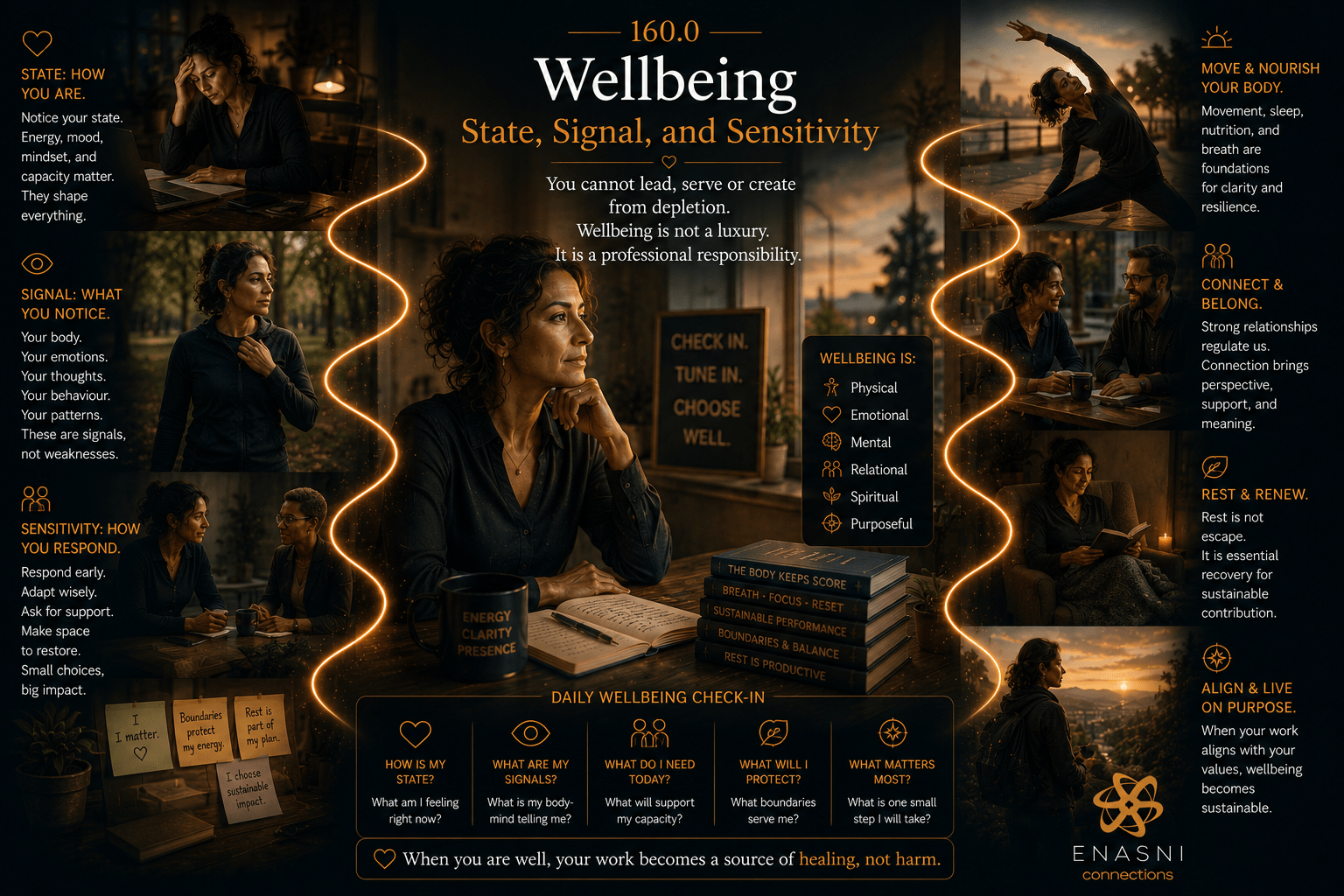
State, Signal, and Sensitivity
Wellbeing matters because functioning is far removed from flourishing on its own, and especially because wellbeing operates as a live signal of how a person is responding to life, work, pressure, and relationship in real time.
This post clarifies what wellbeing actually is, what it is not, how it functions as information rather than identity, and why misunderstanding wellbeing creates fragility rather than resilience from a wholeness perspective.
What Wellbeing Actually Refers To
Wellbeing describes current internal experience.
It includes:
- emotional state
- stress levels
- sense of safety
- mental clarity
- felt capacity
Wellbeing answers:
How am I experiencing life right now?
It is state-based, not character-based.
Why Wellbeing Fluctuates
Wellbeing changes because life changes.
It responds to:
- workload
- sleep
- relationships
- uncertainty
- physical health
- cumulative stress
A drop in wellbeing is not a failure.
It is information.
The problem arises when fluctuations are interpreted as personal deficiency.
Wellbeing as a Signal, Not a Goal
When wellbeing becomes a goal, it becomes fragile.
People begin to:
- chase feeling good
- avoid discomfort
- interpret stress as danger
- suppress valid emotional responses
Wellbeing works best when treated as a signal:
- alerting to overload
- indicating misalignment
- highlighting need for rest, change, or support
Signals are meant to be read — not obeyed blindly.
The Risk of Over-Prioritising Wellbeing
In professional and support contexts, over-prioritising wellbeing can lead to:
- avoidance of challenge
- reduced tolerance for pressure
- loss of resilience
- misinterpretation of discomfort as harm
Growth often involves temporary dips in wellbeing.
Resilience is built by responding, not by removing all strain.
Wellbeing Without Structure Is Unstable
Wellbeing alone does not create:
- direction
- meaning
- coherence
- sustainability
Without structure, wellbeing becomes:
- reactive
- mood-dependent
- easily disrupted
Structure provides containment.
Containment stabilises wellbeing.
Why Wellbeing Cannot Replace Responsibility
Feeling better does not equal living well.
People may experience:
- improved mood
- reduced stress
- emotional relief
without addressing:
- behaviour
- boundaries
- patterns
- responsibility
Wellbeing improves temporarily.
Problems return.
Responsibility anchors wellbeing to reality.
Wellbeing in Professional Contexts
In frontline and support professions, wellbeing is often:
- depleted before it is noticed
- normalised as “part of the job”
- addressed only at crisis point
A wholeness-informed stance treats wellbeing as:
- early-warning information
- a cue for adjustment
- something to be monitored, not moralised
Ignoring wellbeing data does not increase strength.
It delays collapse.
Wellbeing and Nervous System Response
Wellbeing is closely tied to nervous system state.
Chronic activation leads to:
- irritability
- exhaustion
- narrowed attention
Regulation supports wellbeing — but regulation alone is not enough.
Without changes to structure, patterns, or load, regulation becomes maintenance of dysfunction.
Where Wellbeing Sits in the Bigger Picture
Wellbeing:
- reflects how life is being experienced
- signals when adjustment is needed
- responds quickly to change
It does not:
- determine identity
- define worth
- replace wellness or wholeness
Wellbeing is a dashboard light, not the engine.
In Essence
Wellbeing tells the truth about how life is landing.
It deserves attention — not worship.
When wellbeing is read accurately, contained by structure, and integrated with responsibility, it becomes a powerful guide rather than a fragile ideal.
Key Learning Points (KLPs)
- Wellbeing is state-based, not identity-based
- Fluctuations are normal and informative
- Wellbeing works best as a signal, not a goal
- Over-prioritising wellbeing reduces resilience
- Structure stabilises wellbeing
- Wellbeing cannot replace responsibility
- Nervous system state influences wellbeing
Action Points (APs)
- Track wellbeing as information, not judgement
- Notice patterns rather than isolated dips
- Respond to wellbeing signals with structural adjustment
Keywords
wellbeing definition, wellbeing as signal, applied wholeness, nervous system wellbeing, professional wellbeing, emotional regulation awareness, sustainable practice, Enasni Connections