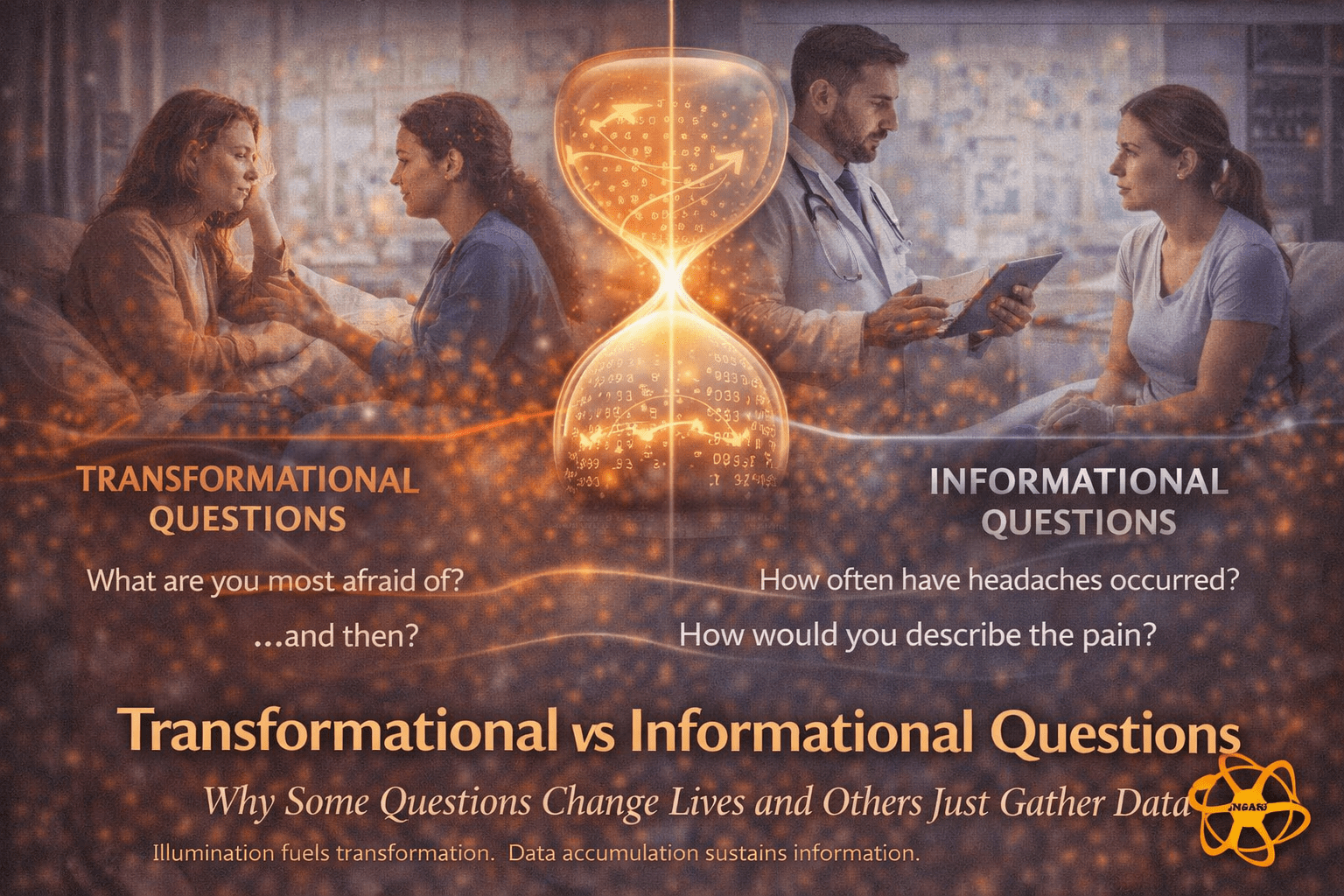
Why Some Questions Change Lives and Others Just Gather Data
Transformational versus informational questions matter because insight is far removed from information alone, and especially because not all questions are designed to produce change.
In coaching, many questions sound powerful but function primarily to collect data. Others appear simple yet catalyse deep internal movement. The difference lies not in intelligence, but in intent, depth, and positioning.
This post clarifies how these two question types differ — and when each is appropriate.
1. What Informational Questions Do
Informational questions aim to:
- gather facts
- clarify context
- understand circumstances
- reduce ambiguity
Examples include:
- “What happened?”
- “When did this start?”
- “Who was involved?”
These questions organise understanding.
They do not, by themselves, create change.
2. The Value of Informational Questions
Informational questions are essential when:
- establishing context
- clarifying reality
- reducing confusion
- grounding conversation
Without information, transformational work floats.
Informational questions prepare the ground.
3. What Transformational Questions Do
Transformational questions:
- shift perception
- engage identity
- invite choice
- alter relationship to experience
Examples include:
- “What does this say about what matters to you?”
- “Who are you becoming through this?”
- “What are you choosing to protect here?”
These questions reorganise meaning.
4. Why Transformational Questions Create Movement
Transformational questions work because they:
- interrupt habitual narratives
- reposition the client as observer
- activate agency
They do not supply answers.
They change the lens through which answers are formed.
5. When Transformational Questions Misfire
Transformational questions misfire when:
- regulation is low
- safety is insufficient
- identity feels threatened
In these moments, informational questions are more appropriate.
Timing determines impact.
6. Sequencing Matters
Effective coaching sequences:
- informational questions → establish clarity
- transitional questions → surface meaning
- transformational questions → restore choice
Skipping steps destabilises inquiry.
Sequencing builds safety.
7. Why Overusing Transformational Questions Fails
Constant depth creates fatigue.
Overuse leads to:
- overwhelm
- resistance
- shutdown
Depth is powerful because it is selective, not constant.
8. Mastery Lies in Discernment
Mastery is not asking deeper questions.
It is knowing:
- which question type is needed
- when to switch
- when to stay simple
Discernment replaces intensity.
In Essence
Informational questions build the map.
Transformational questions change how the map is read.
Coaching mastery lies in using both — deliberately.
Key Learning Points (KLPs)
- Informational questions gather data
- Transformational questions shift perception
- Both are necessary for effective coaching
- Transformational questions require safety
- Sequencing prevents overwhelm
- Overuse of depth reduces impact
- Discernment defines mastery
Action Points (APs)
- Identify whether a question is informational or transformational
- Establish clarity before depth
- Match question type to readiness
Keywords
transformational questions, informational questions, applied wholeness, coaching judgement, coaching inquiry types, questioning mastery, behaviour change, Enasni Connections