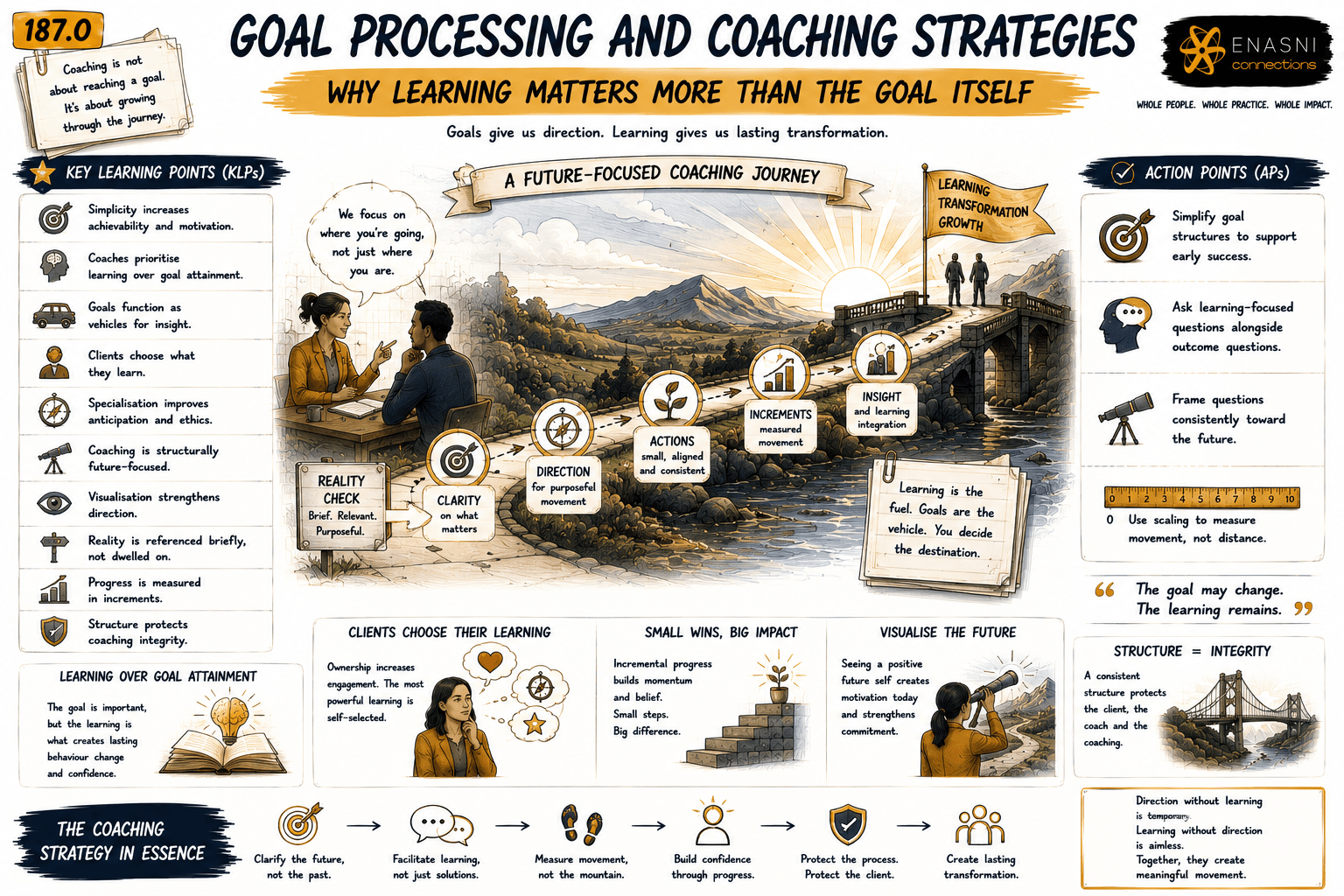
Why Learning Matters More Than the Goal Itself
Goal processing matters because achievement is far removed from development on its own, and especially because coaching is not responsible for whether a client reaches a goal, but for whether the client learns how to move themselves forward.
This post clarifies how goals are processed within coaching, why simplicity and future focus are essential, and how effective coaches protect learning, responsibility, and direction throughout the process from a wholeness perspective.
Simplicity Is Not a Reduction — It Is an Enabler
One of the most consistent findings in coaching practice is this:
The simpler the goal-processing structure, the more achievable and motivating the work becomes.
Complexity completely fails to motivate.
Completion, on the other hand, does.
When one step is achieved:
- confidence increases
- feasibility improves
- momentum builds naturally
This is why coaching resists over-design.
The aim is to be far removed from the impressing of the intellect.
It is to enable movement.
Why Coaches Do Not Fixate on the Goal
A core professional stance sits at the heart of coaching:
The coach is not responsible for the client achieving the goal.
This is often misunderstood.
It does not mean goals are unimportant.
It means learning is primary.
The goal is a vehicle for learning — not the destination itself.
Clients decide:
- what they want to learn
- where they want to grow
- what insight matters most
The coach protects that learning process.
When learning is strong, progress follows.
When learning is weak, goals collapse — even if achieved.
Learning as the Central Outcome
In effective coaching, the most important question is not:
Did you achieve the goal?
It is:
What did you learn about yourself, your patterns, and your capacity?
Learning may occur about:
- motivation
- resistance
- confidence
- limits
- assumptions
- energy
This learning transfers beyond the original goal.
That is the true leverage of coaching .
Specialisation: Knowing What to Hold — and What to Hand Over
As coaches specialise, something important happens.
Patterns emerge.
Experienced coaches begin to recognise:
- recurring themes
- predictable blocks
- common goal types
This improves anticipation and efficiency.
However, professional integrity requires clarity:
If a topic falls outside specialism, it must be referred on.
Coaching is not omnipotent.
Referral is not failure.
It is ethical containment.
Coaching Is Future-Focused by Design
A defining feature of coaching is its orientation.
- Therapy explores the past
- Consulting addresses the present
- Coaching works toward the future
This is not a value judgement.
It is a structural distinction.
Coaching questions are therefore framed deliberately:
- What does the future look like?
- What does it feel like?
- What are you saying to yourself there?
- What are others saying to you?
- What benefits exist in that future?
The future pulls behaviour forward.
The past does not .
Visualisation as a Directional Tool
Visualisation is not imagination for its own sake.
It serves to:
- clarify the endpoint
- strengthen belief
- organise effort
Clients are guided to:
- locate themselves in the future
- notice detail
- identify milestones
This keeps attention forward-facing.
Motivation becomes a by-product, not a demand.
Reality Is Touched — Then Released
Reality is acknowledged briefly.
Not avoided.
Not indulged.
For example:
- “You’re at a four now.”
- “How will you know you’re at a six?”
Reality is used as a coordinate.
Then attention returns to the future.
This prevents:
- rumination
- justification loops
- identity entrenchment
Reality informs direction.
It does not define identity.
Progress Is Measured by Movement, Not Distance
Scaling questions exemplify this:
- How will you know you’ve moved from four to six?
- What will be different?
Progress becomes:
- observable
- achievable
- motivating
Clients stop chasing “ten” immediately.
They start moving deliberately.
Why Coaching Reduces Talk of the Past
Some clients prefer the past.
That is human.
Coaching responds not by confrontation, but by design:
- fewer past-oriented questions
- more future-oriented framing
- permission to interrupt gently
For example:
“Right now, the interest is in what you want to achieve in the future.”
Structure redirects attention without invalidation.
The Discipline That Holds It All Together
The consistent pattern is clear:
- keep goals simple
- focus on learning
- work in the future
- touch reality lightly
- measure movement incrementally
This discipline prevents coaching from drifting into:
- counselling
- advice-giving
- motivational pressure
The work stays clean.
In Essence
Goal processing in coaching is not about reaching targets faster.
It is about building the client’s capacity to move themselves forward repeatedly.
Goals come and go.
Learning compounds.
That is why coaching works.
Key Learning Points (KLPs)
- Simplicity increases achievability and motivation
- Coaches prioritise learning over goal attainment
- Goals function as vehicles for insight
- Clients choose what they learn
- Specialisation improves anticipation and ethics
- Coaching is structurally future-focused
- Visualisation strengthens direction
- Reality is referenced briefly, not dwelled on
- Progress is measured in increments
- Structure protects coaching integrity
Action Points (APs)
- Simplify goal structures to support early success
- Ask learning-focused questions alongside outcome questions
- Frame questions consistently toward the future
- Use scaling to measure movement, not distance
Keywords
goal processing coaching, coaching strategies, learning focused coaching, future focused coaching, applied wholeness coaching, coaching vs therapy consulting, goal simplicity, Enasni Connections