Why Coaching for Health Professionals Matters
Even healers need healing spaces. Coaching health professionals creates a rare space where those who normally support others can pause and reflect. Nurses, doctors, and other frontline practitioners often carry immense responsibility, yet few environments exist where their own thinking, stress signals, and professional identity can be explored safely.
When coaching health professionals, the caregiver becomes the client. This structured pause allows health professionals to process experiences, regulate stress, and reconnect with the purpose that first drew them to their profession.
When the caregiver becomes the client, coaching provides a structured conversation that supports reflection, regulation, and renewed clarity. In professions built around caring for others, this pause becomes essential.
This supports why coaching health professionals is a viable resource when the goal is to sustain capacity, perspective, and wellbeing in environments where responsibility and emotional demand are constant.
1. Introduction
Burnout and emotional exhaustion among health professionals are widely recognised challenges across global health systems. Organisations such as the International Coaching Federation highlight reflective practice and coaching conversations as important supports for professional sustainability.
Coaching health professionals creates useful rooms for that breath.
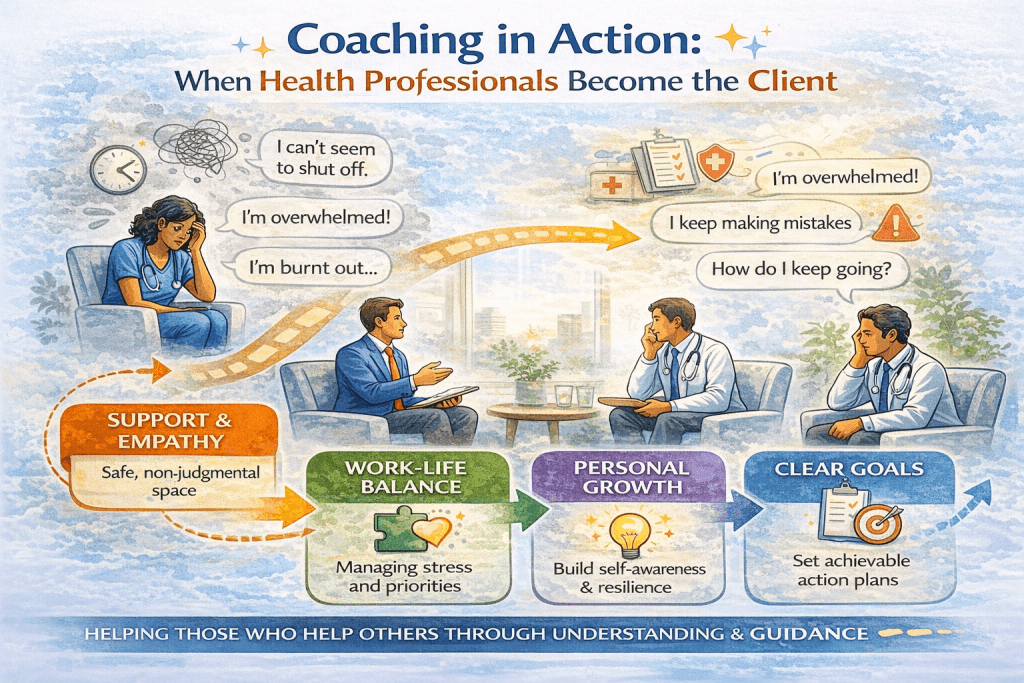
Here’s how it sounds when three different health professionals step into the coaching space from a wholeness perspective.
Each brings a unique pressure. Through coaching, health professionals, can find their way back to clarity, perspective, and renewed professional balance.
Many of these conversations draw upon the listening and reflection skills explored in The Core Competencies of a Great Coaching Session.
2. The Nurse: “I can’t switch off.”
Coach: “What would you like to walk away with today?”
Nurse: “Peace of mind — just one evening where I’m not replaying my shift.”
His tone carries both strength and fatigue. In coaching health professionals, moments like this often reveal how much invisible responsibility is being carried long after a shift ends.
Through reflective questioning — a central element when coaching health professionals — the coach helps him notice the invisible weight he carries home, the stories he keeps replaying long after leaving the hospital.
They explore options: leaving work notes before clocking out, grounding rituals before bed, journaling for five minutes to release what does not belong to him.
Coach: “Which feels doable this week?”
Nurse: “The journaling. I can do that before sleep — five minutes, not more.”
He smiles, softer now. The first real permission he’s given himself all month.
3. The Paramedic: “I can’t find my edge anymore.”
Coach: “You’ve seen a lot lately. What feels hardest to hold?”
Paramedic: “The stillness. When the sirens stop, I don’t know who I am.”
She’s blunt, steady — a woman of action who suddenly has nowhere to run. When coaching health professionals, these moments often surface when the adrenaline fades and the mind finally slows enough to notice the accumulated weight of responsibility.
Coaching health professionals allows them space for that pause, that regulation — a moment where identity, pressure, and purpose can be examined without judgment.
Together, they craft a micro-plan: five minutes of still breathing after every shift, leaving the uniform by the door before stepping into home.
Coach: “On a scale of 1–10, how ready are you to start?”
Paramedic: “Nine. Feels like I’ve been waiting to exhale.”
4. The Doctor: “I’ve lost joy in what I love.”
Coach: “What would joy look like again?”
Doctor: “Curiosity. Remembering that medicine is a privilege, not a punishment.”
She pauses before answering, the exhaustion visible behind her calm professionalism. When coaching health professionals, these moments often reveal how deeply responsibility can blur the line between dedication and depletion.
Her words spill fast, clinical precision masking quiet grief.
They explore her reality — endless admin, no reflection time, perfectionism disguised as dedication. Prolonged sitting accompanied by embedded habit and cemented by a sense of duty.
Options arise: mentoring younger colleagues, blocking one hour weekly for personal reading, taking lunch without a screen.
Coach: “What’s one step you’ll protect this week?”
Doctor: “The hour. Just one. My mind needs play again.”
The session ends not only in answers, but in awareness — the beginning of healing.
5. What These Sessions Reveal
These sessions reveal how coaching health professionals creates room for clarity in environments that rarely allow pause. When health professionals step into the coaching space, pressure begins to reorganise into perspective. Even as little as 10 minutes has long lasting profound effects on regulation, stress mastery and increased capacity.
Through coaching health professionals, small insights often unlock meaningful shifts. A single reflective question can reconnect a professional with internal balance, reminding them that caring for others also requires space to care for their own thinking and wellbeing.
When the healers pause long enough to be seen, change begins.
It is vital to remember that coaching does not cure burnout — it restores perspective. It helps professionals reclaim agency over their own internal state and self regulate. That powerful agency pushes the source of burnout away leaving the individual feeling lighter to begin with and in far greater control over their choices.
This is why coaching health professionals matters — it creates a structured space where those who care for others can reconnect with clarity, capacity, and their own internal balance to become the best professional version of themselves.
6. Key Learning Points
- Even experts need reflective space; coaching offers structure for self-restoration.
- Open, non-judgmental dialogue helps health workers untangle stress and rediscover meaning.
- Small, specific actions (five minutes, one hour, one journal entry) often unlock lasting balance.
- Compassion fatigue eases when boundaries and rituals are reintroduced.
- Coaching gives power back to the professional — quietly, without prescription.
7. Action Points
- Offer reflective sessions specifically for health professionals processing burnout.
- Encourage micro-practices that can be sustained in high-pressure environments.
- Use coaching questions to shift from “fixing problems” to “reclaiming presence.”
7. In Essence
Coaching for health professionals is less about performance — it’s about preservation.
It gives the people who carry everyone else a moment to breathe, reset, and remember why they began. They already know more about performing than any other profession often at great personal cost.
At Enasni, that’s the work we honour most — helping the helpers find their way back to wholeness.