
This post forms part of the Coaching Series.
The best way to understand coaching is to observe or experience a live coaching demonstration.
Theory teaches structure; practice reveals humanity.
Every real session carries lessons on listening, timing, and trust.
Below is a brief live coaching demonstration that captures what effective coaching sounds like in motion — and how small shifts can open big doors from a wholeness perspective.
The live coaching demonstration also shows How Coaching Differs From Other Support approaches such as mentoring, therapy, or consulting.
For a deeper explanation see How Coaching Differs From Other Support Disciplines.
No confidentiality between client and coach was breached in the production of this post.
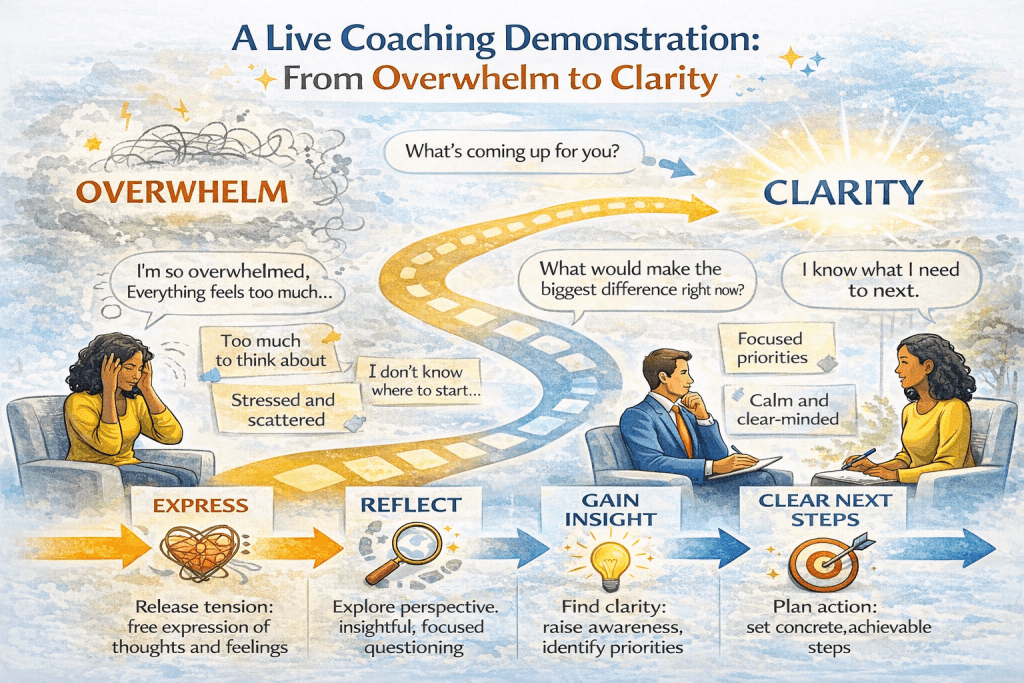
A Live Coaching Demonstration Session
Coach: “Patel, it’s good to see you. How are you?”
Client: “Very well! I’m a single step-mom and self-employed — just trying to find balance and avoid burnout.”
Right there, the goal begins to emerge. It’s not about productivity. It’s about peace.
Through open, reflective questions, the coach helps Patel clarify what “balance” means in practice: organising her day, managing energy, and enjoying time with her step-son without guilt.
Coach: “Patel, when you say balance, what would balance actually feel like in your week?”
Questions like this reflect the Core Competencies of a Great Coaching Session, where listening, reflection, and precise questioning help clients uncover their own clarity.
As the conversation unfolds, several insights surface —
- Morning workouts to energise.
- A daily plan of action.
- Permission to rest.
- Focused work blocks free from distractions.
When the coach asks, “Which could you take action on first?”, Patel chooses the workout. That moment —ownership — is where empowerment begins.
She commits to four sessions a week, 10 to 12 a.m., followed by two focused work hours.
The coach then measures her commitment: “On a scale of 1 to 10?”
Patel replies, “10 for the workout, 8 for the work time.”
The session is closed by celebrating progress and clarity after 30 minutes..
The energy is light. The accountability is set.
What This Demonstration Reveals
A live coaching demonstration reveals something theory alone cannot capture: the rhythm of a real coaching conversation. Coaching unfolds through timing, curiosity, and presence. Questions are not asked mechanically; they emerge from attentive listening and respect for the client’s pace.
In practice, small shifts in perspective often create the greatest breakthroughs. A well-timed question can move attention from confusion toward clarity, from pressure toward possibility.
This is why coaching competencies matter — not as rigid techniques, but as cultivated disciplines that allow the coach to support reflection, awareness, and forward movement.
Coaching is less about instruction and more about illumination. That illumination allows effective coaching to be intentional and far removed from being accidental. It is guided by intention and values, which is why many coaches begin by Crafting Their Coaching Mission and Vision.
Notice what is present in this exchange: listening, structure, empathy, and gentle challenge.
It’s a rhythm — one that moves from awareness to action, always led by the client’s voice.
Key Learning Points
- A positive, professional opening sets the emotional tone for the session.
- Clarifying the client’s primary goal keeps focus and flow.
- Breaking goals into manageable steps helps reduce overwhelm.
- Open-ended questions expand self-awareness and choice.
- Exploring multiple options strengthens autonomy.
- Setting clear, specific actions creates confidence and direction.
- Using commitment questions (“On a scale of 1–10…”) reinforces accountability.
- Summarising and celebrating progress boosts motivation.
Action Points
- Help clients break large goals into small, achievable steps.
- Use commitment questions to assess readiness and reinforce follow-through.
- Anchor every action with clear timelines to promote accountability.
In Essence
Great coaching looks effortless because it’s grounded in presence.
The coach listens for meaning, instead of mistakes — helping the client discover their own answers, one conversation at a time. Moments like this often emerge when clients reconnect with their internal equilibrium — what we at Enasni describes as Wholeness: The Silent Core of Growth.
Professional coaching conversations like this are supported by internationally recognised competency standards such as those outlined by the International Coaching Federation.
At Enasni, this live coaching demonstration reflects what coaching mastery sounds like: calm, curious, human.